

Armodafinil and modafinil are prescription wakefulness-promoting medicines used for closely related purposes. Online comparisons often reduce the difference to slogans such as “stronger,” “cleaner,” or “longer lasting.” Those descriptions are not reliable clinical guidance. The two medicines are chemically related, have overlapping approved indications, and share many warnings, but they are not interchangeable products that should be selected through trial and error.
The useful comparison is not which one wins. It is how their composition, pharmacokinetics, labeling, individual response, and safety considerations may influence a clinician’s decision for a patient with a diagnosed sleep disorder.
The chemical relationship
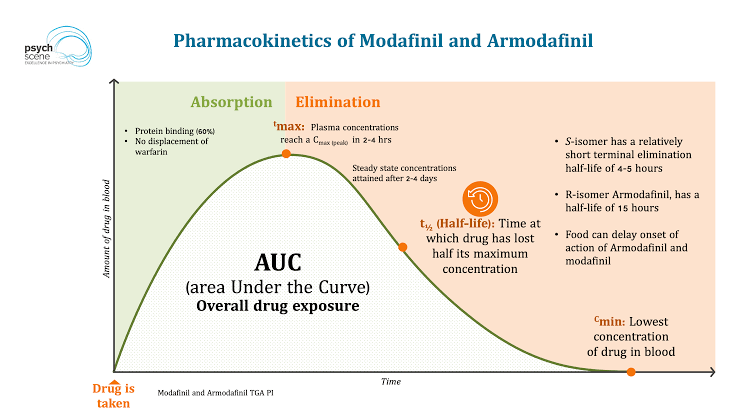
Modafinil is a racemic mixture, meaning it contains two mirror-image forms, or enantiomers, commonly described as R-modafinil and S-modafinil. Armodafinil contains the R-enantiomer. The R-form is eliminated more slowly than the S-form, so blood-concentration profiles differ over the day even when the medicines are being used for similar clinical goals.
That fact is sometimes translated into the claim that armodafinil is automatically “twice as potent.” Chemistry does not justify that simple equation. Dose numbers cannot be compared milligram for milligram without considering formulation, exposure over time, the approved label, and patient response. Only a prescriber should determine whether either medicine is appropriate and how it should be used.
Approved uses overlap
In the United States, both medicines are indicated to improve wakefulness in adults with excessive sleepiness associated with narcolepsy, obstructive sleep apnea, or shift work disorder. The DailyMed armodafinil label makes an important limitation explicit: in obstructive sleep apnea, armodafinil treats excessive sleepiness, not the underlying airway obstruction.
The same principle applies to modafinil. Positive airway pressure or another prescribed airway treatment must not be replaced by a wakefulness medicine. If sleepiness continues, clinicians typically examine treatment adherence, mask leak, sleep duration, other medicines, depression, and additional sleep disorders before assuming that another alertness agent is the answer.
Timing and duration
Because armodafinil contains the longer-lasting R-enantiomer, its concentration may remain higher later in the day than that of racemic modafinil after certain labeled doses. This may be relevant when symptoms extend through a work period. It can also be relevant to unwanted late-day wakefulness or insomnia. A longer profile is not universally better; the goal is useful alertness without disrupting the next sleep opportunity.
Food can influence how quickly peak concentration is reached, and individual metabolism varies. Liver function, age, genetics, and interacting medicines can alter exposure. A person’s subjective report after one day does not provide a safe conversion rule. Clinical follow-up is needed to judge whether wakefulness, sleep timing, and adverse effects are moving in the right direction.
Effectiveness is individual, not a brand ranking
Both medicines have evidence for the approved excessive-sleepiness conditions. Direct comparisons are less abundant than the volume of online opinion suggests. Differences in study populations, endpoints, and dosing make broad claims difficult. One person may respond better to one product, but that experience does not establish a universal hierarchy.
Meaningful outcomes include fewer unintended sleep episodes, improved ability to sustain necessary activities, and better function without unacceptable adverse effects. Feeling stimulated is not the same as achieving those outcomes. Neither medicine guarantees normal alertness, and neither should be used to justify driving when sleepiness remains.
Shared adverse effects and warnings
Armodafinil and modafinil have similar safety themes. Common adverse effects can include headache, nausea, dizziness, anxiety, nervousness, and insomnia. The labels warn about serious skin reactions, angioedema or other hypersensitivity, psychiatric symptoms, and cardiovascular effects. New rash, blistering, mouth sores, facial swelling, trouble breathing, or systemic illness requires urgent assessment.
Psychiatric symptoms may include agitation, mania, hallucinations, depression, aggression, or suicidal thinking. People with a psychiatric history should discuss it openly before treatment, and new symptoms should be reported promptly. Cardiovascular history and blood pressure may also need review. The absence of a rapid “buzz” does not make a wakefulness-promoting medicine free of stimulant-like risks.
Drug interactions and hormonal contraception
Both medicines affect hepatic drug-metabolizing pathways. They can reduce exposure to steroidal contraceptives, potentially decreasing contraceptive effectiveness during treatment and for a period after the medicine is stopped. Patients should follow the exact product labeling and discuss alternative or additional contraception with a clinician.
Other interactions may involve cyclosporine, warfarin, certain antiseizure medicines, antidepressants, antipsychotics, benzodiazepines, and drugs metabolized through CYP pathways. A pharmacist can help check a complete list. Supplements marketed for energy or focus should be included because their ingredients may be stimulating, variable, or undisclosed.
Controlled-substance status
Modafinil and armodafinil are Schedule IV controlled substances in the United States. They have accepted medical uses and a recognized potential for misuse or dependence. Secure storage, no sharing, and lawful prescription dispensing are basic safety practices. A history of alcohol or drug misuse should be part of the clinical conversation.
The controlled status also underscores why an unverified online source is not equivalent to a pharmacy. Counterfeit or substandard tablets may have the wrong active ingredient, incorrect strength, contamination, or misleading packaging. Product reviews and laboratory-looking certificates do not replace a regulated supply chain.
Are they cognitive enhancers for healthy people?
Neither medicine is approved as a general smart drug, study aid, or productivity enhancer for healthy, well-rested adults. Research on modafinil in this population has found mixed or small effects depending on the task and study design. Evidence about laboratory performance should not be generalized to long-term academic success, creativity, professional judgment, or overall brain health.
The risk-benefit calculation is different without pathological sleepiness. Serious adverse reactions are uncommon, but an uncertain productivity benefit does not automatically justify even a low probability of significant harm. Nonmedical use can also worsen sleep, creating a cycle in which a person uses wakefulness agents to compensate for insomnia partly caused by those agents.
How clinicians may choose between them
A clinician considers the diagnosis, timing of symptoms, prior response, adverse effects, other medicines, liver function, cardiovascular and psychiatric history, pregnancy considerations, cost, insurance coverage, and legal availability. The decision may also include whether late-day exposure is desirable or likely to interfere with sleep.
Treatment is not simply a choice between two tablets. For narcolepsy, a broader plan may include scheduled naps, regular sleep timing, workplace or school accommodations, and treatment of cataplexy or disrupted nighttime sleep. For shift work disorder, schedule and circadian strategies remain important. For obstructive sleep apnea, effective airway treatment remains foundational.
Questions worth asking at follow-up
Patients can prepare specific observations: How often do unintended naps occur now? Is the commute safer, or does drowsiness remain? Has sleep onset become harder? Are headaches, anxiety, palpitations, appetite changes, rash, or mood symptoms present? Is airway therapy being used consistently? Has any medicine, supplement, or contraceptive changed?
These questions help distinguish a useful response from mere subjective stimulation. They also allow the treatment plan to evolve. Persistent sleepiness may call for more diagnostic work rather than a higher dose or an unsupervised switch.
The bottom line
Armodafinil is the R-enantiomer of modafinil, while modafinil contains both R- and S-enantiomers. Their approved uses overlap, their concentration profiles differ, and their warnings and interactions are broadly similar. Those facts do not support a universal claim that one is better, safer, or more effective for every person.
The appropriate choice, if either is appropriate, depends on a confirmed diagnosis and individualized medical review. Neither medicine replaces sleep, treats the airway obstruction in sleep apnea, or turns ordinary fatigue into a simple drug-selection problem. A careful comparison leads back to the same principle: treat the cause, measure real function, and keep safety central.
