

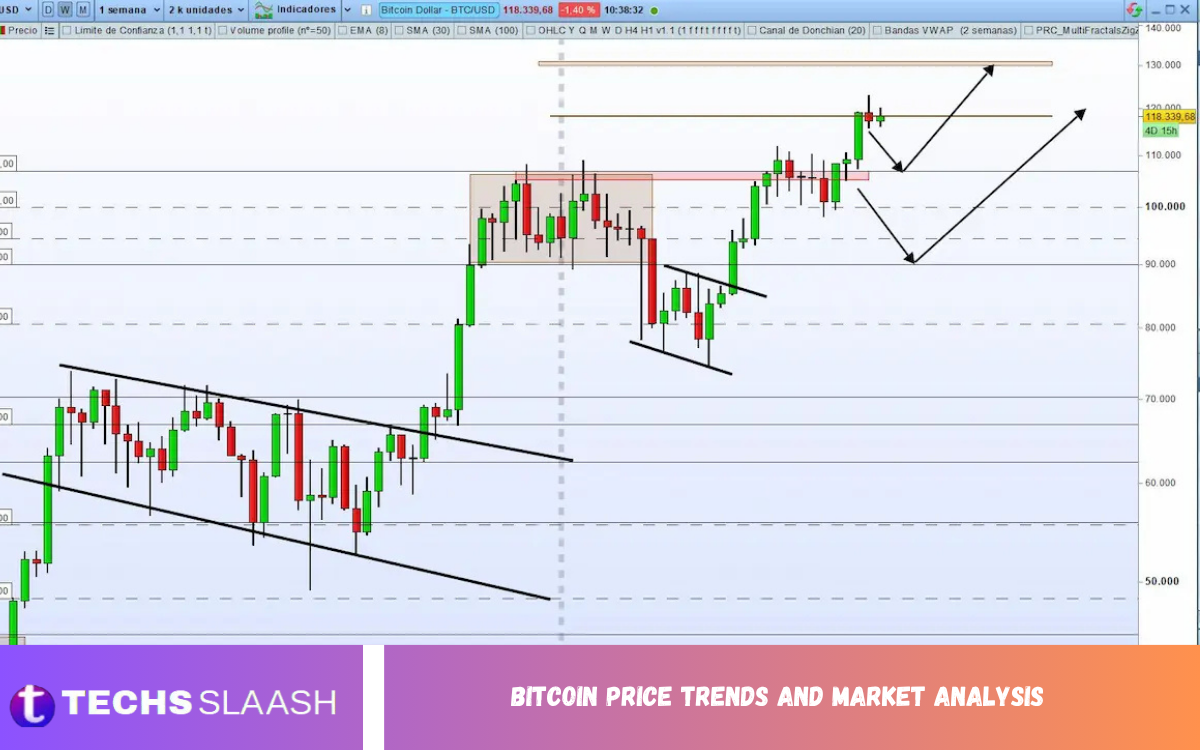
Bitcoin remains one of the most closely watched digital assets in the global financial market. Its price can change rapidly in response to investor sentiment, monetary policy, institutional activity, liquidity conditions, regulation, and broader economic developments. Understanding these factors is essential for anyone following Bitcoin price trends and market analysis.
As of September 2026, Bitcoin is trading around the high-$70,000 range after recently recovering above $80,000. Recent market movements show how quickly Bitcoin can respond to interest-rate expectations, employment data, inflation concerns, and shifts in risk appetite.
Current Bitcoin Price Trend
Bitcoin has experienced significant volatility throughout 2026, moving through periods of sharp declines followed by powerful recoveries. Recent technical analysis shows Bitcoin breaking above several key moving averages during its latest recovery, although resistance around the low-$80,000 area remains important in determining whether the broader recovery can continue.
The latest price action also shows that Bitcoin remains highly sensitive to macroeconomic news. Strong employment data and inflation concerns have recently pressured prices, while more supportive comments about Federal Reserve policy helped Bitcoin approach $81,000. This creates a market environment where economic announcements can quickly change short-term momentum.
Major Factors Influencing Bitcoin Prices
One of the biggest influences on Bitcoin is global monetary policy. Interest rates affect the attractiveness of riskier assets, and changes in expectations for Federal Reserve policy can influence Bitcoin alongside stocks, bonds, the U.S. dollar, and other financial markets. Higher rates can reduce risk appetite, while expectations for easier financial conditions can support speculative assets.
Liquidity is another important factor in Bitcoin price trends and market analysis. Historically, Bitcoin has often benefited from expanding liquidity, although recent research suggests that the relationship between global money supply and Bitcoin has become less consistent.
Institutional Adoption and Bitcoin ETFs
Institutional participation has become an increasingly important part of the Bitcoin market. Spot Bitcoin exchange-traded funds have made it easier for traditional investors to gain exposure to Bitcoin without directly managing wallets or private keys, potentially increasing the connection between cryptocurrency markets and conventional financial markets.
Recent market activity demonstrates the importance of institutional flows. Bitcoin ETFs recorded substantial net inflows over several trading sessions in early September, suggesting that institutional demand can remain supportive even during periods of significant volatility. However, ETF flows can change quickly and should be considered alongside price, volume, derivatives, and macroeconomic data.
Bitcoin Halving and Supply Dynamics
Bitcoin’s halving mechanism is another factor frequently discussed when analyzing its long-term price behavior. Approximately every four years, the number of new bitcoins created through mining rewards is reduced, lowering the rate at which new supply enters the market. Historically, halving events have been associated with major market cycles.
However, previous cycles should not be treated as guaranteed forecasts. As Bitcoin becomes more integrated with institutional finance, ETFs, professional trading, and global macro markets, the traditional four-year cycle’s influence may change. Research from Charles Schwab similarly notes that halving effects may continue to influence behavior but could become less predictable as the market evolves.
Read Also: Latest Bitcoin News and Market Updates
Technical Analysis of Bitcoin
Technical analysis plays an important role in short-term Bitcoin price analysis. Traders commonly monitor moving averages, support and resistance levels, trading volume, momentum indicators, market structure, and chart patterns to identify potential changes in direction.
Recent technical analysis identified important Bitcoin support around $71,781 and $75,674, while resistance was observed near $82,793. A sustained move above significant resistance could improve bullish momentum, whereas a breakdown below major support levels could increase the possibility of another decline.
Bitcoin Market Sentiment and Volatility
Market sentiment can change quickly in cryptocurrency markets. Positive developments involving regulation, institutional adoption, liquidity, or monetary policy can encourage buying, while unexpected economic data, geopolitical tensions, or liquidation events can cause rapid selling.
Bitcoin’s derivatives market can amplify these movements. Highly leveraged positions may be liquidated when prices move sharply, creating additional buying or selling pressure. Recent Bitcoin rallies have partly involved short-position liquidations, so traders should distinguish sustainable demand from temporary movements driven by positioning.
Macroeconomic Conditions and Bitcoin
Bitcoin increasingly trades within the broader global macroeconomic environment. Inflation, employment figures, Treasury yields, currency movements, central-bank decisions, and geopolitical developments can all influence investor expectations and therefore affect cryptocurrency prices.
The September 2026 market environment demonstrates this connection clearly. Bitcoin has faced pressure ahead of U.S. inflation data, while stronger employment figures have increased concerns about monetary policy. At the same time, geopolitical tensions and higher energy prices have added another layer of uncertainty for global markets.
Bitcoin Support and Resistance Levels
Support and resistance levels help traders understand where buying or selling pressure may become stronger. Support represents an area where buyers may attempt to prevent further declines, while resistance represents an area where sellers may become more active.
Bitcoin’s recent technical structure places considerable attention on the $80,000-$83,000 region. A convincing breakout above resistance could strengthen the recovery narrative, while failure to maintain higher levels could bring lower support zones back into focus. These levels are not guarantees because Bitcoin can move rapidly through technical zones during major news events.
Bitcoin Market Outlook
The Bitcoin outlook remains dependent on several competing forces. Institutional demand, ETF flows, regulatory developments, and improving market sentiment could provide support, while restrictive monetary policy, inflation concerns, geopolitical risks, and strong U.S. dollar conditions could create renewed pressure.
Rather than relying on a single Bitcoin price prediction, investors can benefit from monitoring multiple scenarios. A sustained move above major resistance would strengthen the bullish case, while a breakdown below established support could indicate that the recent recovery is losing momentum. Market analysis should therefore remain flexible as new economic and crypto-specific information becomes available.
Risks in Bitcoin Investment
Bitcoin offers significant growth potential but also carries substantial risk. Its price can move sharply in short periods, and investors can lose a significant portion of their capital during major market corrections. Volatility is a fundamental characteristic of Bitcoin, not an unusual exception.
Investors should also consider regulatory uncertainty, exchange risks, cybersecurity threats, liquidity conditions, leverage, and changing market sentiment. A disciplined approach generally involves understanding personal risk tolerance, avoiding excessive leverage, and making decisions based on research rather than short-term market excitement.
How to Analyze Bitcoin Price Trends
Effective Bitcoin analysis requires combining several forms of information. Price charts can reveal market structure, while volume can help assess a move’s strength. Macroeconomic indicators provide context, and on-chain data can offer insight into network activity and investor behavior.
It is also useful to compare short-term and long-term trends. A temporary price decline does not necessarily invalidate a long-term bullish structure, just as a short-term rally does not automatically confirm a new long-term bull market. Using multiple indicators can provide a more balanced view of Bitcoin’s changing market conditions.
Frequently Asked Questions
What is Bitcoin price analysis?
Bitcoin price analysis is the process of studying price movements, market trends, economic conditions, trading activity, technical indicators, and fundamental factors that may influence Bitcoin’s value.
Why is Bitcoin so volatile?
Bitcoin is volatile because its market operates continuously, sentiment can shift rapidly, liquidity varies over time, and investors react strongly to economic, regulatory, and geopolitical developments.
What affects Bitcoin’s price the most?
Interest rates, liquidity, institutional demand, ETF flows, market sentiment, regulation, Bitcoin supply dynamics, macroeconomic conditions, and investor positioning can all significantly affect Bitcoin’s price.
Is Bitcoin still influenced by the halving cycle?
Yes, the halving remains an important supply-related event, but its influence may evolve as Bitcoin becomes more integrated into traditional financial markets and institutional investment products.
What are Bitcoin support and resistance levels?
Support is a price area where buying pressure may increase, while resistance is an area where selling pressure may become stronger. Traders use these levels to understand possible market scenarios.
How do Bitcoin ETFs affect the market?
Bitcoin ETFs give traditional investors regulated market exposure to Bitcoin and can boost institutional demand. ETF inflows and outflows are therefore important data points when analyzing market conditions.
Can interest rates affect Bitcoin?
Yes. Interest-rate expectations can influence liquidity, investor risk appetite, bond yields, and the attractiveness of speculative assets such as Bitcoin.
Is technical analysis reliable for Bitcoin?
Technical analysis can help identify market patterns and potential support or resistance areas, but it cannot predict Bitcoin’s price with certainty. Unexpected news can quickly invalidate technical signals.
What could drive Bitcoin higher?
Increasing institutional demand, stronger ETF inflows, favorable liquidity conditions, regulatory progress, improving investor sentiment, and a sustained technical breakout could support higher prices.
What could cause Bitcoin to fall?
Bitcoin could face downward pressure from restrictive monetary policy, higher interest rates, inflation concerns, geopolitical instability, large liquidations, declining demand, regulatory uncertainty, or deteriorating overall market sentiment.
Conclusion
Bitcoin price trends and market analysis require more than watching the latest price movement. Technical conditions, institutional demand, ETF activity, monetary policy, liquidity, supply dynamics, regulation, and global investor sentiment influence the cryptocurrency.
The current 2026 environment highlights the importance of staying flexible. Bitcoin has recently shown strong recovery momentum but still faces resistance and macroeconomic uncertainty.

1 Comment
Pingback: Latest Ethereum News, Updates and Market Trends - Techsslaash.com