

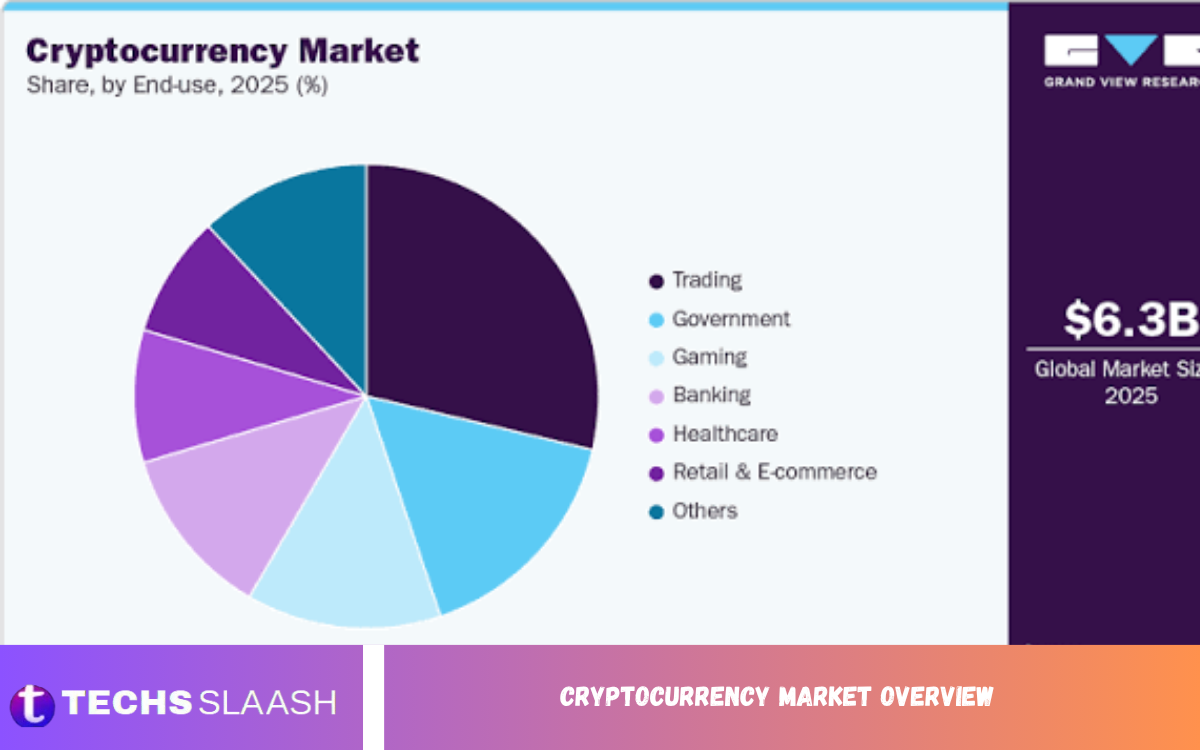
The Cryptocurrency Market Overview provides a broad understanding of how digital assets are performing, how market capitalization changes, and what factors influence prices. Cryptocurrencies have developed from a niche technology into a major digital-asset sector with thousands of coins and tokens, multiple blockchain networks, decentralized applications, and growing institutional participation.
As of September 2026, the global cryptocurrency market remains highly dynamic. CoinGecko reports total crypto market capitalization near $2.8 trillion, with Bitcoin accounting for about 57% of the market and stablecoins roughly $307 billion.
Current State of the Cryptocurrency Market
The cryptocurrency market continues to experience significant price movements as investors respond to economic conditions, regulation, liquidity, technological developments, and market sentiment. Bitcoin remains the dominant digital asset, while Ethereum continues to play an important role in decentralized applications and blockchain infrastructure.
Recent market data shows that the overall crypto market has recovered from the weakness seen during the first half of 2026. CoinGecko reported that total cryptocurrency market capitalization fell to about $2.1 trillion at the end of the second quarter, down 12.6% for the quarter.
Bitcoin Market Performance
Bitcoin remains the most influential cryptocurrency and frequently determines the direction of the wider digital-asset market. Its large market capitalization means that major movements in Bitcoin can affect altcoins, investor confidence, trading volumes, and overall market sentiment.
Current market data places Bitcoin near $79,000, with its market capitalization around $1.59 trillion. Bitcoin dominance is approximately 57%, demonstrating that the leading cryptocurrency still represents more than half of the total crypto market value.
Ethereum and the Altcoin Market
Ethereum remains the second-largest cryptocurrency and a key part of the blockchain ecosystem because it supports smart contracts, decentralized finance, tokenization, and decentralized applications. Its network continues to influence the development of numerous digital assets and blockchain projects.
The broader altcoin market includes thousands of cryptocurrencies with different purposes and technologies. Some focus on payments, others on decentralized finance, gaming, artificial intelligence, privacy, infrastructure, or tokenized assets. Their performance can vary considerably depending on market conditions and project-specific developments.
Stablecoins and Market Liquidity
Stablecoins have become an important component of the cryptocurrency market because they are designed to maintain relatively stable values compared with traditional cryptocurrencies. Dollar-linked stablecoins are widely used for trading, transferring funds, liquidity management, and decentralized applications.
CoinGecko reported stablecoin market capitalization of approximately $305.1 billion at the end of the second quarter of 2026. The sector remained comparatively resilient despite weakness across the wider cryptocurrency market, highlighting the importance of stablecoins as a source of digital liquidity.
Cryptocurrency Market Capitalization
Market capitalization is one of the most commonly used measurements for understanding the size of the cryptocurrency market. It is generally calculated by multiplying the current price of a cryptocurrency by its circulating supply.
Looking at total market capitalization helps investors understand whether the broader market is expanding or contracting. However, market capitalization alone does not explain liquidity, adoption, technology, risk, or the fundamental strength of individual projects, so it should be considered alongside other market indicators.
Cryptocurrency Trading Volume
Trading volume provides another important perspective on market activity. Higher trading volume can indicate increased participation and liquidity, while declining volume may signal reduced market interest or lower risk appetite.
During the second quarter of 2026, centralized-exchange spot trading volume declined 27.9% to approximately $1.95 trillion, according to CoinGecko. This demonstrated how cautious market conditions affected trading activity across major exchanges.
DeFi and Decentralized Applications
Decentralized finance, commonly known as DeFi, remains one of the most important areas of blockchain development. DeFi applications allow users to access services such as decentralized exchanges, lending, borrowing, staking, and other financial functions without relying entirely on traditional financial intermediaries.
The DeFi ecosystem is closely connected with Ethereum and other smart-contract platforms. Its growth depends on factors such as transaction costs, security, user adoption, liquidity, regulation, and the development of useful decentralized applications.
Factors Influencing Cryptocurrency Prices
Numerous factors can influence cryptocurrency prices at the same time. Monetary policy, interest rates, inflation expectations, institutional investment, regulatory announcements, technological upgrades, exchange activity, market liquidity, and investor sentiment can all contribute to price movements.
Macroeconomic conditions remain particularly important because cryptocurrencies often respond to changes in global risk appetite. Recent market analysis has also highlighted the relationship between cryptocurrency prices, U.S. monetary policy, bond yields, and broader financial-market expectations.
Read Also: Latest Ethereum News, Updates and Market Trends
Cryptocurrency Regulation
Regulation has become a major factor in the digital-asset industry’s development. Governments and financial regulators are increasingly working to establish frameworks covering exchanges, stablecoins, custody, taxation, consumer protection, and digital-asset classification.
Stablecoins are receiving particular regulatory attention because of their growing role in payments and financial infrastructure. Recent regulatory developments in the United States have focused on establishing clearer rules for certain payment stablecoins while recognizing that other digital assets may be treated differently.
Institutional Adoption and Crypto Investment
Institutional participation has become an important part of the cryptocurrency market. Financial institutions, asset managers, payment companies, and other businesses are increasingly exploring digital assets, custody solutions, tokenization, and blockchain-based financial services.
Institutional involvement can contribute to market liquidity and broader acceptance, but it does not eliminate cryptocurrency volatility. Digital assets can still experience substantial price movements because market expectations, liquidity, leverage, and sentiment can change quickly.
Cryptocurrency Market Volatility
Volatility is a defining characteristic of the cryptocurrency market. Prices can rise or fall sharply within short periods because digital assets trade continuously and are influenced by global events, leverage, liquidity conditions, and investor psychology.
For this reason, cryptocurrency should not be viewed as a guaranteed source of profit. Market participants should understand that historical performance does not guarantee future results, and individual cryptocurrencies can behave very differently from the broader market.
Future Trends in Cryptocurrency
The future of cryptocurrency is likely to involve greater integration between blockchain technology and traditional financial systems. Stablecoins, tokenized assets, decentralized applications, blockchain infrastructure, and digital-asset custody are among the areas receiving continued attention.
Tokenization may also become increasingly important as financial institutions explore blockchain-based representations of traditional assets. At the same time, improvements in scalability, security, interoperability, and regulatory clarity could affect how quickly blockchain technology integrates into mainstream financial services.
What Investors Should Watch?
Anyone following the cryptocurrency market should monitor several indicators rather than relying on price alone. Bitcoin dominance, total market capitalization, trading volume, stablecoin supply, exchange flows, network activity, regulatory developments, and macroeconomic conditions can provide useful context.
It is also important to distinguish between established cryptocurrencies and highly speculative tokens. Many cryptocurrencies exist, but market size alone does not guarantee long-term usefulness, security, or adoption. Careful research remains essential before making financial decisions.
Cryptocurrency Market Risks
The cryptocurrency market carries significant risks, including extreme volatility, cybersecurity threats, scams, regulatory changes, liquidity problems, and project failures. Investors can potentially lose some or all of the money committed to highly speculative digital assets.
Risk management therefore remains essential. Understanding an asset’s technology, purpose, development team, token economics, liquidity, security history, and regulatory environment can help market participants make more informed decisions, although research cannot eliminate investment risk.
Cryptocurrency Market Outlook
The cryptocurrency market is entering a period where adoption, regulation, institutional participation, and technological development are increasingly interconnected. Bitcoin continues to dominate the market, Ethereum remains a major blockchain platform, and stablecoins continue to play an important role in digital-asset liquidity.
Current market conditions also show why cryptocurrency should be viewed as a constantly changing financial and technological ecosystem. Market capitalization can shift rapidly, and developments in monetary policy, regulation, technology, and investor sentiment can quickly change the market outlook.
Frequently Asked Questions
What is a Cryptocurrency Market Overview?
A Cryptocurrency Market Overview summarizes the digital-asset market, covering prices, market capitalization, trading volume, Bitcoin dominance, major cryptocurrencies, stablecoins, DeFi, market trends, and key developments affecting the industry.
What is the current cryptocurrency market size?
CoinGecko data places global cryptocurrency market capitalization at about $2.8 trillion in September 2026. The value changes continuously because cryptocurrency prices trade around the clock.
Which cryptocurrency has the largest market capitalization?
Bitcoin currently has the largest cryptocurrency market capitalization. Its market value is substantially larger than that of other individual digital assets, and Bitcoin dominance remains above 50% of the overall cryptocurrency market.
Why does Bitcoin affect the cryptocurrency market?
Bitcoin has the largest market capitalization and significant market liquidity, so its price movements can influence investor sentiment and the performance of many other cryptocurrencies.
What are stablecoins?
Stablecoins are digital assets designed to maintain a relatively stable value, often by referencing currencies such as the U.S. dollar. They are commonly used for trading, transfers, liquidity, and decentralized applications.
Why is the cryptocurrency market volatile?
Cryptocurrency prices can be highly volatile because of changing investor sentiment, market liquidity, leverage, regulation, macroeconomic conditions, technological developments, and speculative activity.
What is cryptocurrency market capitalization?
Cryptocurrency market capitalization generally represents the current price of an asset multiplied by its circulating supply. Total market capitalization combines the market values of cryptocurrencies tracked across the broader market.
What is Bitcoin dominance?
Bitcoin dominance measures Bitcoin’s share of the total cryptocurrency market capitalization. A rising dominance percentage can indicate that Bitcoin is gaining relative market value compared with other cryptocurrencies.
Is cryptocurrency a safe investment?
Cryptocurrency investments can carry substantial risk and are not guaranteed to generate profits. Prices can change dramatically, and individual projects may face technological, regulatory, liquidity, or security problems.
What could shape the future of cryptocurrency?
Regulatory clarity, institutional adoption, stablecoins, tokenization, blockchain scalability, decentralized finance, cybersecurity, and broader consumer adoption will likely shape the future of the cryptocurrency industry.
Conclusion
The Cryptocurrency Market Overview shows an industry that continues to evolve through changing market conditions, technological innovation, regulatory developments, and increasing institutional involvement. Bitcoin remains the leading digital asset, while Ethereum, stablecoins, DeFi, and emerging blockchain technologies contribute to a much broader ecosystem.
Although the cryptocurrency market offers significant opportunities for innovation and financial development, it also involves substantial uncertainty and risk.
