

The human eye is a biological marvel, capable of processing complex visual scenes with incredible speed and clarity. However, it is fundamentally limited by its temporal resolution. We perceive motion as a continuous stream because our brains “smooth over” events that occur faster than approximately 60 frames per second. In the world of physics, ballistics, and advanced materials science, this biological limitation represents a significant barrier to understanding. Critical phenomena—such as the propagation of a shockwave, the fracture of a composite material, or the micro-dynamics of a combustion engine—happen in millionths of a second. To observe these events, researchers rely on a specialized class of instrumentation known as high speed cameras. These devices have evolved from bulky mechanical film cameras into sophisticated digital sensors capable of capturing millions of images per second, effectively freezing time and allowing us to analyze the mechanics of the universe at a granular level.
The Physical Foundations of Temporal Resolution
To appreciate the complexity of ultra-fast imaging, one must first understand the relationship between light, sensors, and time. In conventional photography, a shutter stays open long enough to gather sufficient light for a clear exposure. In the realm of high-speed imaging, the exposure time must be incredibly short to prevent “motion blur.” If an object is moving at 1,000 meters per second, even a microsecond-long exposure would result in the object moving one millimeter across the sensor, causing a blur that obscures vital data. Therefore, the primary engineering challenge is not just the speed of the shutter, but the sensitivity of the sensor.
Modern sensors utilize advanced CMOS (Complementary Metal-Oxide-Semiconductor) technology, where each pixel acts as an independent light-to-voltage converter. The faster the camera runs, the less time each pixel has to collect photons. This necessitates the use of high-intensity lighting systems, often involving specialized lasers or high-powered LED arrays, to illuminate the subject. The interplay between frame rate, exposure time, and light sensitivity is the “holy trinity” of high-speed photography, and balancing these factors requires a deep understanding of both optoelectronics and thermodynamics.
Advancements in Sensor Architecture and Data Throughput
The leap from thousands to millions of frames per second required a fundamental redesign of how data is moved off the sensor. In standard digital cameras, data is read from the sensor row by row. At high speeds, this method is too slow and creates a rolling-shutter effect. Ultra-high-speed cameras utilize “global shutter” designs, where every pixel on the sensor begins and ends its exposure at the exact same nanosecond.
Furthermore, the sheer volume of data generated is staggering. A camera capturing five million frames per second at one-megapixel resolution generates terabytes of raw data in just a few seconds. To manage this, specialized cameras often incorporate on-sensor memory or localized “burst” storage buffers. This allows the camera to record a brief but incredibly detailed sequence of events and then transfer that data to a computer for analysis at a slower pace. The most advanced systems in 2026, such as the high speed cameras found in top-tier research laboratories, utilize unique sensor architectures where each pixel has its own dedicated memory bank. This “in-situ” storage allows for full-resolution imaging at speeds that were previously only possible through streak photography or lower-resolution framing.
Applications in Ballistics and Defense Research
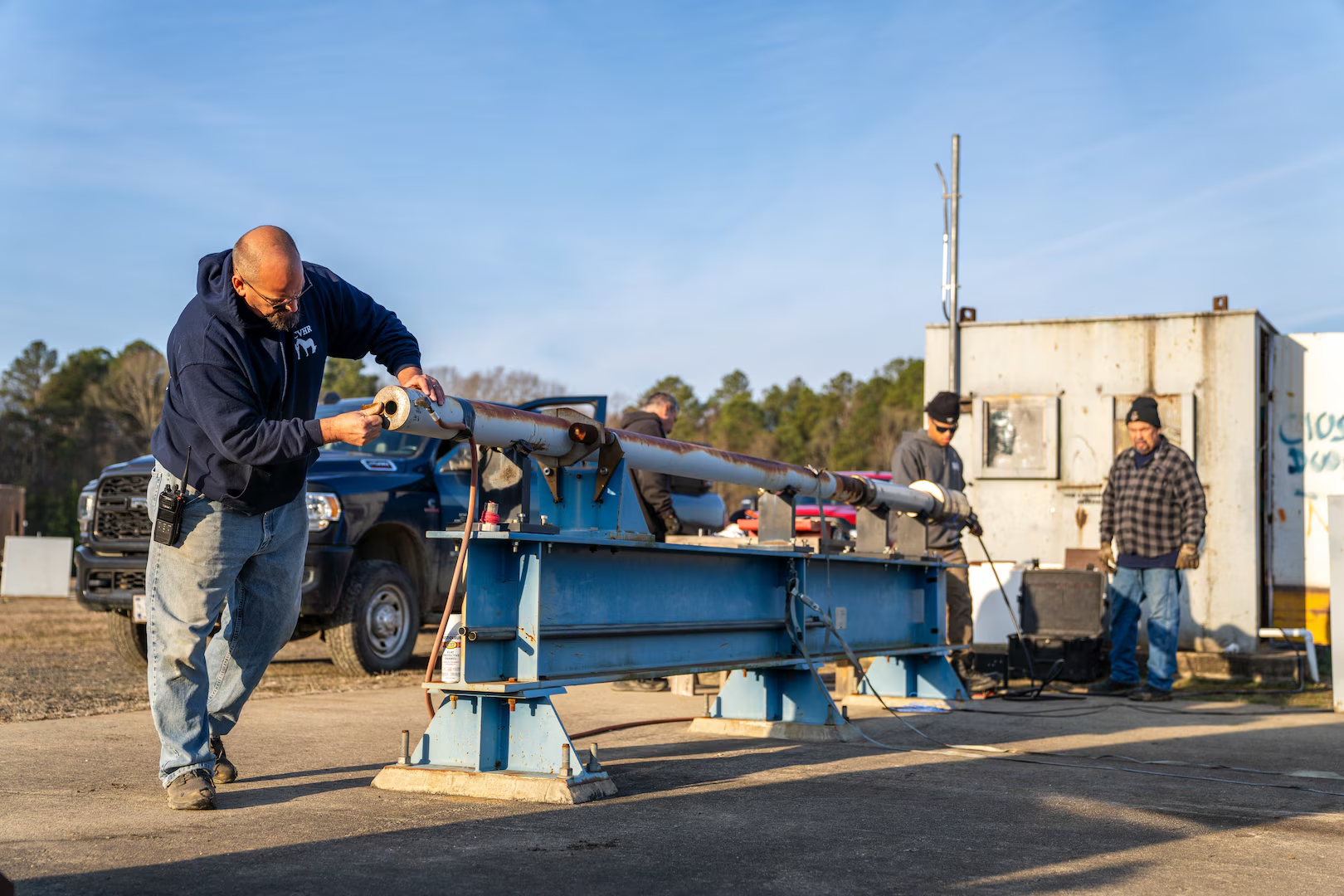
One of the most historically significant drivers of high-speed imaging technology has been the defense sector. The study of ballistics—the flight and impact of projectiles—requires capturing events that are both extremely fast and highly destructive. Researchers use these cameras to observe the moment of impact, analyzing how armor deforms or how a projectile fragments upon hitting a target.
By slowing down these events, engineers can calculate the exact velocity, spin, and pitch of a round, as well as the shockwave patterns generated in the air around it. This data is critical for developing more effective protective gear for personnel and vehicles. In the modern era, this research has expanded into the study of hypersonic flight, where objects travel at more than five times the speed of sound. Understanding the plasma flow and thermal stresses on hypersonic vehicles would be impossible without the ability to visualize these phenomena with nanosecond precision.
The Role of Ultra-Fast Imaging in Materials Science and Engineering
Beyond the explosive world of ballistics, high-speed imaging is a cornerstone of modern materials science. When a new alloy or a carbon-fiber composite is developed, it must undergo rigorous stress testing. Engineers use high-speed cameras to watch the exact micro-second a crack begins to form and how it propagates through the material’s structure.
This field, known as Digital Image Correlation (DIC), involves mapping a speckled pattern onto the surface of a material and using high-speed footage to track the displacement of those dots under load. This allows researchers to create high-precision 3D maps of strain and deformation. This data is used to validate computer simulations, ensuring that the bridges, aircraft, and medical implants of the future are as safe as possible. The ability to see the “invisible” vibrations and structural failures in real-time allows for a level of iterative design that has significantly accelerated the pace of industrial innovation.
Biological and Fluid Dynamics: From Insect Flight to Microfluidics
The natural world is full of high-speed mysteries. For decades, scientists struggled to understand how a bee stays aloft or how a chameleon’s tongue reaches its prey with such velocity. High-speed imaging has provided the answers, revealing the complex vortex patterns created by a wingbeat and the elastic energy storage mechanisms in biological tissues.
In the medical and pharmaceutical fields, these cameras are used to study fluid dynamics at a microscopic scale. Microfluidic devices, which are used for everything from DNA sequencing to drug delivery, rely on the precise movement of droplets. By observing these droplets in high-definition at high speeds, researchers can optimize the design of these devices, leading to faster diagnostic tools and more effective treatments. The study of “cavitating” bubbles—tiny bubbles that collapse with enough force to damage metal—is another area where high-speed imaging is vital, helping engineers design more durable boat propellers and industrial pumps.
The Future of Temporal Visualization: AI and Beyond
As we look toward the future, the integration of Artificial Intelligence (AI) with high-speed sensors is set to revolutionize the field once again. AI algorithms can now be trained to “trigger” the camera only when a specific event occurs—such as a spark or a specific fracture pattern—saving researchers hours of manual footage review. Furthermore, AI is being used to enhance image quality, reducing noise in low-light, high-speed captures and even “interpolating” frames to provide even smoother slow-motion playback.
The ultimate goal of the industry is to reach “femtosecond” imaging, where we can observe the movement of light itself or the transition of electrons within an atom. While we are already approaching these boundaries in specialized laboratory settings, the democratization of high-speed technology means that these tools are becoming more accessible to smaller universities and private startups.
Conclusion: Expanding the Horizons of Human Knowledge
In conclusion, the high-speed camera is far more than a recording device; it is a scientific instrument that extends the reach of human perception. By conquering the challenges of light sensitivity, data throughput, and sensor design, we have opened a window into a world that was once hidden behind the veil of time. From the safety of our vehicles to the effectiveness of our medicines, every aspect of modern life has been touched by the insights gained through ultra-fast imaging.
As the technology continues to mature, it will remain at the forefront of the quest for knowledge. Whether it is a student observing the impact of a raindrop or a physicist analyzing a nuclear fusion experiment, the ability to see clearly what happens in the blink of an eye is a fundamental power. Time is the final frontier of measurement, and with high-speed imaging, we are finally learning how to measure it in all its breathtaking detail. The invisible world is no longer out of reach; it is simply waiting to be captured, analyzed, and understood.
