

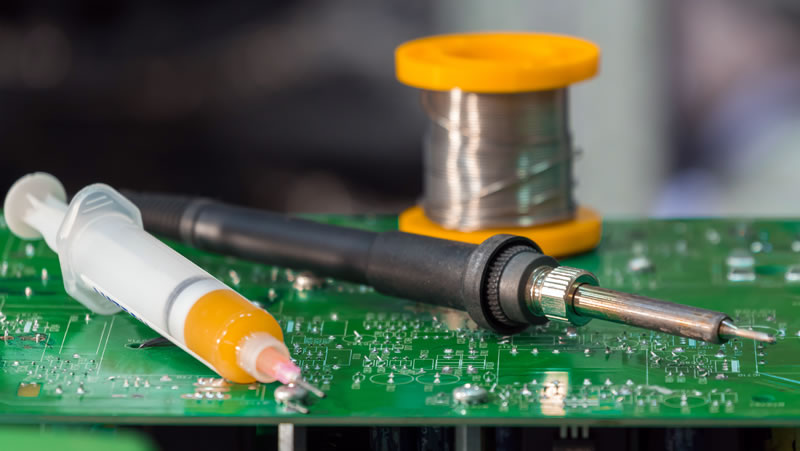
I don’t consider any of you inexperienced or unable to solder. I assume that you can and do solder electronics. I will devote this article to a simple thing – remembering those mechanics when working with soldering irons, which many have forgotten about.
One of the severe problems with hand soldering is cold soldering.
Cold soldering occurs when three circumstances coincide:
1) Insufficient heating of the printed circuit board at the soldering joint to the melting temperature of the solder.
2) The solder has Insufficient wettability, either due to a lack of flux for soldering or poor quality, low-cost Chinese fluxes.
3) Oxide films on surfaces. Oxides on printed circuit boards appear from incorrect technology for soldering printed circuit boards in cheap production facilities, from the operation of electronics in a humid environment, or from the printed circuit board not sufficiently protected from the external environment.
Everything seems clear at first glance, but let’s dig deeper.
Let’s look at each point separately.
1) You have an average quality soldering flux, but the soldering joints must be fixed. You are checking the temperature of the tip! Whatever soldering iron you have, remember that the tip’s job is to melt the solder and heat the soldered surfaces. The ideal temperature on professional soldering irons is 320 degrees, especially with small tips. This is necessary so that it is possible to heat the soldering area in a few seconds so that later, due to the excellent wettability of the flux, the solder will flow into the hole or onto the surfaces being soldered. At the same time, the soldering flux managed to eliminate oxide films from the surfaces, and the solder penetrated all joints. Typical time is 3 seconds per soldering point.
2) Incorrectly selected flux, old, illiquid, will not help you in your work but will only aggravate the situation with defects and cold solders. Different metals have different oxide films, and fluxes are also different. In addition, fluxes are divided by activity from a minimum of 0.2% to 2.5%, and the higher its activity, the more intensively it copes with oxide films on printed circuit board metals. However, the higher the activity, the greater the interaction of this flux with all metals. So, I suggest you thoroughly wash every soldering flux, even no-clean ones. This is especially true for microcircuits with hidden BGA, QFN, and similar pins. You can find a spray-on PCB cleaner.
3) Oxide films are a product of metal oxidation from interaction with oxygen and water. Oxide films are found on almost all metals. Soldering flux gel or liquid eliminates oxide films, and this process requires time and sufficient temperature. At the same time, on the soldered joint from the tip or when manually feeding the wire, the solder flows into the hole or onto the pad and fills it.
Oxide films prevent the solder from creating a solid connection with the PCB pad’s copper, silver, or gold deposit. Good adhesion can only be achieved if high-quality flux eliminates oxide films. It can be either part of a soldering wire or as a separate flux in a syringe or jar. In 3 seconds at temperatures from 280 to 350, high-quality soldering flux copes with oxide films if the printed circuit board has not been in the water and has not become covered with a crust of total oxide. This is not about restoring the coating; you need a powerful acid flux, which will then be difficult to wash, and the printed circuit board will have current leaks between the conductors.
That’s all. Do you remember?
So that’s great!
Thanks for reading!
