

Every few years, a new architectural philosophy comes along in the realm of e-commerce and revolutionizes everything. Composable commerce is different, not on the marketing’s word, but because it addresses a real problem with staying persistent and getting more acute as businesses grow.
What Composable Commerce Actually Means
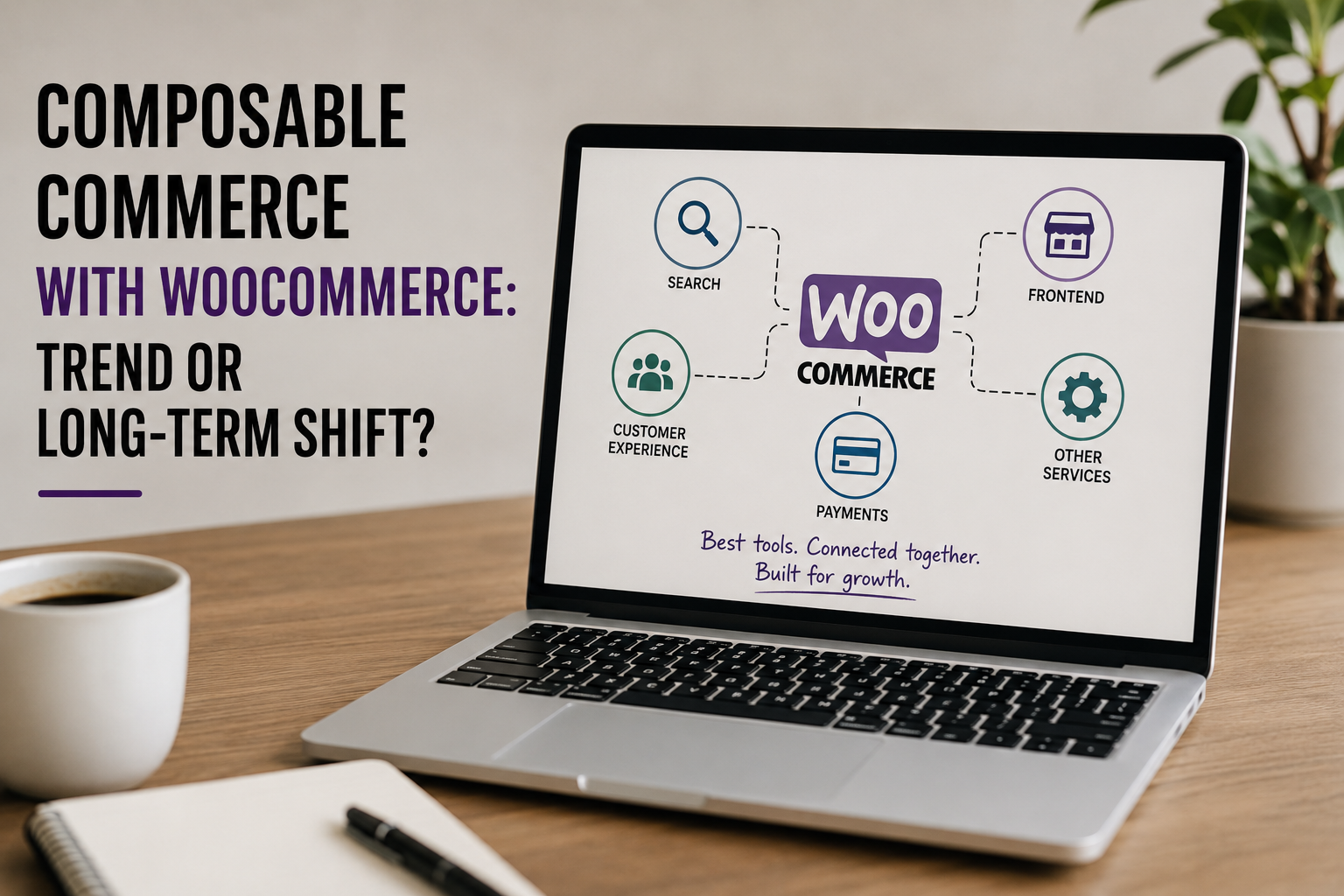
Composable commerce is an approach to the architecture of online stores using best of breed services for different business functions (search, checkout, product catalogue, pricing, personalisation, payments etc.) instead of a single monolithic store. A composable commerce stack is composed of multiple systems, each built to handle a specific piece of functionality, that communicate with each other and each do something really well, through APIs that allow data to flow between them and that they can work together with.
Coined by analyst firm Gartner, the term has been embraced and claimed by some, by vendors everywhere in the e-commerce world. When you demystify the marketing-speak, it’s really just this: create a commerce environment like a modern software app with modular pieces that you can easily replace, upgrade and add to without tearing up the roof.
This idea might seem far-fetched or enterprise-only for WooCommerce store owners. It is neither. Its open architecture, paired with WordPress’ well-developed REST API, makes WooCommerce one of the most naturally composable platforms to power growing businesses and there are more WooCommerce development services that grasp this architecture shift and are building shops to exploit it than ever before.
The Problem That Made Composable Commerce Inevitable
It’s worth first understanding why stores are being driven towards composable commerce for it to make sense that the concept has become a strategic consideration for them. When ecommerce was simpler and customer expectations were less demanding, it was a good idea to have everything serviced by a single party: the storefront, the checkout, the CMS, the search, the promotions engine and the customer account system.
However, as digital commerce evolved these expectations changed dramatically. Consumers started to benchmark all stores that they visited on the internet’s fastest, most personalised, most frictionless experiences, and capabilities baked into every platform started to feel like they were running out of steam. The search feature that was included with the platform was never better than a dedicated search tool. The personalisation engine couldn’t compete with the personalisation provided by the specialist provider. The checkout was satisfactory and not maximised. Any modification of these factors required either working inside the platform’s boundaries, or the high cost of custom development, which would restrict you to a single vendor’s ecosystem.
Composable commerce is the architectural solution to the problem. Instead, it’s time to abandon the notion that there’s one platform that does everything well and embrace the idea that there are individual tools that do individual tasks very well, and that these tools can be put together in a seamless manner for the customer.
It’s no longer a question of which platform works everything. It’s the architecture that allows you to utilize the most suitable tool for the task without having to purchase an enterprise license to replace the tool.
Where WooCommerce Fits in a Composable Architecture
WooCommerce is a unique, and actually helpful, solution in the composable commerce sector. It can be used as an all-in-one monolithic store, to manage everything from product management to checkout to customer accounts and it can also be the commerce backbone of a composable stack, with specialised services at the perimeter extending and/or supplanting those native to Commerce.
Many stores are adopting WooCommerce as their commerce backend system that handles your products, orders, inventory, and customer data, while simultaneously integrating it with a headless front-end, built in a modern JavaScript framework for performance and design flexibility. Search is delegated to a specific provider such as Algolia or Elasticsearch that can return results in a few milliseconds and offer personalisation and synonym search capabilities that WooCommerce does not. Payments are processed using a mix of processors that are optimised to different regions or customers. A dedicated CRM system is used to manage email and retention using a real-time data feed from WooCommerce via API.
All of these connections are composable, meaning they’re not just choosing the best tool for the job, but the best tool for the job that’s available, not willing to settle for what’s available in the core platform. All of them, when executed properly, make a measurable impact on the customer experience that they serve. The final output throughout the entire composable stack is a store that not only performs well on each individual metric that matters to the consumer but also surpasses its monolithic counterparts.
The Real Costs and Honest Trade-offs
Composable commerce does not come easily. The architectural freedom it provides brings with it real complexity, complexity that must be navigated carefully or you risk having another type of problem, the integration between integrations, becomes the weak link, the failure point, and the maintenance burden that the approach was designed to solve.
Every API dependency between components is another contract to be tracked, maintained and updated when any of the components change. A composable stack that has six separate services external to the stack is six potential failures, six vendor relationships to manage, and six sets of documentation to keep up to date. This overhead can easily exceed the performance benefits for small stores without special technical staff.
The truth is that composable commerce is most useful when stores are past the point where WooCommerce will work for them, and they have the technical expertise or can find a specialist, like a woocommerce development services company, that can properly develop and manage the integration layer itself. A well-crafted, traditional WooCommerce stack, carefully optimized and carefully tended, will beat a poorly constructed composable stack and architecture hands down for stores that are still early in their journey.
Signs Your Store Is Ready for a Composable Approach
When certain constraints are actively harming the business, it makes sense to move towards composable architecture. If your current WooCommerce search is generating an unacceptable number of poor results, customers are turning away without finding what they are looking for, it will pay off quickly to have a dedicated service. A composable payments layer can solve payment method gaps in certain geo-locations or customer segments without platform migration. When your front-end performance is limited by WordPress rendering model and speed is driving measurable conversions, a headless architecture provides you with the control you need.
The trend is always the same: composable options are warranted when there is a clearly defined and measurable problem that can’t sufficiently be solved with native platform functionality. They have nothing to do with architectural aspirations. Without a problem that the store is solving, the simple reason that the store is a composable architecture is not enough to justify the complexity without return.
The right Woocommerce development services partner will be clear about this separation. They will determine where they actually have a problem, which of those they can solve with a composable integration, and create a phased plan to implement composable components where they fit, and where they make sense, not where they are trendy.
Trend or Long-Term Shift? The Honest Answer
Like most marketing terms, the composable commerce label will disappear over time. But the core architectural approach – creating commerce capabilities from distinct, interoperable services and not relying on a single platform to provide all capabilities – is a real and lasting shift in the way digital commerce infrastructure is being built and maintained.
The key point for WooCommerce store owners is not to go for the architecture but its logic. All composable decisions are really questions of fitness for purpose: if a tool is doing this job, is this the best tool for this job or is it just the default? Savvy store owners who ask that question every day, and take that answer seriously, are the ones who outperform those that plateau, no matter what the store owner’s theory or mantra is for that year.
