

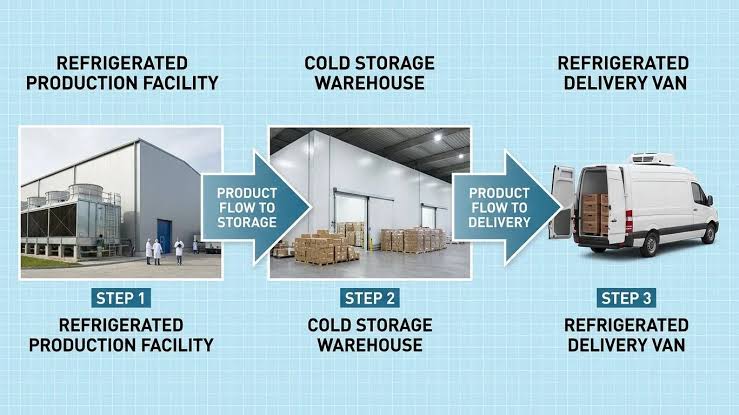
Most discussions of research peptides focus on what is in the vial. Far less attention goes to what happens to that vial between the moment it leaves a supplier’s warehouse and the moment it is logged into a laboratory freezer. Yet temperature history is one of the biggest variables in whether a compound arrives in the condition described on its Certificate of Analysis. Lyophilised peptides are reasonably robust, but they are not indestructible, and reconstituted solutions are considerably less forgiving.
This piece looks at the technology stack behind a well-managed cold chain for research compounds in Australia: the packaging that leaves the dispatch bench, the sensors that ride along with it, the freezers that receive it, and the logging practices that tie the whole journey together. It is aimed at laboratory managers, technicians and students who handle these materials. The compounds discussed are strictly for laboratory and research use only, not for human or animal consumption, and Australian suppliers restrict sales to adults who confirm they are qualified researchers.
Why temperature history matters for a freeze-dried powder
Lyophilisation removes water from a peptide solution by freezing it and sublimating the ice under vacuum, leaving a porous cake or powder with very low residual moisture. In this state, the chemical reactions that degrade peptides in solution, chiefly hydrolysis of the peptide backbone, oxidation of residues such as methionine and tryptophan, and deamidation of asparagine and glutamine, slow dramatically. That is why the standard storage recommendation for lyophilised material is a -20°C freezer.
Slowed is not the same as stopped. Elevated temperatures accelerate the residual reactions, and repeated warming and cooling encourages moisture uptake from the headspace of the vial, which in turn speeds degradation. A few days in a hot delivery van is unlikely to ruin a well-prepared lyophilised product, but a vial that has spent a week on a sun-exposed loading dock in a Queensland summer is a different proposition. Without temperature data, nobody can say which scenario applied, and the only option is to run confirmatory HPLC before use.
Reconstituted peptides are a separate story. Once dissolved in bacteriostatic water or buffer, the protective effect of the dry state is gone. Standard guidance is to refrigerate solutions and use them within about four weeks, and some sequences are less stable than that. This is why the cold chain conversation really has two halves: a robust but finite tolerance for the dry product in transit, and a strict requirement for the solution once it is made up in the lab.
Packaging technology at the dispatch bench
The first line of defence is the parcel itself. Insulated shipping containers come in several grades, and the choice depends on the transit time and the season.
- Expanded polystyrene (EPS) coolers remain the workhorse: cheap, light and effective for overnight and two-day deliveries when paired with refrigerant packs.
- Polyurethane and vacuum-insulated panel boxes offer several times the thermal resistance of EPS at the same wall thickness, extending hold times for longer routes or hot weather.
- Gel packs and phase-change materials absorb heat as they melt. Water-based gel packs hold near 0°C; engineered phase-change materials can be tuned to hold a specific temperature band, which matters when the goal is “cool” rather than “frozen”.
- Dry ice maintains roughly -78°C and is used when material must stay frozen throughout transit, though it requires hazardous-goods labelling, venting and carrier acceptance.
For domestic express shipping, the realistic goal for lyophilised peptides is to keep the parcel cool and shield it from heat spikes, not to replicate a freezer in a cardboard box. A supplier that dispatches from Melbourne and Sydney with same-day processing on orders placed before 3 PM AEDT, for example, is designing around a transit window measured in hours to a day or two for most Australian metro addresses, and the packaging specification should match that window rather than a week-long international journey.
Data loggers: the sensor that rides with the parcel
Insulation controls the temperature; a data logger proves it. The simplest devices are single-use electronic indicators that flash a warning if a threshold was breached. A step up are USB temperature loggers, small enough to drop into the cooler, that record a reading every few minutes and produce a PDF or CSV when plugged into a computer at the destination. Bluetooth and NFC loggers allow the receiving technician to pull the data with a phone without opening the device, and cellular loggers transmit live, though those are generally reserved for high-value or regulated shipments.
Whichever type is used, the useful information is the same: the maximum temperature reached, how long the parcel spent above any defined threshold, and whether there were sharp excursions that might indicate the box was left outside. A logger trace that sits flat at a cool temperature for the whole transit is strong evidence that the compound arrived as dispatched. A trace with a several-hour plateau at ambient summer temperature is a prompt to quarantine the vial and run analytical checks before committing it to an experiment.
Laboratories can also deploy their own loggers. Placing a cheap USB logger in the receiving area, and another in the freezer where incoming stock is held, closes the gap between carrier delivery and lab intake, which is often the least-documented leg of the journey. Working with a peptide supplier Australia based laboratories can reach quickly by express courier shortens that gap considerably, but it does not remove the need to record it.
Laboratory freezers: the destination, and its own failure modes
A -20°C freezer sounds simple, but domestic and laboratory units behave very differently. Household freezers are typically frost-free, which means they run periodic defrost heating phases that lift the internal temperature by several degrees for short periods. For food that is irrelevant; for a shelf of research compounds it introduces hundreds of small thermal excursions per year. Manual-defrost laboratory freezers avoid this, holding a more stable temperature at the cost of occasional manual maintenance.
Other considerations include door-opening frequency, which causes the largest swings in day-to-day use; the position of vials within the cabinet, since the door shelves and top baskets warm fastest; and alarm capability, with dial-out or networked alerts that notify staff of a failure overnight or at the weekend. Many laboratories keep a dedicated small freezer for peptides and reference standards precisely so that a busy general-purpose unit does not become the weak link.
Within the freezer, good practice is to aliquot material so that a single working vial can be removed while the bulk stays undisturbed, to use labelled secondary containers that resist frost and moisture, and to include a desiccant where the packaging allows. Reconstituted solutions belong in a 2 to 8°C refrigerator, dated, and discarded on schedule rather than kept “just in case”.
Logging: tying the chain together
Hardware is only half of a cold chain. The other half is the record. A minimal receiving log for research compounds captures the date and time of delivery, the carrier and tracking reference, the condition of the outer packaging, whether refrigerant was still cold or frozen on arrival, any logger data retrieved, the product name and lot number, and the initials of the person who placed the vial in the freezer. Matching the lot number against the supplier’s batch record, which documentation-focused suppliers such as Peak Haven publish on a dedicated Batch Documentation page alongside COAs available on request, confirms that the analytical data on file actually applies to the vial in hand.
From that point, every removal from the freezer, every reconstitution and every disposal should be noted. Paper logbooks still work; spreadsheets or a basic laboratory inventory system work better because they can flag solutions approaching their use-by window and generate a freezer map. The payoff comes when something goes wrong. A questionable result months later is far easier to investigate if the compound’s entire temperature and handling history is on file, from the dispatch timestamp to the last aliquot.
Regulatory framing and responsibility
Nothing in this article should be read as implying that careful storage turns a research compound into something it is not. In Australia, therapeutic goods are regulated by the Therapeutic Goods Administration, and research-use-only peptides are not approved medicines. The cold-chain and storage practices described here exist to protect the integrity of laboratory materials and the validity of the research performed with them, and suppliers in this sector are expected to state plainly that their products are not for human or animal consumption.
Practical wrap-up
A reliable cold chain for research peptides is built from unglamorous components: insulated packaging sized to the actual transit time, a data logger that turns a guess into a record, a laboratory freezer chosen for stability rather than convenience, and a receiving log that links the vial’s lot number to its temperature history and its Certificate of Analysis. Choose a supplier that dispatches domestically and quickly, check the parcel and any logger on arrival before the vial goes into storage, keep lyophilised stock at -20°C in a manual-defrost unit, refrigerate solutions and discard them on schedule, and write everything down. Peak Haven and similar domestic suppliers shorten the journey; the laboratory still owns the last and most important metres of it.
