

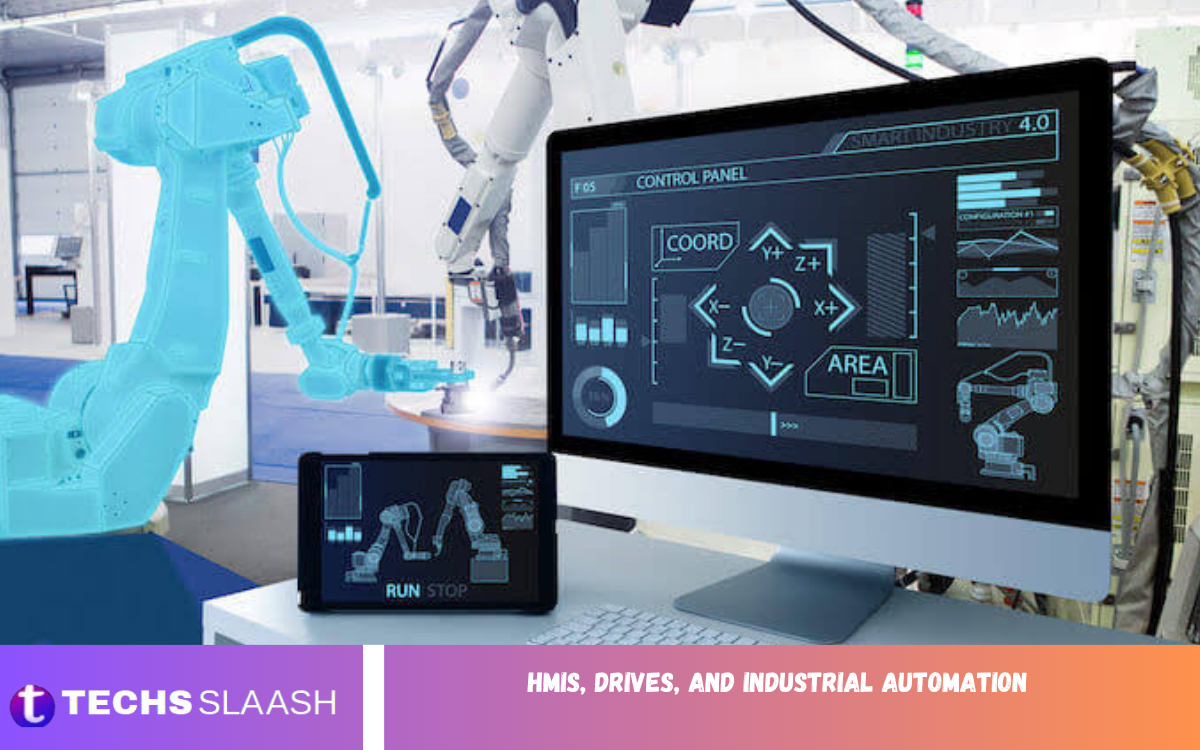
Human Machine Interfaces (HMIs), industrial drives, and industrial automation are essential technologies that power modern manufacturing and industrial operations. An HMI serves as the communication bridge between operators and machines, allowing users to monitor system performance, control equipment.
Together, these technologies form the foundation of automated production systems. Industrial automation integrates programmable controllers, sensors, actuators, robotics, HMIs, and motor drives to streamline industrial processes with minimal human intervention.
What Are HMIs?
A Human Machine Interface (HMI) is a graphical interface that enables communication between operators and industrial equipment. HMIs allow users to monitor machine status, control industrial processes, view alarms, analyze production data, and configure system parameters through an intuitive touchscreen or display.
Instead of manually interacting with machinery using switches and indicator lights, operators use HMIs to visualize entire production processes from a centralized interface.
Modern HMIs provide:
- Real-time process monitoring
- Equipment diagnostics
- Alarm management
- Production reporting
- Data visualization
- Remote machine access
- Historical trend analysis
Industries such as automotive manufacturing, pharmaceuticals, food processing, water treatment, oil and gas, and energy production rely heavily on HMIs for efficient process control.
Understanding Industrial Drives
Industrial drives control the speed, torque, and direction of electric motors. Since electric motors power most industrial equipment, drives play a vital role in optimizing production efficiency while reducing energy consumption.
The most common industrial drives include:
Variable Frequency Drives (VFDs)
Variable Frequency Drives regulate motor speed by adjusting electrical frequency and voltage. VFDs significantly reduce energy usage while improving process control.
Applications include:
- Pumps
- Fans
- Compressors
- Conveyors
- HVAC systems
- Water treatment plants
Servo Drives
Servo drives provide highly accurate motion control for applications requiring exceptional precision.
Common uses include:
- CNC machines
- Robotics
- Packaging systems
- Semiconductor manufacturing
- Printing equipment
DC Drives
Although less common today, DC drives remain useful in heavy industrial environments where high starting torque is required.
What Is Industrial Automation?
Industrial automation refers to the use of control systems, software, sensors, robotics, PLCs, HMIs, and motor drives to perform industrial operations with minimal human intervention.
Automation enables machines to perform repetitive, complex, and hazardous tasks with greater speed and consistency than manual processes.
Core automation components include:
- PLCs
- HMIs
- Industrial drives
- Sensors
- Actuators
- SCADA systems
- Industrial robots
- Communication networks
These components work together to create reliable, intelligent manufacturing systems.
How HMIs, Drives, and Industrial Automation Work Together
The true power of modern manufacturing comes from integrating HMIs, drives, and industrial automation into one seamless system.
For example:
Sensors detect machine conditions and production variables.
PLCs process incoming information and execute control logic.
Industrial drives adjust motor speed and movement according to production requirements.
HMIs display process information and allow operators to monitor and control equipment.
SCADA software collects production data for reporting and remote monitoring.
This integrated approach enables manufacturers to achieve higher productivity while maintaining consistent quality.
Benefits of HMIs, Drives, and Industrial Automation
Improved Productivity
Automation significantly increases production output by reducing manual intervention and minimizing process interruptions.
Higher Product Quality
Precise machine control ensures consistent manufacturing standards while reducing defects and product variations.
Reduced Energy Consumption
Variable Frequency Drives optimize motor performance, lowering electricity usage and operating costs.
Enhanced Workplace Safety
Automation minimizes human exposure to dangerous environments, high temperatures, chemicals, and heavy machinery.
Read Also: Hidden Problems Uncovered During Air Conditioning Repair in Mt Juliet, TN
Lower Maintenance Costs
Predictive maintenance systems detect equipment issues before failures occur, reducing downtime and repair expenses.
Better Process Visibility
HMIs provide operators with real-time production information, enabling faster decision-making.
Faster Production Cycles
Automated systems complete manufacturing tasks more quickly than manual processes while maintaining high accuracy.
Industries Using HMIs, Drives, and Industrial Automation
Industrial automation has become essential across numerous sectors.
Manufacturing
Manufacturers automate production lines to increase efficiency and reduce labor costs.
Automotive Industry
Robotic assembly, welding, painting, and quality inspection rely heavily on automation technologies.
Food and Beverage
Automation improves hygiene, packaging accuracy, filling operations, and quality assurance.
Pharmaceuticals
Precise automation ensures regulatory compliance, sterile production, and accurate batch processing.
Oil and Gas
Automation systems monitor pipelines, drilling equipment, storage facilities, and refinery operations.
Water Treatment
Industrial drives regulate pumps while HMIs provide real-time monitoring of water treatment processes.
Power Generation
Automation improves power plant efficiency while ensuring reliable energy distribution.
Role of PLCs in Industrial Automation
Programmable Logic Controllers (PLCs) act as the central processing units of automated systems.
PLCs receive signals from sensors, execute programmed instructions, and control industrial equipment through outputs connected to motors, valves, and actuators.
When integrated with HMIs and drives, PLCs enable flexible and reliable production systems.
Importance of Industrial Communication
Modern automation systems depend on high-speed communication between devices.
Popular industrial communication protocols include:
- Modbus
- Ethernet/IP
- PROFINET
- EtherCAT
- CANopen
- Profibus
Reliable communication improves data exchange, synchronization, and production efficiency.
Industry 4.0 and Smart Manufacturing
Industry 4.0 has transformed traditional automation into intelligent connected manufacturing.
Key technologies include:
- Industrial Internet of Things (IIoT)
- Artificial Intelligence
- Machine Learning
- Cloud Computing
- Edge Computing
- Digital Twins
- Big Data Analytics
These innovations enable predictive maintenance, remote diagnostics, real-time analytics, and data-driven decision-making.
Choosing the Right HMI and Drive
Selecting suitable equipment depends on several factors:
- Application requirements
- Motor type
- Environmental conditions
- Communication protocol compatibility
- Display size
- Processing performance
- Expansion capabilities
- Cybersecurity features
- Energy efficiency
- Budget
Proper system design ensures long-term reliability and maximum return on investment.
Future Trends
The future of HMIs, drives, and industrial automation includes AI-powered diagnostics, collaborative robots (cobots), cloud-connected control systems, wireless industrial networks, cybersecurity enhancements, digital twin technology, and sustainable energy management. These advancements will enable smarter factories with greater flexibility, efficiency, and resilience.
Frequently Asked Questions
How do HMIs and PLCs work together?
PLCs execute control logic by processing input signals from sensors and controlling outputs. HMIs provide a graphical interface that allows operators to monitor system status, adjust settings, and view alarms without directly interacting with the PLC program.
What are the advantages of using Variable Frequency Drives (VFDs)?
Variable Frequency Drives (VFDs) help reduce energy consumption, improve motor efficiency, extend equipment lifespan, provide smooth motor starting and stopping, and enable precise speed control for industrial applications.
Which industries use HMIs, drives, and industrial automation?
These technologies are widely used in manufacturing, automotive, food and beverage, pharmaceuticals, oil and gas, water treatment, power generation, mining, packaging, chemical processing, and logistics industries.
What is the difference between an HMI and a SCADA system?
An HMI is designed to monitor and control individual machines or production lines, while a SCADA (Supervisory Control and Data Acquisition) system manages and monitors multiple processes, facilities, or entire industrial plants from a centralized location.
How does industrial automation improve productivity?
Industrial automation increases production speed, minimizes human error, improves product quality, reduces downtime, enhances workplace safety, lowers operating costs, and enables continuous production with consistent performance.
What should you consider when selecting an HMI or industrial drive?
Important factors include application requirements, motor specifications, communication protocols, display size, processing capability, environmental conditions, scalability, cybersecurity features, ease of integration, and overall system compatibility.
What is the future of HMIs, drives, and industrial automation?
The future includes AI-powered automation, Industrial Internet of Things (IIoT), cloud-based monitoring, predictive maintenance, digital twins, advanced robotics, edge computing, and smart factories that deliver greater efficiency, flexibility, and data-driven decision-making.
Conclusion
HMIs, drives, and industrial automation have become the backbone of modern industrial operations. By combining intuitive operator interfaces, precise motor control, and intelligent automation systems, businesses can improve productivity, reduce costs, enhance safety, and maintain consistent product quality.
