

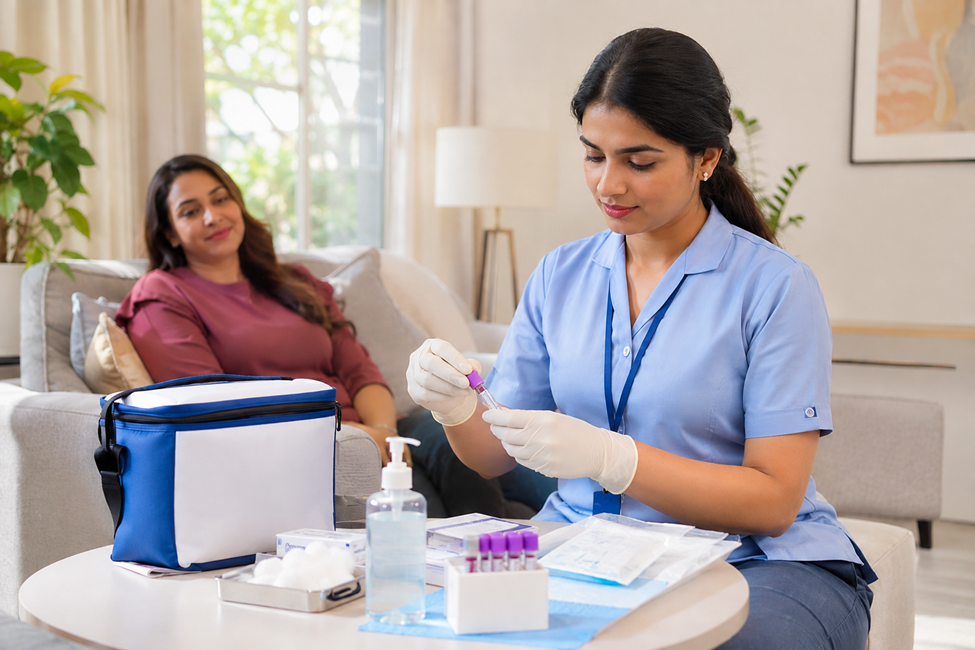
More people are choosing to have their blood drawn at home, especially when getting to a clinic is a hassle. A trained professional comes to your door, takes the sample and sends it off to a laboratory. It sounds straightforward, and mostly it is. Still, the quality of your result depends on what happens before, during and after the draw.
Below, we look at how the process works, what safety standards apply, how reliable the results can be, and what to ask before you book.
How Home Blood Sample Collection Works
A visit usually starts with a test request from your doctor, or a booking for a specific panel. When the collector arrives, they confirm who you are, check what the test needs and set out clean, single-use equipment. Once the blood is drawn, the tubes are labelled, kept at the right temperature and taken to the laboratory.
Venous and Capillary Sampling
Most tests use a venous sample, which means blood taken from a vein in the arm. A few tests need only a few drops from a finger prick, called capillary sampling. The WHO guidelines say this method suits certain tests that require only a small amount of blood. The test decides which method is used, not convenience.
Safety Standards Followed During Blood Collection
Drawing blood is routine, but it is still an invasive procedure. The WHO points out that patients can get bruised, that health workers can suffer needle-stick injuries, and that both can be exposed to bloodborne infections. Good practice exists to keep those risks low.
In practice, that usually means:
- Clean hands and fresh gloves for every patient
- Disinfecting the skin before the needle goes in
- New, sterile, single-use needles and lancets
- Sharps going straight into a puncture-proof container
- Checking the patient’s identity and labelling the tubes in front of them
WHO material also notes that fainting, nerve damage and haematomas can happen, and that its guidance is meant to make the procedure safer. A good collector knows how to handle these situations calmly, including a patient who suddenly feels light-headed.
How Accurate Are Tests on Home-Collected Samples?
A home draw is not automatically less accurate than one done in a clinic. The sample ends up in a laboratory either way. What counts is whether each step was done properly, from patient preparation and collection technique to handling, transport and lab processing.
Research on laboratory errors shows why the early steps matter so much. One review found that roughly 62 to 68 per cent of laboratory errors happen in the preanalytical phase, the stage that covers everything before the sample is analysed. Mistakes during the analysis itself were far less common.
That finding isn’t unique to home collection. It holds in every setting, which is exactly why careful collection and handling deserve attention.
It’s also worth knowing that not every test suits home collection. Some need to be processed quickly, handled in a special way or done in a clinical setting. Your doctor or the laboratory can tell you whether yours is suitable.
Factors That Can Affect Sample Quality
A handful of avoidable problems can change a result:
- Contamination. The WHO gives a simple example: touching the skin to find a vein before inserting the needle makes contamination more likely.
- Rough handling in transit. Jostling and jarring can break open red blood cells and lead to false results. Haemolysis shows up often as a reason for rejected samples in hospital audits.
- Labelling and identification errors. An Italian study found that tube-filling and patient identification mistakes were among the most common preanalytical problems.
- Delays and temperature. Some samples must be kept cool or processed within a set time.
- Patient factors. Fasting, hydration, medication and recent exercise can all affect certain results.
How to Prepare Before a Home Blood Test
Most of the preparation is up to you, and it can make a real difference.
- Find out whether you need to fast. Tests that require fasting usually ask for 8 to 12 hours without food or calorie-containing drinks. Plain water is generally fine. Plenty of common tests don’t need fasting at all, so check with your doctor or the laboratory.
- Keep taking your medicines as directed. Don’t stop or change a prescription unless your doctor says so.
- Drink water. Staying hydrated usually makes veins easier to find.
- Follow any special instructions. Some tests come with rules about supplements, alcohol or timing.
- Have your paperwork ready. Keep the test request, your ID and a list of your current medicines close by.
Benefits and Limitations of Home Collection
For older adults, people with limited mobility, parents of young children and anyone with a packed schedule, home collection saves the travel and the time in a waiting room. It can also feel less stressful if you don’t like clinical settings. If you’re curious about how a blood test at home Dubai works in practice, a local provider’s website can show you how its process runs and which tests it covers.
There are limits too:
- Not every test can be collected or transported safely from home.
- Samples may travel further before reaching the lab, so careful handling matters even more.
- Some tests need a doctor’s supervision or specialised equipment.
- A home visit doesn’t replace a medical consultation, and results still need to be interpreted by a qualified professional.
What to Check Before Choosing a Provider
Convenience shouldn’t come at the cost of quality. Before you book, it’s worth asking a few questions:
- Qualifications. Are the collectors trained and licensed to practise?
- Regulation. Is the service, and the laboratory it uses, approved by the relevant health authority?
- Laboratory quality. Does the lab follow recognised quality standards and take part in external quality assessment?
- Sample handling. How are samples stored and transported, and how fast do they reach the lab?
- Infection control. Are single-use needles, gloves and proper sharps disposal standard?
- Clear instructions. Will you get preparation guidance in advance?
- Privacy and reporting. How is your data protected, and who receives the results?
A trustworthy provider will answer these openly. It will also tell you when a test isn’t suitable for home collection.
Conclusion
Home blood collection can be a safe and practical choice when it follows established phlebotomy standards. How accurate the result is depends less on where the blood is drawn and more on careful preparation, correct technique, proper handling and good laboratory processing.
Follow your doctor’s instructions, ask questions about the process, and pick a provider that is upfront about how it works. And if a result surprises you, talk it through with a healthcare professional instead of drawing your own conclusions.
