

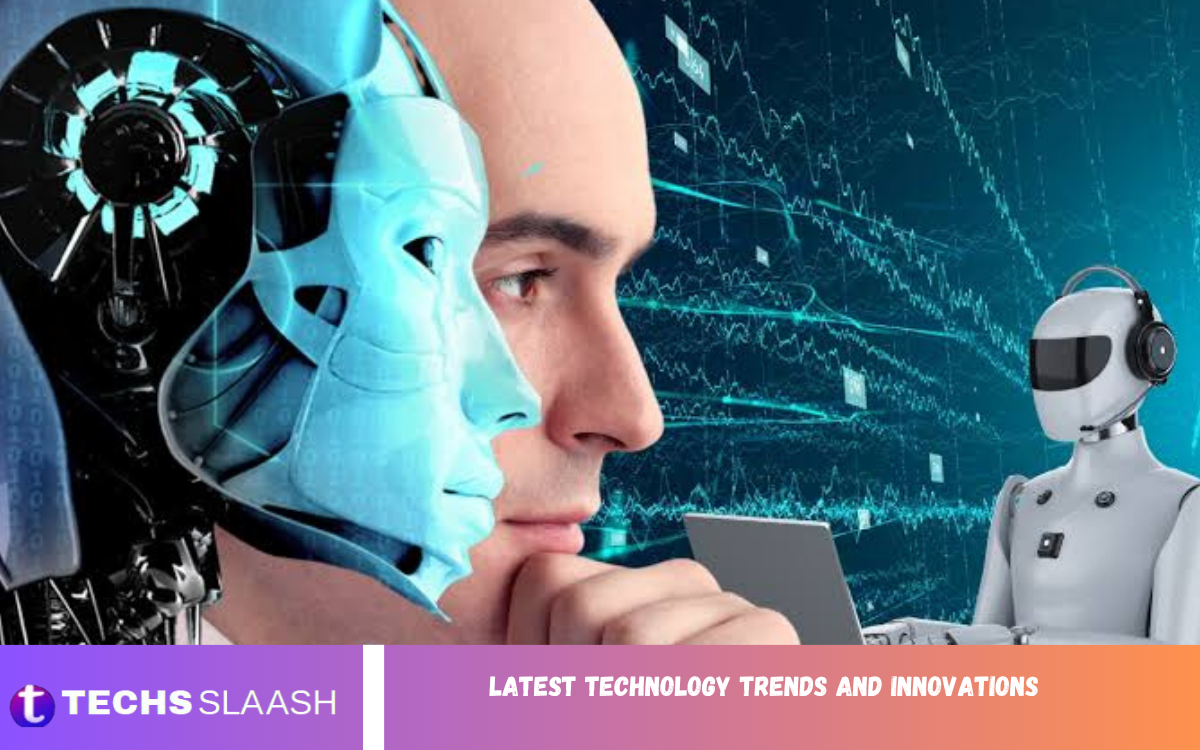
Artificial intelligence remains one of the most influential developments in modern technology. AI systems are becoming more capable of understanding language, analyzing information, generating content, writing software, and supporting complex business processes. In 2026, the focus is shifting from basic chatbots toward AI agents that can complete multi-step tasks with less human intervention.
Businesses are using AI to improve customer service, analyze data, automate repetitive work, and support decision-making. At the same time, developers are creating specialized AI systems tailored to particular industries, helping organizations achieve greater accuracy, security, and compliance than general-purpose models.
Agentic AI and Autonomous Software
Agentic AI is becoming an important part of the Latest Technology Trends and Innovations because these systems are designed to do more than simply respond to instructions. AI agents can plan tasks, use digital tools, analyze results, and perform multiple steps toward a defined objective. This approach could significantly change how employees interact with software.
The growth of multi-agent systems is also attracting attention. Instead of relying on one AI system for every task, organizations can use several specialized agents that cooperate on different parts of a workflow. This could make complex automation more flexible while creating new requirements for monitoring, permissions, security, and human oversight.
Physical AI and Advanced Robotics
Artificial intelligence is increasingly moving from screens into the physical world. Physical AI combines intelligent software with robots, sensors, cameras, machines, and other hardware, allowing systems to understand environments and respond to changing conditions. This trend is particularly important for manufacturing, logistics, healthcare, agriculture, and transportation.
Humanoid robots are another emerging development. Modern robotics research is moving toward machines that can adapt to environments instead of following only fixed instructions. Although widespread adoption still faces challenges involving safety, cost, integration, and reliability, physical AI is becoming a significant area of technology investment and research.
Edge Computing and On-Device AI
Edge computing is changing where digital information is processed. Instead of sending every request to a distant cloud server, edge systems can process information closer to where it is generated. This can reduce latency and improve responsiveness for applications such as smart cameras, industrial machines, connected vehicles, and mobile devices.
On-device AI is also becoming increasingly important. Smartphones, wearables, cameras, and other connected products can perform certain AI functions locally, reducing their dependence on constant cloud connectivity. This can provide advantages for privacy, speed, reliability, and network efficiency.
AI Hardware and Specialized Computing
The rapid expansion of AI is creating demand for more powerful and efficient computing hardware. Graphics processors, custom AI accelerators, specialized chips, and new memory architectures are being developed to handle increasingly demanding AI workloads. Recent research highlights that memory bandwidth and data movement are major challenges when serving large AI models.
This trend is encouraging greater collaboration between software and hardware developers. Rather than relying on a single processor type for every task, future systems are likely to combine different computing architectures based on workload requirements. Energy efficiency will also become increasingly important as AI infrastructure expands.
Quantum Computing and Quantum Technologies
Quantum computing continues to develop as a promising long-term technology. Unlike traditional computers, quantum systems use quantum mechanical principles to process certain types of problems differently. Potential applications include materials research, optimization, drug discovery, financial modeling, and cryptography.
Quantum technology is still developing, and broad commercial benefits are not expected immediately across every industry. However, progress in quantum hardware, sensing, networking, and hybrid quantum-classical systems is attracting increasing attention. Recent developments indicate that researchers and companies are working to move quantum computing closer to practical deployment.
Cybersecurity and Digital Trust
As technology becomes more interconnected, cybersecurity is becoming an essential part of innovation. Organizations are dealing with increasingly sophisticated cyber threats while also managing enormous amounts of sensitive information. Modern security strategies are therefore moving toward proactive protection, stronger identity management, AI security, and continuous monitoring.
AI itself is also creating new security challenges. Organizations must protect AI models, data, applications, and automated agents from manipulation and unauthorized access. Digital provenance and confidential computing are emerging as important approaches for establishing trust and protecting sensitive information while technology systems become more autonomous.
Cloud Computing Is Becoming More Intelligent
Cloud computing remains a foundation of modern digital infrastructure, but its role is evolving. Instead of simply providing storage and computing resources, cloud environments are increasingly designed around AI workloads, automation, analytics, and intelligent application development. This allows businesses to scale advanced technology without having to build every component themselves.
The combination of cloud, edge, and AI infrastructure is particularly important. Cloud platforms can provide large-scale computing power, while edge systems can handle time-sensitive tasks closer to users and devices. Together, they create flexible architectures capable of supporting modern applications across different environments.
Read Also: Effective TikTok Growth Tips for Building a Strong Audience
Digital Twins and Intelligent Simulation
Digital twins are another important technological innovation. A digital twin is a virtual representation of a physical object, machine, building, process, or environment. Data from sensors and connected systems can help keep the virtual representation up to date, enabling organizations to monitor performance and explore potential changes.
Industries can use digital twins to test processes before making expensive physical changes. Manufacturing companies, transportation organizations, energy providers, and infrastructure operators can use simulations to identify potential problems, improve maintenance, and optimize operations. When combined with AI, digital twins can become even more useful for prediction and automated decision-making.
Smart Devices and the Internet of Things
The Internet of Things continues to connect everyday objects to digital networks. Smart appliances, vehicles, wearable devices, industrial equipment, environmental sensors, and security systems can collect and exchange information, creating increasingly connected environments.
The next stage of IoT is becoming more intelligent as connected devices integrate sensors with AI and edge processing. Instead of simply collecting information, devices can interpret data and respond automatically. This development could improve smart homes, healthcare monitoring, industrial automation, agriculture, and transportation.
Sustainable Technology and Green Innovation
Sustainability is becoming an important consideration in technology development. Companies and researchers are exploring ways to reduce energy consumption, improve resource efficiency, and develop technologies that support cleaner infrastructure. The World Economic Forum’s 2026 emerging technology research highlights innovations across energy, materials, health, and computing that are moving toward real-world deployment.
Energy-efficient computing is particularly important as AI and data centers require substantial computational resources. Advances in specialized processors, efficient cooling, renewable energy integration, and smarter power management can help reduce the environmental impact of expanding digital infrastructure.
Future of Connectivity and Smart Infrastructure
Connectivity is also evolving beyond traditional internet services. Advanced wireless networks, satellite communications, connected vehicles, and intelligent infrastructure are helping create more continuous digital connectivity. These technologies can support remote areas, transportation systems, emergency communications, and connected industries.
Smart infrastructure combines connectivity with sensors, automation, and AI. Cities and businesses can use these technologies to monitor traffic, manage energy, improve public services, and respond to changing conditions. As connected systems become more common, cybersecurity and privacy will remain essential considerations.
Biotechnology and Technology-Driven Healthcare
Technology is increasingly transforming healthcare through AI-assisted analysis, advanced sensors, personalized treatments, and biotechnology. AI can help researchers analyze large datasets and support the development of new medicines, while wearable devices can collect health-related information for monitoring and analysis.
The convergence of AI and biology is also opening new possibilities. IEEE’s 2026 technology predictions highlight adaptive bio-AI interfaces capable of interpreting biological signals and potentially supporting therapies that adjust in real time.
Augmented Reality and Spatial Computing
Augmented reality and spatial computing are changing how people interact with digital information. Instead of viewing everything through traditional screens, spatial technologies can place digital objects and information within a user’s physical environment.
Businesses can use these technologies for training, product visualization, design, education, maintenance, and collaboration. As hardware becomes more capable and software becomes easier to develop, spatial computing could become a more practical tool across professional and consumer environments.
The Importance of Technology Skills
The rapid development of technology is increasing demand for people who understand AI, cybersecurity, cloud computing, data, automation, and software development. However, technical knowledge alone is not enough. Professionals also need analytical thinking, communication, creativity, adaptability, and an understanding of responsible technology use.
Organizations are increasingly focused on turning technology experiments into measurable business results. This means professionals who can connect technical capabilities with real-world problems will remain valuable as companies adopt new digital systems.
What These Technology Trends Mean for the Future?
The Latest Technology Trends and Innovations demonstrate that the future of technology will be defined by convergence. AI will increasingly work with robotics, sensors, cloud platforms, edge computing, advanced chips, cybersecurity, biotechnology, and connected infrastructure rather than developing independently.
The most successful innovations will likely be those that solve practical problems while remaining secure, affordable, efficient, and responsible. Technology is moving rapidly, but adoption depends on more than technical capability. Trust, regulation, skills, infrastructure, and real-world value will determine which innovations become mainstream.
Frequently Asked Questions
What are the latest technology trends?
The major trends include artificial intelligence, agentic AI, physical AI, robotics, edge computing, cybersecurity, advanced AI hardware, quantum technologies, cloud computing, digital twins, IoT, and sustainable technology.
Why is artificial intelligence important in 2026?
AI is becoming more capable of handling complex tasks, analyzing information, generating content, supporting software development, and automating business processes. Its integration with other technologies is expanding its practical applications.
What is agentic AI?
Agentic AI refers to AI systems designed to plan and complete multi-step tasks rather than simply responding to individual questions. These systems can potentially use tools, evaluate results, and coordinate actions.
Will robots become more common?
Robotics is expected to expand across manufacturing, logistics, healthcare, agriculture, and other industries. However, widespread adoption depends on improvements in safety, reliability, cost, integration, and workforce readiness.
What is edge computing?
Edge computing processes data closer to where it is generated, rather than sending all data to centralized cloud servers. It can reduce latency and support real-time applications.
Is quantum computing ready for everyday use?
Quantum computing remains an emerging technology. It has significant long-term potential, but broad commercial applications are still developing, with researchers focusing on hardware, algorithms, error correction, and hybrid systems.
Why is cybersecurity becoming more important?
More connected devices, AI systems, cloud services, and digital platforms create additional opportunities for cyberattacks. Strong security measures are therefore necessary to protect information, infrastructure, and automated systems.
How does AI affect the workplace?
AI can automate repetitive tasks, assist employees with research and analysis, improve productivity, and support decision-making. At the same time, workers may need to develop new technical and human skills to work effectively alongside AI.
What is a digital twin?
A digital twin is a virtual representation of a physical object, process, or environment. It can use real-world data to monitor performance, simulate changes, identify problems, and support optimization.
What technology skills should people learn?
AI literacy, data analysis, cybersecurity, cloud computing, automation, software development, and digital problem-solving are valuable areas to explore. Communication, creativity, critical thinking, and adaptability are equally important.
Conclusion
The Latest Technology Trends and Innovations are reshaping the digital and physical world. AI, agentic systems, robotics, edge computing, quantum technologies, advanced hardware, cybersecurity, IoT, digital twins, biotechnology, and sustainable innovation are creating new opportunities across industries.
The future will not be shaped by one technology alone. Instead, the strongest impact will come from technologies working together to solve practical problems.

1 Comment
Pingback: Advanced Artificial Intelligence Technology – Techsslaash.com