

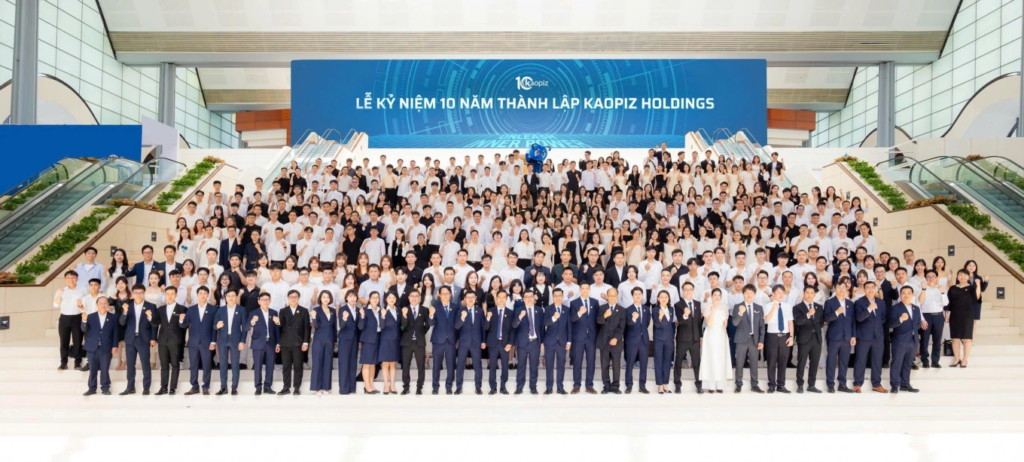
Kaopiz’s team after 11 years of operation
Many Japanese enterprises still rely on legacy IT systems developed decades ago. These systems often support critical business operations such as manufacturing management, logistics coordination, and financial processing. While they have delivered stability for many years, aging technologies now limit flexibility, scalability, and integration with modern digital platforms.
As companies accelerate digital transformation initiatives, Legacy system modernization for Japan has become a strategic priority. By modernizing legacy environments, enterprises can improve system performance, adopt cloud infrastructure, and integrate advanced technologies such as data analytics and AI.
The “2025 Digital Cliff” and legacy systems in Japan
One of the biggest drivers behind modernization efforts is Japan’s widely discussed “2025 Digital Cliff.”
According to a report by Japan’s Ministry of Economy, Trade and Industry (METI), outdated legacy systems could cause economic losses of up to ¥12 trillion per year after 2025 if companies fail to modernize their IT infrastructure. This risk arises from aging systems that are difficult to maintain, lack integration capabilities, and rely on outdated technologies.
The METI report also highlights that many legacy systems were developed more than 20 years ago and are supported by shrinking pools of engineers familiar with those technologies. As experienced engineers retire, maintaining these systems becomes increasingly difficult.
Because of these risks, many enterprises are accelerating investments in legacy modernization Japan as part of broader digital transformation strategies.
Why legacy systems are a risk for Japanese enterprises
Although legacy systems continue to support daily operations, relying on outdated technology environments creates several long-term risks.
Rising maintenance costs
Maintaining aging systems often requires specialized engineers and outdated tools, which can significantly increase operational costs over time.
Limited integration with modern technologies
Legacy platforms were not designed to support cloud services, advanced analytics, or AI-based automation. This limits companies’ ability to adopt modern digital capabilities.
Security vulnerabilities
Older systems may not receive regular security updates, making them more vulnerable to cyber threats and operational disruptions.
Reduced innovation speed
Organizations relying heavily on legacy infrastructure may struggle to deploy new digital services quickly, which can affect competitiveness in rapidly evolving markets.
These challenges are pushing many organizations to prioritize enterprise system modernization as a foundation for long-term digital transformation.
Challenges in legacy system modernization
Despite its importance, legacy modernization projects can be technically complex.
Complex system architecture
Legacy systems often consist of tightly connected applications, databases, and internal services. Updating one component may affect multiple dependent systems.
Limited documentation
Systems that have evolved over many years may lack complete documentation, making it difficult for development teams to fully understand system architecture.
Operational continuity
Enterprise platforms must remain operational during modernization. Companies often adopt phased migration strategies that gradually update systems without disrupting daily business operations.
Because of these factors, Legacy system modernization for Japan requires structured planning and experienced engineering teams.
Approaches to legacy modernization
Organizations typically choose from several modernization strategies depending on system complexity and business goals.
System refactoring
Existing applications are restructured to improve performance and compatibility with modern technologies.
Cloud migration
Legacy systems are moved to cloud infrastructure to improve scalability and operational efficiency.
System rebuilding
In some cases, outdated systems are rebuilt using modern architectures and development frameworks.
A combination of these strategies often provides the most effective path toward modernization while maintaining system stability.
The role of modernization in digital transformation
Modernizing legacy systems provides the technical foundation for broader digital transformation initiatives. Once systems are upgraded, enterprises can integrate new technologies more easily and improve their ability to respond to changing business demands.
For example, modernized systems enable organizations to:
- adopt cloud-based infrastructure
- integrate data analytics platforms
- implement AI-driven automation
- improve system scalability and reliability
These capabilities allow companies to transition from rigid legacy environments to flexible digital platforms.
Kaopiz, supporting legacy system modernization
Many enterprises choose to collaborate with external engineering partners when modernizing complex IT environments.
Kaopiz, supporting legacy system modernization, provides development services that help organizations upgrade enterprise systems while maintaining With experience supporting Japanese enterprises, Kaopiz works closely with clients to analyze legacy architectures, design modernization strategies, and implement scalable technology solutions.
Legacy system modernization for Japan
Enterprises planning modernization initiatives often seek technology partners capable of delivering reliable engineering execution.
Through structured development processes and experienced engineering teams, Kaopiz helps organizations transition from legacy environments to modern digital platforms.
Conclusion
Legacy systems continue to support critical operations across many Japanese enterprises. However, the risks highlighted by the “2025 Digital Cliff” show that relying on outdated IT infrastructure can limit innovation and create significant operational challenges.
As digital transformation accelerates, Legacy system modernization for Japan has become essential for organizations seeking to improve system scalability, integrate modern technologies, and maintain long-term competitiveness.
With the support of experienced partners such as Kaopiz, supporting legacy system modernization, enterprises can modernize legacy infrastructure while ensuring stable and efficient business operations.
INFORMATION CONTACT:
Email: [email protected]
Address:
Japan Office:
03-5809-2633
3F, 3-8-8 Minami Ikebukuro, Toshima-ku, Tokyo
Singapore Office:
1 Raffles Place #19-61, One Raffles Place Tower 2, Singapore 048616
Vietnam Office 1:
024-6652-2105
1-2-4-5F, CT1-C14 Bac Ha building, To Huu street, Dai Mo ward, Hanoi
Vietnam Office 2:
024-6652-2105
12F, SHB Da Nang building, 06 Nguyen Van Linh street, Hai Chau ward, Da Nang
