

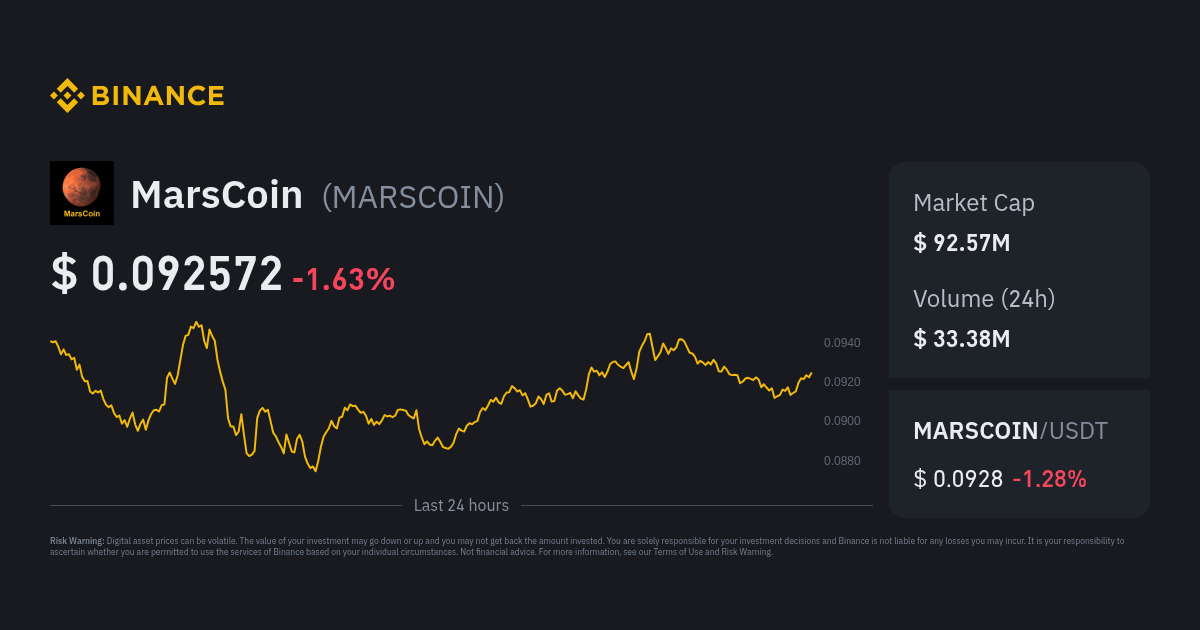
MarsCoin is heading into the final quarter of 2026 with a new catalyst behind its growing market narrative. Binance’s decision to support SPCXB rewards for eligible MARSCOIN holders has added another layer to a token already emerging as a major trending hot topic due to its links to BNB Chain, Elon Musk, and the broader tokenized SpaceX narrative.
The timing has also caught the attention of crypto trader Bonk Guy, who recently described the MARSCOIN chart as “very clean” and said the token could be setting up for an aggressive Q4 rally. His thesis points to a combination of technical momentum, Binance ecosystem activity and the potential appeal of SPCXB rewards.
The real question is whether SPCXB rewards can turn attention into steady trading volume and holder demand. That depends on how the rewards work, what the bull case needs to hold and where the structure is fragile. MARSCOIN/USDT has traded on KuCoin since September 5, so the last section covers how to approach it.
What Is MarsCoin (MARSCOIN)?
MarsCoin (MARSCOIN) is a fixed-supply meme token on BNB Chain, paired with SPCXB, a tokenized SpaceX asset, instead of a stablecoin. It has no product, revenue or disclosed team. Its pairing and reward structure define it.
Why is MarsCoin paired with SpaceX?
MarsCoin launched on July 27, 2026 through the Flap launchpad, with SPCXB as its primary trading pair. Most tokens launch against a stablecoin or BNB. This design ties MarsCoin’s market to a widely followed equity theme, SpaceX’s Nasdaq listing in June 2026.
The name refers to a 2021 exchange between CZ and Elon Musk on the idea of a MarsCoin. The project’s community cites it as an origin story. Because the project has no disclosed team, the reference should be read as branding.
SPCXB is a separate asset and is covered in the next section.
How does MarsCoin work?
MarsCoin works through a transaction tax that funds automatic SPCXB rewards for holders. The process has four steps:
- Fixed supply: The token has a fixed supply of one billion.
- Transaction tax: A 3% tax applies to each buy and sell.
- Rewards vault. The full tax amount is used to buy SPCXB, which funds the vault.
- Holder distributions. Wallets holding at least 10,000 MARSCOIN receive SPCXB from the vault automatically. More than $3.9 million had been distributed by early September 2026.
Holders therefore earn SPCXB by holding MARSCOIN, and the size of that reward follows trading activity. Higher volume fills the vault faster. Lower volume produces smaller distributions.
Users should also confirm they are trading the correct asset. Other tokens share the name, including the separate proof-of-work Marscoin (MARS) launched in 2014. On KuCoin, MarsCoin trades as MARSCOIN/USDT.
What Is SPCXB and How Does the MarsCoin Airdrop Work?
SPCXB is a BNB Chain token that tracks SpaceX shares. Binance’s airdrop gives MarsCoin holders a second reward source, separate from the project’s own tax vault.
What is SPCXB?
SPCXB is a BEP-20 token on BNB Smart Chain, issued through Binance’s bStocks program by BTech Holdings Limited, a Binance group affiliate. Binance describes bStocks as fully backed tokenized securities representing select U.S. stocks, which eligible users can trade around the clock and self-custody in BNB Chain wallets.
SPCXB follows the price of SpaceX, whose Nasdaq shares began trading after its June 2026 IPO. Availability varies by region.
Does SPCXB give you ownership in SpaceX?
No. Binance’s disclosure states that bStocks are not stocks or shares and do not let holders directly own a share of the underlying company. Holders also receive no voting rights or shareholder privileges.
Holders depend on the issuer and its custodian to hold the backing shares. Binance Academy makes the same point about MARSCOIN: owning it does not give SpaceX shares or voting rights.
How does the Binance airdrop differ from MarsCoin’s own rewards?
On September 28, Binance announced support for a SPCXB airdrop to MARSCOIN holders. It has two components: SPCXB that the project allocates onchain, which Binance passes to qualifying holders, and additional rewards funded by 30% of the spot trading fees Binance collects on MARSCOIN.
Binance says the fee-funded component continues until further notice and may be adjusted or ended.
Why Do Traders Expect a MarsCoin Rally in Q4 2026?
Trader Bonk Guy, who posts as Unipcs on X, argues that MarsCoin is set up for a strong fourth quarter. His case rests on narrative and ecosystem support, not on a product. The points below set his arguments beside the data. They are analysis, not a forecast.
What is the Musk and CZ connection to MarsCoin?
The name traces to February 2021. CZ suggested that a new coin be called MarsCoin, and Elon Musk replied that there would definitely be one. It was a conversation, not a launch or partnership.
Bonk Guy argues the 2026 token joins those two figures to the SpaceX theme. He points to SHIB and DOGE, which he says passed $40 billion and $80 billion in value last cycle. He reasons that meme narratives strengthen when several recognizable themes meet. That view is his own.
How does BNB Chain growth affect MarsCoin?
Bonk Guy expects BNB Chain to become more influential this cycle. Some data supports that. Binance Research reported that BNB Chain and Robinhood Chain rose from 2.3% of tracked chain volume in June to 88.2% in early September, and Token Terminal counts about 1.8 million tokenized stock holders on BNB Chain, the most of any network.
MarsCoin sits inside that segment. It is a BNB Chain token paired with SPCXB, and it moved from Binance Alpha to a Binance spot listing on September 4. KuCoin followed on September 5, opening a spot trading pair across its crypto markets with Spot Grid, Infinity Grid and DCA bot support.
Chain growth does not automatically reach individual tokens. The relevant question is whether sustained BNB Chain activity can become lasting liquidity and attention for MARSCOIN, whose liquidity is about 1.9% of its market cap.
What Are the Risks of Trading MarsCoin?
MarsCoin is a high-volatility meme token, and its structure adds risks most meme coins do not have. It rose from about $0.003 on July 29 to about $0.263 on September 5, and it now trades roughly 43% below that peak. Binance’s own listing carries a Seed Tag, its label for early-stage, higher-risk assets.
How does the SPCXB pairing affect MarsCoin’s price and liquidity?
MarsCoin’s deepest pool is quoted against SPCXB, a tokenized SpaceX share, not a stablecoin. An early September Phemex analysis found about 59% of its on-chain liquidity in that pool. The rest sits in stablecoin pools, and Binance has listed USDT and USDC pairs since 4 September. So SPCXB is a major influence on the dollar price, not the sole source of it.
Think of it as pricing a product in another asset. The pool ratio can stay put while MarsCoin’s dollar value moves because SPCXB moved. So far the effect has been small: MarsCoin gained 265% in a week when SPCXB rose about 5%.
Liquidity is thin. CoinMarketCap shows it at about 1.9% of market cap, roughly $2.9 million against $149 million, so large orders can move the price sharply.
Note: Figures are as of 30 September and change constantly. The 59% is a single-source, early-September snapshot.
Will MarsCoin rewards last if trading volume falls?
Rewards would shrink, because they depend on trading volume. The 3% tax funds the vault, and payouts also vary with eligible balances and SPCXB’s price. They are not a fixed yield.
If attention fades, volume falls, the vault fills more slowly and distributions get smaller. Where the tax applies, a round trip costs about 6%. SPCXB paid on-chain also goes to the wallet holding the tokens, so tokens held on an exchange depend on that exchange’s policy.
Is MarsCoin safe? Team, supply and disclosure risks
MarsCoin offers limited transparency. The project has no publicly identified team and no formal roadmap. CoinMarketCap counts about 52,000 holders, but a holder count does not show how supply is split among the largest wallets. Concentrated selling by a few holders cannot be ruled out, so check holder distribution before trading.
MarsCoin Price Outlook: Key Q4 Catalysts
October should provide several measurable signals for the MarsCoin rally thesis. The first is the initial SPCXB distribution, scheduled for early October under the new holder rewards program.
Eligible MARSCOIN balances are assessed through daily snapshots, with holdings above 10,000 MARSCOIN qualifying for rewards. The program also directs a portion of MARSCOIN spot trading fees toward additional SPCXB rewards, creating a potential link between trading activity and the size of the reward pool.
Traders may therefore watch:
- The size and reception of the first SPCXB distribution
- MARSCOIN spot trading volume and liquidity
- Changes in the number of MARSCOIN holders
- Price action following the reward distribution
- Whether MARSCOIN can reclaim levels lost after its initial exchange listings
These metrics can help distinguish a short-lived reaction to the announcement from sustained market participation.
Narrative momentum vs. sustained demand )
MARSCOIN has accumulated a dense narrative stack around Musk, CZ, SpaceX, Binance and BNB Chain. That combination can generate attention quickly, particularly when reinforced by a new rewards mechanism. But attention alone is different from sustained demand.
For the Q4 thesis to strengthen, the market would need to show evidence across several areas: liquidity, trading activity, holder demand, functioning rewards and continued interest in the BNB Chain ecosystem. A strong narrative can bring traders to an asset, but sustained participation determines whether that attention persists.
Bonk Guy’s thesis remains a thesis
Bonk Guy has argued that MARSCOIN’s technical setup looks “very clean” and that its combination of Musk, CZ and SPCX-related narratives could support a strong Q4. RootData reported his September 29 comments, while his own posts similarly pointed to the Binance rewards program and BNB Chain as key parts of his thesis.
The more useful test now is measurable: Will October’s SPCXB distributions translate into sustained demand? Will trading activity remain strong enough to support the reward mechanism? And can MARSCOIN turn its unusually dense narrative stack into lasting market participation?
Conclusion
MarsCoin enters Q4 with several catalysts, including SPCXB rewards, wider exchange access and continued interest around BNB Chain and the SpaceX narrative. The first October distributions could show whether these catalysts translate into sustained trading activity and holder demand.
For MARSCOIN, volume, liquidity, holder growth and price action after the rewards begin will be key signals to watch. The reward mechanism adds a new catalyst, but the token remains highly speculative, with thin liquidity and limited project disclosure.
FAQs
What is MarsCoin (MARSCOIN)?
MarsCoin is a BNB Chain meme token with a fixed supply of 1 billion. It uses transaction taxes to fund SPCXB rewards for eligible holders.
What is SPCXB in MarsCoin?
SPCXB is a BNB Chain token representing tokenized SpaceX exposure. MARSCOIN holders can receive SPCXB rewards through the token’s reward mechanism and eligible distributions.
How do MarsCoin holders earn SPCXB rewards?
Eligible MARSCOIN holders receive SPCXB through the project’s reward vault and additional distributions linked to MARSCOIN trading activity and qualifying holdings.
Can MarsCoin rally in Q4 2026?
A Q4 rally would depend on factors such as trading volume, liquidity, holder demand, SPCXB distributions and continued market interest in the MARSCOIN narrative.
