

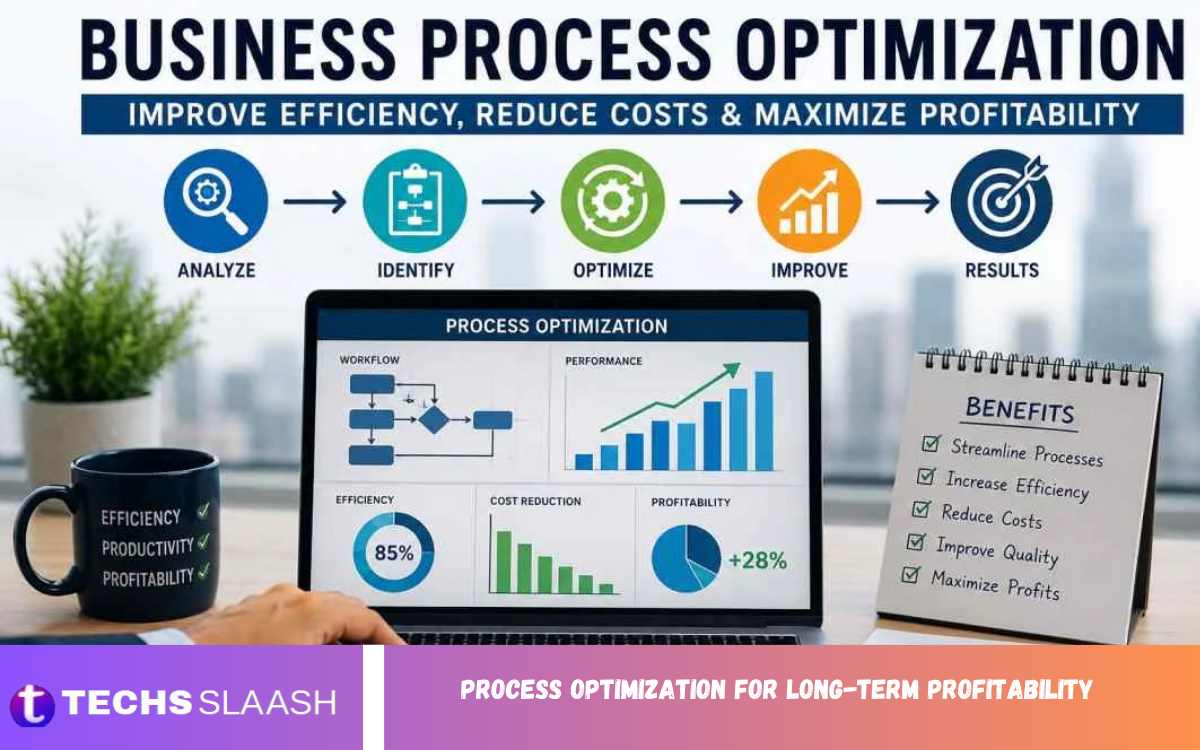
Process optimization is the systematic approach of improving business activities to make them faster, more efficient, cost-effective, and reliable. It involves reviewing existing workflows, identifying weaknesses, removing unnecessary steps, and developing more efficient methods for completing everyday tasks.
For modern organizations, process optimization is not simply about reducing expenses. It is about creating a stronger operational structure that allows employees, technology, resources, and management systems to work together effectively. When processes are designed properly, businesses can improve performance while creating a foundation for sustainable growth.
Why Process Optimization Matters for Long-Term Profitability?
Process Optimization for Long-Term Profitability helps organizations control operating costs while improving the quality and consistency of their products or services. Inefficient processes often consume valuable time, create repeated work, increase errors, and require additional resources.
Over time, these small inefficiencies can significantly affect financial performance. Optimized processes allow companies to achieve more with existing resources, improve customer satisfaction, and protect profit margins. This makes operational efficiency an important part of long-term business strategy.
Identify Inefficient Business Processes
The first step toward process optimization is understanding how work is currently performed. Businesses should examine workflows from beginning to end and identify delays, duplicate tasks, unnecessary approvals, communication problems, and activities that provide little value.
Employees who perform these processes regularly can provide valuable insights because they often understand operational problems better than anyone else. Gathering feedback from different departments can reveal hidden inefficiencies and help management prioritize the areas that require improvement.
Set Clear Performance Objectives
Process improvement becomes more effective when organizations establish measurable objectives before making changes. Goals may include reducing processing time, lowering operational costs, improving productivity, minimizing errors, or increasing customer satisfaction.
Clear objectives also make it easier to determine whether an optimization strategy is successful. Instead of making changes based on assumptions, businesses can compare performance before and after implementation and use measurable results to guide future decisions.
Reduce Unnecessary Steps
Many business processes become complicated because additional steps are added over time. Some may have been useful in the past but no longer provide meaningful value. Reviewing each stage of a workflow can reveal opportunities to simplify operations.
Removing unnecessary approvals, repetitive data entry, duplicate reporting, and redundant communication can save considerable time. A simpler process is generally easier to manage, easier to train employees on, and less likely to produce costly mistakes.
Automate Repetitive Tasks
Automation can play an important role in process optimization by handling repetitive and predictable activities. Tasks such as data entry, scheduling, notifications, document processing, reporting, and routine calculations can often be automated to reduce manual effort.
However, automation should be introduced strategically rather than simply because technology is available. Businesses should first understand the process, eliminate unnecessary steps, and then determine which remaining activities can benefit from automation. This approach prevents companies from automating inefficient workflows.
Improve Employee Productivity
Employees are central to successful process optimization. Even advanced systems cannot deliver strong results if workers lack appropriate training, clear responsibilities, or access to the information they need to perform their jobs effectively.
Organizations can improve productivity by simplifying procedures, providing practical training, improving internal communication, and giving employees appropriate tools. When employees understand how their work contributes to broader business objectives, they are also more likely to identify opportunities for improvement.
Use Data to Support Better Decisions
Data provides businesses with an objective way to understand operational performance. Companies can monitor indicators such as processing time, production costs, error rates, employee productivity, customer complaints, and resource utilization.
Analyzing this information can reveal patterns that are difficult to identify through observation alone. Data-driven process optimization allows managers to focus on areas with the greatest potential impact instead of making changes based only on personal opinions or assumptions.
Improve Quality and Consistency
Process optimization should never focus exclusively on speed. Increasing productivity while reducing quality can create customer dissatisfaction, returns, complaints, and reputational damage. Sustainable profitability requires an appropriate balance between efficiency and quality.
Standardized procedures can help employees perform important tasks consistently. Clear instructions, quality checks, performance standards, and regular reviews reduce variations and help organizations maintain reliable results as they grow.
Strengthen Customer Experience
Efficient internal processes often produce better customer experiences. Faster response times, accurate orders, dependable delivery, clear communication, and effective support can increase customer confidence and loyalty.
Businesses should therefore evaluate processes from the customer’s perspective as well as the internal perspective. A process may appear efficient internally but still create unnecessary inconvenience for customers. Understanding the complete customer journey can reveal valuable optimization opportunities.
Manage Costs More Effectively
Cost management is one of the most direct benefits of process optimization. Organizations can reduce waste by identifying unnecessary expenses, inefficient resource usage, excessive inventory, repeated work, and avoidable operational delays.
The objective should not be to cut every possible expense. Excessive cost reduction can negatively affect employees, quality, technology, and customer service. Effective optimization focuses on eliminating waste while protecting the resources that contribute to long-term value.
Optimize Resource Allocation
Every organization has limited resources, including employees, equipment, capital, time, and materials. Process optimization helps management determine where these resources generate the greatest value.
By examining workload, capacity, and performance data, companies can better allocate resources to important activities. This can reduce bottlenecks, prevent overworked teams, and improve overall operational efficiency without requiring unnecessary expansion.
Create Standard Operating Procedures
Standard Operating Procedures, commonly known as SOPs, provide employees with clear instructions for completing recurring tasks. Well-designed SOPs can reduce confusion and make important processes more consistent.
SOPs are particularly valuable when businesses are expanding or experiencing employee changes. Documented procedures help new employees understand responsibilities more quickly while ensuring that critical activities continue to follow established standards.
Read Also: Using Annuity Calculators for Retirement Planning
Monitor and Improve Processes Continuously
Process optimization should not be treated as a one-time project. Business conditions, customer expectations, technologies, regulations, and market competition constantly change, meaning that processes can become inefficient again over time.
Continuous improvement encourages organizations to regularly review performance and identify new opportunities. Small, consistently implemented improvements can create significant long-term benefits while reducing the need for disruptive, large-scale changes.
Overcome Common Process Optimization Challenges
Resistance to change is one of the most common challenges businesses face when improving processes. Employees may worry that new systems will increase their workload, eliminate responsibilities, or create uncertainty. Transparent communication and employee involvement can make transitions easier.
Another challenge is optimizing processes without understanding their full impact. Changing one department’s workflow may unintentionally create problems elsewhere. Organizations should therefore consider how processes connect across departments before implementing major changes.
Build a Culture of Continuous Improvement
Long-term process optimization becomes easier when continuous improvement becomes part of company culture. Employees should feel comfortable identifying problems, suggesting ideas, and reporting inefficiencies without fear of unnecessary criticism.
Leadership plays an important role in establishing this culture. Managers should recognize useful suggestions, measure improvement efforts, communicate results, and demonstrate that efficiency and quality are shared organizational responsibilities.
Measure the Financial Impact
The effectiveness of process optimization should ultimately be reflected in business performance. Companies can evaluate improvements through metrics such as operating costs, productivity, profit margins, customer retention, processing times, and revenue per employee.
Financial measurement helps management determine which optimization projects deserve additional investment. It also demonstrates the value of operational improvements to stakeholders and creates a stronger basis for future strategic decisions.
Scale Successful Processes
A process that works effectively in one department or location may provide opportunities for broader implementation. Businesses should identify successful improvements and determine whether they can be standardized across other teams or operations.
Scaling successful processes can create greater efficiency without requiring organizations to develop completely new solutions for every department. However, businesses should consider differences in workloads, responsibilities, and customer requirements before applying a process universally.
The Role of Technology in Process Optimization
Modern technology provides businesses with many opportunities to improve workflows. Digital systems can connect departments, provide real-time information, automate routine activities, and make performance monitoring more efficient.
Technology should support business objectives rather than become the objective itself. Organizations that select technology without first understanding their operational requirements may create additional complexity rather than improve efficiency. A practical technology strategy begins with process needs and then identifies suitable solutions.
Long-Term Benefits of Process Optimization
The benefits of Process Optimization for Long-Term Profitability extend beyond immediate cost savings. Efficient processes can improve scalability, employee productivity, customer satisfaction, operational resilience, and decision-making.
A well-optimized organization is also better positioned to respond to market changes. When processes are flexible and clearly understood, businesses can introduce new products, serve customers more effectively, and adapt operations without unnecessary disruption.
Frequently Asked Questions
What is Process Optimization for Long-Term Profitability?
Process Optimization for Long-Term Profitability means improving business workflows to reduce waste, increase efficiency, control costs, enhance quality, and sustain financial performance over time.
Why is process optimization important for businesses?
Process optimization helps businesses use resources more effectively, reduce operational waste, improve productivity, and deliver better customer experiences. These improvements can strengthen profitability over the long term.
How can a company identify inefficient processes?
Companies can analyze workflows, collect employee feedback, review performance data, identify bottlenecks, and examine areas involving repeated work, delays, errors, or unnecessary approvals.
Can process optimization reduce business costs?
Yes. Optimization can reduce costs by eliminating waste, minimizing errors, improving resource allocation, reducing unnecessary work, and increasing productivity without automatically requiring additional resources.
Does process optimization require expensive technology?
No. Some improvements can be achieved through better procedures, clearer responsibilities, training, communication, and workflow simplification. Technology can support optimization, but it is not always necessary.
How does automation support process optimization?
Automation can handle repetitive and predictable tasks, reducing manual effort and processing errors. It can also allow employees to focus on activities that require judgment, creativity, communication, and strategic thinking.
How often should business processes be reviewed?
Processes should be reviewed regularly rather than only when serious problems occur. Ongoing monitoring allows organizations to identify inefficiencies early and make smaller improvements before problems become costly.
How does process optimization improve customer satisfaction?
Efficient processes can result in faster responses, fewer errors, reliable delivery, consistent quality, and smoother interactions. These improvements can increase customer trust and encourage long-term loyalty.
What metrics should businesses use to measure process optimization?
Useful metrics include operating costs, processing time, productivity, error rates, customer satisfaction, employee performance, resource utilization, and profit margins. The best metrics depend on the specific process being improved.
What is the biggest challenge in process optimization?
Resistance to change is a major challenge. Employees may be uncomfortable with new procedures or technologies, so organizations should communicate clearly, provide training, involve employees, and demonstrate the benefits of improvement.
Conclusion
Process Optimization for Long-Term Profitability is a strategic approach to building a more efficient, adaptable, and financially sustainable organization. By identifying inefficient workflows, reducing unnecessary activities, improving resource allocation, using data, and applying technology strategically, businesses can create measurable operational improvements.
The strongest results come from treating optimization as an ongoing responsibility rather than a one-time project.

1 Comment
Pingback: Benefits of Selling Your House for Cash - Techsslaash.com