

Recognizing a famous product name is not the same as verifying the product in front of you. A professional buyer may know the Profhilo brand well and still need to establish the exact presentation, source, batch, remaining shelf life, and handling history of a particular order. Familiarity helps with identification, but it should not replace a documented acceptance process.
The original 2 mL presentation is also easy to confuse with broader discussions of the Profhilo family. A research paper may concern one formulation, a seller may offer another presentation, and an article may use the brand name without distinguishing them. Accurate product information keeps those details connected rather than assuming the name alone resolves them.
This guide explains the visible formulation information, the limits of authenticity checks, the evidence behind a widely cited safety publication, and the practical questions to ask before purchasing. It is professional product education, not a treatment protocol. Individual suitability, administration, and lawful use require the current applicable instructions and qualified clinical assessment.
Identify the original 2 mL presentation
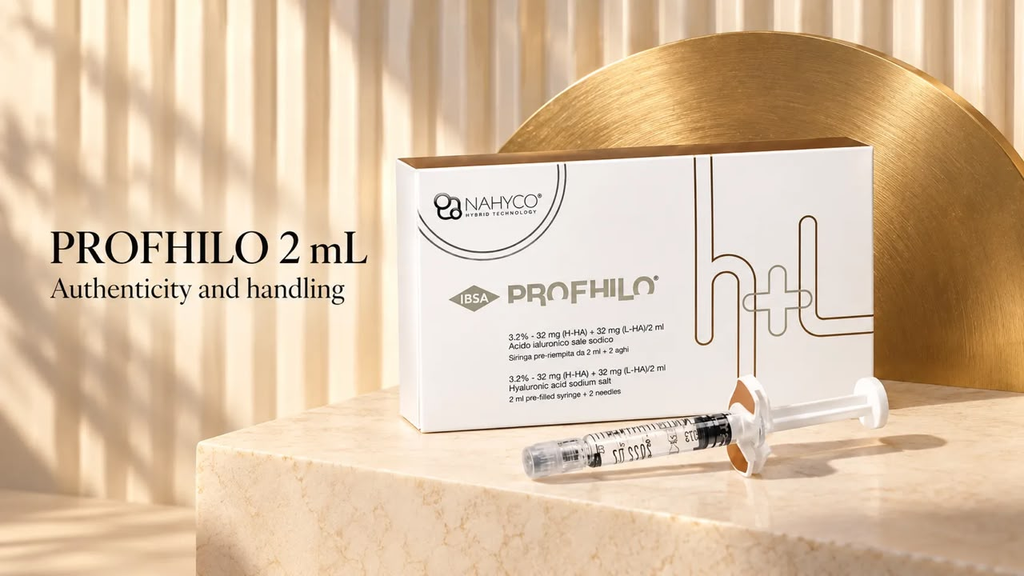
The Profhilo 2ml listing shows the familiar white and gold IBSA carton with a prefilled syringe. The pictured label states 32 mg of high-molecular-weight hyaluronic acid and 32 mg of low-molecular-weight hyaluronic acid in 2 mL. That is a total of 64 mg in the labeled presentation, not 64 mg per milliliter.
The arithmetic matters because a small unit error can become a large factual error when copied across product descriptions. Keep mass, volume, and concentration distinct. If a source describes the total amount per syringe, do not relabel it as a concentration without performing and clearly stating the correct calculation.
IBSA’s official Profhilo information is the appropriate starting point for the product family, while the actual supplied label and instructions should establish the details relevant to the purchased version. A commercial photograph is useful for recognition, but it does not prove that the stock offered today has the same market labeling or package contents. [1]
Keep the original product separate from the wider range
A brand family can expand while the best-known name remains the same in everyday conversation. Buyers should therefore use the complete product designation and presentation in quotations and inventory records. Do not assume that another item bearing the Profhilo name has the same formulation, packaging, instructions, or evidence.
Ask the seller to identify the exact stock and provide current photographs of the relevant label panels. If a quotation says only “Profhilo,” request the presentation and product code where available. That clarification is particularly important when a supplier offers several related items or market versions.
Research should be matched in the same way. A study of the original high- and low-molecular-weight formulation should not automatically be used to validate every later product in the family. The exact product tested, the proposed use, and the supplied presentation need to remain visible in the evidence review.
Understand the formulation description without overclaiming
Profhilo is described in the literature through hybrid complexes of high- and low-molecular-weight hyaluronans and the manufacturer’s NAHYCO technology. This identifies a particular formulation approach. It should not be reduced to a generic claim that any mixture of two hyaluronic acid molecular weights will behave identically.
Nor should the formulation description be used as a shortcut to clinical promises. A material characteristic can help explain a rationale, but claims about visible improvement, duration, or comparative performance require relevant clinical evidence. The phrase bioremodeling is not a substitute for a defined outcome measure.
For a reader comparing options, ask what is meant by improved skin quality. Hydration, texture, laxity, and satisfaction are different endpoints. A study addressing one does not necessarily establish all the others. Clear product education identifies the outcome and the limitations rather than turning a broad category phrase into a universal benefit.
| Information | What it establishes | What requires separate evidence |
| Labeled mass and volume | Nominal formulation presentation | A patient-specific amount |
| Manufacturer technology name | Product and process identity | Superiority over every alternative |
| Brand recognition | Familiarity with the product family | Authenticity of a shipment |
| A published safety analysis | Findings within its data and methods | A guarantee of no complications |
| Product availability | A commercial offer | Local authorization for the proposed use |
Read the postmarketing safety paper carefully
A 2020 paper by Cassuto and colleagues examined spontaneous adverse-event reports associated with Profhilo received in IBSA’s global safety database during a defined three-year period. It reported twelve cases, none classified as serious in that dataset, and disclosed company employment among several authors. The paper provides useful postmarketing information, but it is not a randomized comparison. [2]
Spontaneous reporting has an important limitation: not every event is necessarily reported or captured. The number of reports cannot be treated as a complete count of all events in all treated people. It also should not be converted into a precise personal risk estimate by dividing reports by an estimated number of users.
This is a general principle of evidence interpretation. A database can be valuable for identifying reported patterns while still being limited for estimating incidence. A favorable conclusion in one dataset does not establish that a procedure is risk free or appropriate for every individual.
For public-facing copy, describe the study design and keep the conclusion within its scope. Avoid presenting the paper as proof of guaranteed safety, superiority, or a particular benefit that it was not designed to measure. A reader should understand why the study is relevant and what it cannot answer.
Compare research designs before comparing headlines
Different study designs answer different questions. A controlled clinical study may help assess whether an observed change differs from a comparison condition. A postmarketing report analysis can describe events that reached a reporting system. A laboratory study can investigate material behavior or a possible mechanism. None automatically replaces the others.
When a seller provides a reference list, group the sources by purpose. Identify which support composition, which address clinical outcomes, and which concern safety monitoring. This makes it easier to see whether a particular marketing claim has direct support or is being inferred from a different type of evidence.
Ask whether the research concerns the exact product and relevant population. Check the follow-up period before accepting a duration claim, and note whether other treatments were used. A well-presented graph is only as informative as the methods and context behind it.
Use authenticity checks as a system
No single visual feature can establish authenticity with certainty. Packaging can be copied, legitimate designs can change, and different market versions may use different labeling. A responsible process combines product identification with provenance and verification through appropriate sources.
Begin with the seller’s legal identity and the commercial records for the order. Then connect the offered product to current packaging information, batch details, and any verification process provided by the manufacturer or responsible local distributor. Keep a record of what was actually confirmed, rather than writing a general statement that the product is “verified.”
If a code or serial feature is present, follow the genuine verification instructions for that feature. Do not assume that scanning any printed code into any website provides an authoritative answer. The destination and purpose of the verification process matter as much as the presence of the code itself.
| Check | Useful question | Limitation |
| Carton appearance | Does it match the documented version | Appearance can be imitated |
| Batch and expiry | Are they readable and linked to the order | A printed number alone proves little |
| Supplier records | Can the transaction and source be traced | Records require scope and consistency checks |
| Manufacturer verification | What exact fact was confirmed | Confirmation may have a limited scope |
| Handling history | Were applicable conditions maintained | Authenticity does not establish correct storage |
Do not confuse genuine with acceptable
A genuine product can still be unsuitable for acceptance if it is expired, damaged, incorrectly supplied, or subject to an unresolved handling concern. Authenticity is one part of the review, not the entire decision. The receiving process should therefore evaluate identity, condition, documentation, and handling separately.
Consider a hypothetical delivery that is confirmed as genuine but arrives with damaged primary packaging. The authenticity confirmation does not remove the packaging concern. The responsible team must evaluate the damage under the applicable instructions and quality procedures before deciding what to do with the stock.
The reverse is also true. An undamaged carton does not establish provenance. A complete review needs both a credible source and acceptable condition. Keeping those questions separate prevents one reassuring detail from overshadowing another unresolved issue.
Request batch information before dispatch
Ask which batch or batches are available and what expiry dates they carry. If the supplier cannot reserve a particular batch until payment, agree on the minimum acceptable remaining shelf life and require confirmation before dispatch. This is more precise than a general promise of “fresh stock.”
For mixed-batch orders, request the quantity associated with each batch. Record those quantities separately in the inventory system. An average expiry date or a single generic batch entry can obscure differences that matter for stock rotation and later traceability.
Photographs should relate to the offered stock where possible. A historical marketing image may identify the product but cannot confirm the current batch. Ask the seller to distinguish representative imagery from actual-stock documentation so the buyer understands what each image supports.
Establish handling from the applicable instructions
Storage and transport requirements should come from the current instructions for the exact supplied product. Do not copy a range from a different Profhilo presentation or another hyaluronic acid product. Record the source and revision used to build the local handling plan.
Ask the seller how the proposed shipping method addresses those requirements. Consider expected transit time, customs delays, transfer points, and the receiving schedule. An insulated package can be part of a plan, but insulation alone does not demonstrate that conditions were maintained throughout the journey.
If monitoring data are supplied, connect them to the actual shipment and preserve the original record. Where a concern arises, keep the affected stock pending review and seek a documented disposition. Do not infer acceptability from the fact that the syringe looks normal or the package arrived sooner than expected.
Prepare a receiving process that is easy to follow
The receiving team should have the approved purchase specification before the parcel arrives. At delivery, compare the product name, presentation, quantity, batch, expiry, and package condition with that specification. Record the receipt date and the staff member performing the check.
Photograph damage or mismatches promptly and preserve the shipping materials needed for investigation. Keep the relevant invoice, packing list, and monitoring records together. A concise evidence package makes it easier for the supplier or responsible organization to assess the issue without repeated requests for missing details.
Use clear inventory statuses. Accepted stock should be distinguishable from stock awaiting identity verification, handling review, or a commercial resolution. A product should not become available merely because someone entered the invoice into the accounting system.
Compare suppliers beyond the advertised price
When evaluating a professional aesthetic products supplier, ask how the seller documents provenance, confirms available batches, and resolves a problem after delivery. These questions test the quality of the process behind the offer. A large catalog and a polished website are useful for navigation but do not answer them.
Compare quotations using the same confirmed presentation and unit of sale. Include freight, applicable transaction costs, remaining shelf life, and the conditions under which the buyer may reject a mismatch. Where a cost is uncertain, show the assumption rather than presenting a misleadingly exact total.
Keep payment and invoicing details consistent with the agreed seller identity. If another entity is involved, ask for a clear explanation. This is ordinary commercial due diligence and helps preserve the traceable relationship between the order, payment, and supplied stock.
Plan inventory without creating treatment pressure
Bulk discounts can be attractive, but stock should reflect realistic appropriate demand. Estimate turnover using actual service plans and allow for receiving review, staff availability, and possible changes in practice. An order that creates pressure to use short-dated stock may not represent good value even when its unit price is low.
Use first-expiring stock appropriately within the organization’s procedures, while keeping batch identity intact. If products move between locations, record the transfer and the quantity. The original purchase and receiving information should remain retrievable after the stock leaves the first site.
Review slow-moving inventory early. A proactive discussion about future ordering is more useful than discovering an expiry problem at the last moment. The purchasing team should manage stock levels without making clinical decisions about who should receive a product.
Prepare accurate information for a consultation
Readers considering a procedure should be able to ask the professional which exact product is proposed and why it is relevant to their concern. The answer should distinguish the expected benefit, the limits of the evidence, alternatives, and follow-up arrangements. A recognizable brand should not end the conversation.
Avoid guarantees about a fixed result or duration. Individual factors, the actual intervention, and the way outcomes are measured all affect interpretation. A responsible explanation connects expectations to evidence while acknowledging uncertainty in terms the person can understand.
This article does not provide injection points, volumes, or techniques. Those belong to qualified clinical practice and the applicable instructions. Its practical contribution is to help readers identify the product and assess the quality of the information being used to support a decision.
Keep product copy and evidence records synchronized
When a product page is updated, check the linked internal specification and evidence summary as well. A new image, revised label, or expanded product family can make an old comparison inaccurate. Assign an owner to review changes instead of relying on informal memory.
For every clinical claim, retain the source and a short explanation of how it supports the wording. If the wording changes from “studied” to “proven superior,” the evidence requirement changes too. Editorial review should catch that shift before publication.
Do not add medical-review credentials unless a real qualified reviewer has performed the stated role. A factual article can be credible through transparent sourcing and careful interpretation. An invented authority would undermine the very trust the content is intended to build.
Test the traceability record before it is needed
Choose one received batch and ask a staff member who did not place the order to retrieve its invoice, acceptance record, storage location, and subsequent transfers. The exercise should be quick enough to fit ordinary work. If information is missing, repair the process while the original records are still available.
This does not certify the product or replace an audit. It checks whether the organization’s own records are usable. A well-designed system should allow another person to understand what was purchased, why it was accepted, and where the stock went without reconstructing a long private message history.
Record the outcome and any corrective action. Over time, repeated small improvements make the purchasing process less dependent on one experienced employee and more reliable across the team.
A worked example of reviewing a safety claim
Imagine that a draft product page says Profhilo has “no serious risks” and cites the 2020 postmarketing paper. The citation is real, but the sentence is broader than the study can support. The editor should identify the precise mismatch rather than merely adding a disclaimer at the bottom of the page.
The paper concerns reports captured in a defined system during a defined period. A statement about what was reported in that dataset is different from a statement about every possible risk in every patient. The draft should therefore describe the study design and its scope, then leave individual clinical risk assessment to the appropriate professional discussion.
The editor also checks whether the page implies that the study demonstrates superiority over another product. If the cited analysis does not contain that comparison, the implication should be removed. A real reference can still be used misleadingly when the surrounding language asks it to support a question it did not investigate.
Next, the team reviews any percentage calculated from the number of reports. The denominator, completeness of reporting, and interpretation matter. An attractive small percentage can create false precision if readers understand it as the probability of an adverse event. The safer editorial choice is to avoid an incidence claim that the data do not reliably establish.
Finally, the clinical and purchasing records are kept separate. The publication may inform the professional evidence review, but it does not authenticate the stock in a particular shipment. Batch, provenance, expiry, and handling still need to be checked through the commercial and quality records. A strong publication cannot repair a weak supply-chain record, and a well-documented shipment cannot prove a clinical claim.
This hypothetical editing exercise demonstrates a practical standard for evidence-based writing: a citation must support the exact statement next to it. The existence of a peer-reviewed paper is not enough. Readers should be able to understand the kind of study, the question it addressed, and the main limitation that affects the conclusion being drawn.
Apply the same standard to duration claims
If a draft promises a result for a fixed number of months, identify the source for that duration and the outcome being measured. Check whether the study evaluated the exact product, whether the observation period supports the claim, and whether the result was consistent across participants. Do not infer duration from a different formulation or from the persistence of a material in a laboratory setting.
The final wording should reflect what the evidence actually shows. It may be appropriate to describe a study’s follow-up period without guaranteeing that every person will experience the same result for that entire time. This preserves useful information while avoiding an individualized promise the research cannot make.
Keeping a short claim-to-source record makes later revisions easier. When a new study becomes available, the team can update the relevant statement and its limitations without rewriting the entire product page from memory.
Frequently asked questions
Does the pictured formulation contain 64 mg per mL
No. The reviewed label shows a total of 64 mg in 2 mL, split between the stated high- and low-molecular-weight fractions. Keep the total amount per presentation distinct from concentration. Confirm the actual supplied product label rather than copying a shortened online description.
Can the carton alone prove authenticity
No. Appearance is one identification check. Combine it with transaction records, provenance, batch information, and the appropriate manufacturer or distributor verification process where needed. A convincing photograph does not establish the history of the stock being offered.
Does the safety paper prove there are no risks
No. The paper analyzes reports received within a defined postmarketing system and period. Such data have reporting limitations and cannot establish zero risk. Clinical suitability and informed discussion still require qualified professional assessment of the exact product and proposed use.
Can one Profhilo product replace another automatically
No. Confirm the full presentation, formulation, applicable instructions, and evidence for each item. Shared branding does not establish interchangeability. A proposed substitution should be reviewed and documented before it is accepted.
What if the product is genuine but handling is uncertain
Keep it pending review. Authenticity does not resolve a temperature, damage, expiry, or packaging concern. Preserve the relevant evidence and obtain an appropriate documented disposition before releasing the stock.
What should be included in a quotation request
Specify the exact 2 mL presentation, quantity, destination, minimum remaining shelf life, required documents, and substitution policy. Ask for current batch information and the proposed shipping arrangements. A clear request produces an offer that can be compared and reviewed meaningfully.
Build the purchase around a verifiable product
Before committing to an order, connect the exact Profhilo presentation with its current instructions, provenance, batch details, and handling plan. Compare complete quotations and have the responsible professional review the intended use and relevant evidence. Keep unresolved questions visible until they are answered.
Brand recognition can make a search easier, but a documented process makes the final decision stronger. The goal is a product that is clearly identified, appropriately reviewed, and traceable through receipt and storage, with public claims that reflect the evidence rather than the familiarity of the name.
References
[1] IBSA Derma. Profhilo. Official product and brand information. Accessed September 2026.
[2] Cassuto D, Delledonne M, Zaccaria G, Illiano I, Giori AM, Bellia G. Safety Assessment of High- and Low-Molecular-Weight Hyaluronans (Profhilo) as Derived from Worldwide Postmarketing Data. BioMed Research International. 2020;2020:8159047.
The pictured formulation and commercial presentation were checked against the FillersFairy Profhilo 2ml listing. The postmarketing publication is discussed within the limits of spontaneous reporting. Purchasing scenarios and workflow suggestions are illustrative editorial tools.
