

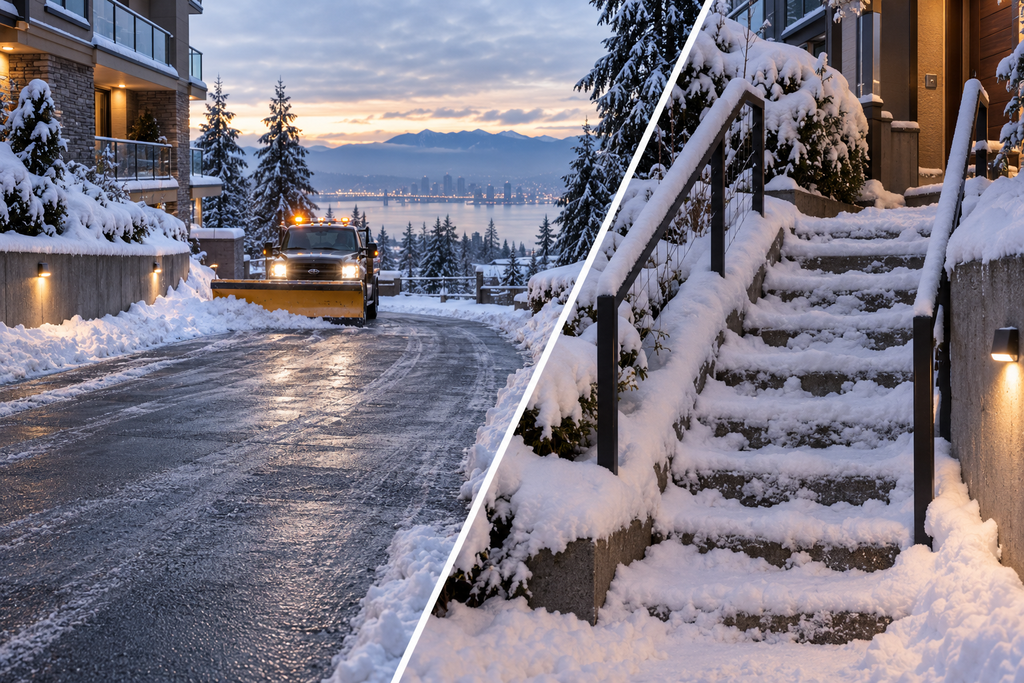
Slope-aware winter service in North Vancouver
A steep driveway can dominate attention during a winter event.
It is highly visible, difficult for vehicles, and often the first surface managers worry about when snow begins accumulating. Once equipment clears the grade and restores vehicle access, the property can appear operational again.
But residents still have to get from their vehicles to their doors.
That is where hillside stairs snow clearing becomes part of the same access problem rather than a separate cosmetic task. Exterior stairs, intermediate landings, handrail approaches, short connector paths, and pedestrian shortcuts can remain covered even after the main slope has been successfully serviced.
A winter plan that restores vehicle movement but leaves the pedestrian route unfinished has solved only part of the property problem.
This matters particularly on hillside strata sites, where buildings may sit at different elevations and residents depend on stairs to move between parking, entrances, sidewalks, mail areas, garbage facilities, and shared amenities.
The terrain should be planned as one connected route.
Clearing the Hill Can Hide the Real Gap
Large surfaces naturally attract attention.
A driveway filled with snow looks urgent. A flight of twelve steps beside it occupies much less area and may be easy to miss during a quick inspection.
Yet surface area is a poor way to determine priority.
A small staircase can carry nearly every pedestrian entering one section of a property. If that staircase remains untreated, residents may improvise by walking along the vehicle slope instead.
That creates a new operational problem.
The surface designed for cars becomes an unintended pedestrian route at exactly the time vehicles have reduced traction and visibility.
This is why hillside properties need a clear division of responsibility between machine work and hand work.
The plow route and the pedestrian route should not be treated as unrelated service categories. They are two parts of the same access system.
Stair Priority and Terrain Sequencing
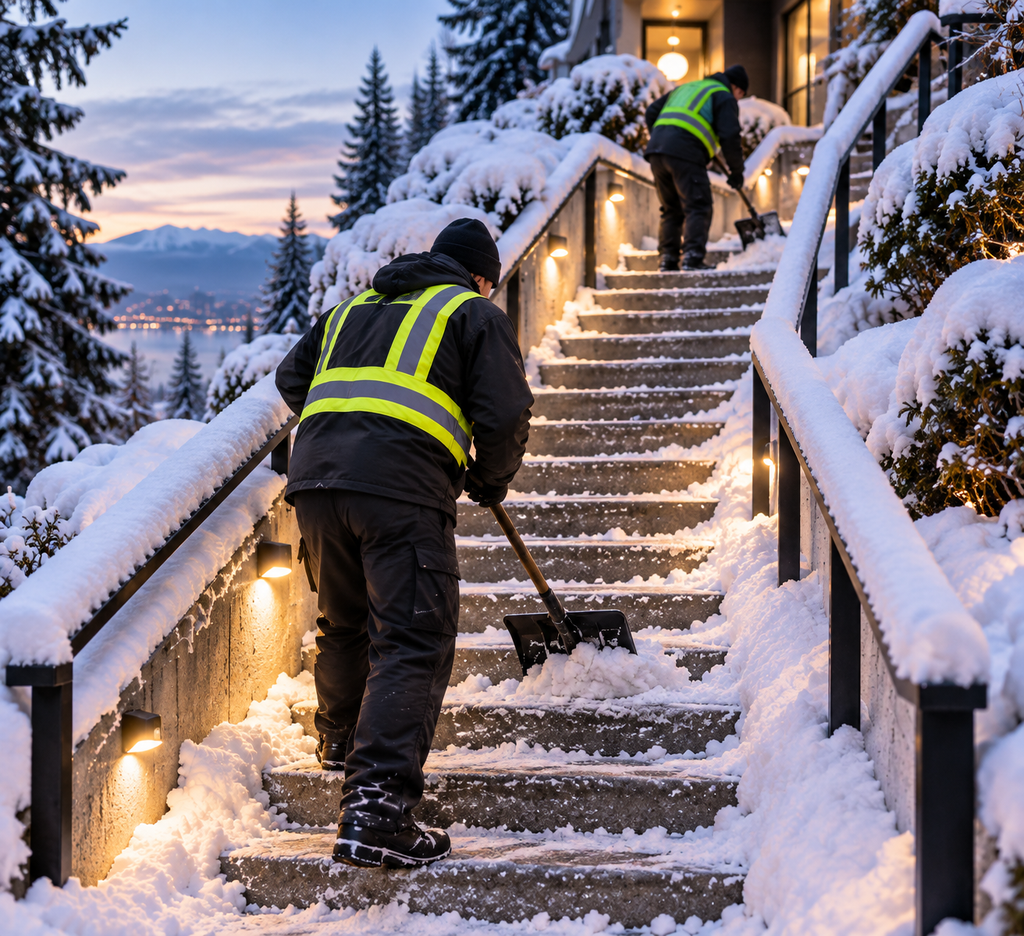
Good winter service depends on sequence, especially where the property changes elevation.
Machines and Hand Crews Work on Different Clocks
A plow or compact machine can clear a driveway quickly. Exterior stairs usually require a different process: shovelling, scraping compacted material, clearing landings, checking handrail access, and applying ice-control material where necessary.
If the contract or route plan does not identify those surfaces in advance, hand work can easily fall behind machine work.
Effective hillside stairs snow clearing should therefore be included in the route sequence rather than added after crews believe the main job is finished.
A practical plan might define vehicle access as the first operational priority while assigning stairs and connector routes immediately afterward.
The important point is that both stages are expected.
Landings Deserve Their Own Check
The staircase itself is not the only concern.
Landings can collect snow pushed from individual steps. They may also receive roof runoff, drifting snow, or meltwater from higher pavement.
Because residents change direction or pause on landings, even a small untreated section can disrupt the entire route.
A useful service check should therefore consider the full pedestrian sequence: approach, stairs, landing, next flight, and destination.
A Safe Driveway Does Not Mean a Safe Arrival
Winter access should be assessed from the resident’s point of view.
Imagine a resident returning home after the slope has been cleared.
The vehicle reaches the parking area without difficulty. The resident steps out, walks toward the building, and encounters a staircase still holding compacted snow.
From an operations perspective, the site is not fully restored.
The same logic applies to visitors, delivery workers, caregivers, contractors, and emergency access between different levels of a shared property.
This is where strata-specific planning becomes valuable.
Only Strata Snow Removal focuses exclusively on strata properties, so service planning can account for the interaction between internal roads, exterior stairs, pedestrian connectors, parkade access, entrances, and shared facilities rather than treating each surface in isolation.
Strict capacity limits also matter. Hand work can be labour-intensive, and a contractor that overbooks routes may be tempted to prioritize fast machine passes while smaller surfaces wait.
A reliable plan has to include enough capacity for both.
Documentation and Follow-Up Planning
Terrain adds another difficulty: conditions do not remain fixed after the first service.
Photos Should Capture More Than the Driveway
GPS records can show when crews attended the property, while photos can document what specific surfaces looked like at that time.
For hillside sites, documentation should not stop with the largest cleared area.
A useful record can include the priority stairs, landings, pedestrian approaches, and other surfaces identified in the site plan.
This helps managers distinguish between an area that was missed and one that changed after service.
A staircase may be clear at 7:00 a.m. and receive new snow from wind, tree branches, roof shedding, or later accumulation.
Time-specific documentation makes that sequence easier to understand.
Refreeze Can Reopen a Completed Route
Stairs also respond quickly to meltwater.
Snow on an upper landing may melt during daylight and move down several treads. The staircase can appear improved in the afternoon while moisture is actually spreading across multiple walking surfaces.
If temperatures later fall, a route that was mechanically cleared may require targeted ice control.
Only Strata’s proactive dispatch and large salt reserves support this type of follow-up response when conditions justify it rather than assuming the initial clearing permanently resolved the site.
The Route Is Only Complete When People Can Finish It
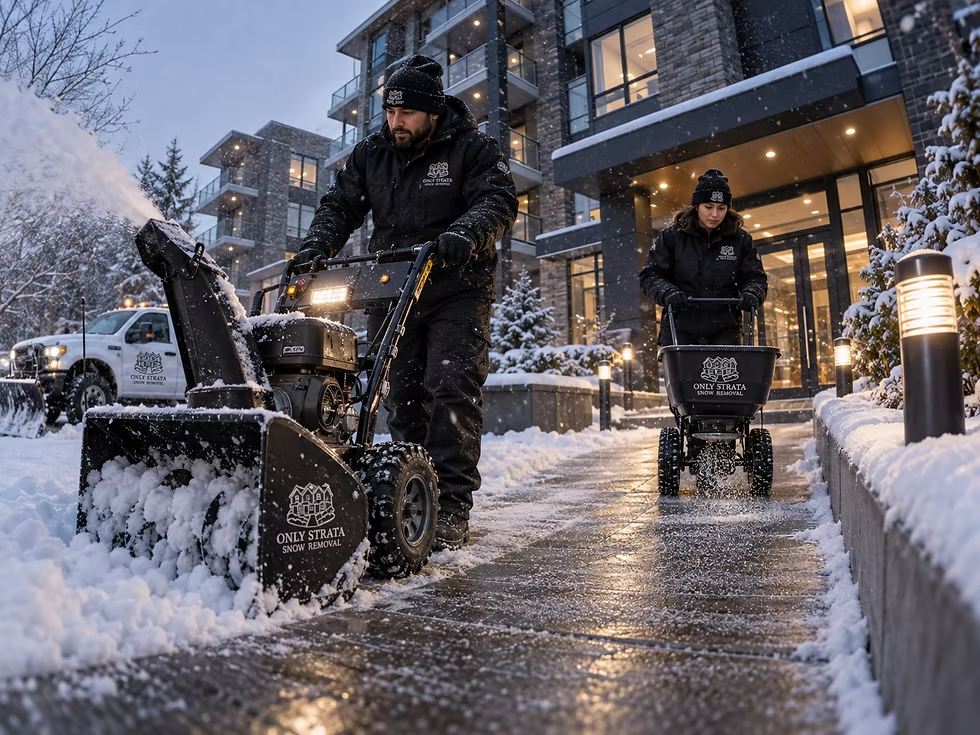
A hillside winter plan should answer a simple question: can someone complete the entire journey through the property?
Not just drive up the slope.
Not just park.
Not just see bare pavement from the street.
The route should connect vehicle access to safe pedestrian movement.
That means identifying exterior stairs before winter, defining which ones are priority routes, understanding where landings collect snow and water, assigning machine and hand work in the right sequence, and documenting both parts of the service.
It also means recognizing that not every staircase carries the same importance.
A rarely used secondary flight may reasonably follow the main entrance stairs. A staircase linking the primary parking area to residential entrances may deserve immediate attention.
The service standard should make those priorities clear before crews arrive.
Only Strata Snow Removal combines this property-level planning with GPS and photo service logs, proactive dispatch, strict capacity limits, substantial material reserves, a damage repair guarantee, cancellation flexibility, and reliable winter response.
Those features support the operating plan, but the core principle remains straightforward.
Hillside stairs snow clearing should never become the forgotten task between plowing and departure.
A property built on changing grades is a connected system of slopes, stairs, landings, and pathways.
Clearing the biggest surface first may be correct.
Treating it as the last surface that matters is not.
Because if the slope is open but residents cannot safely complete the walk home, the winter route is still incomplete.
