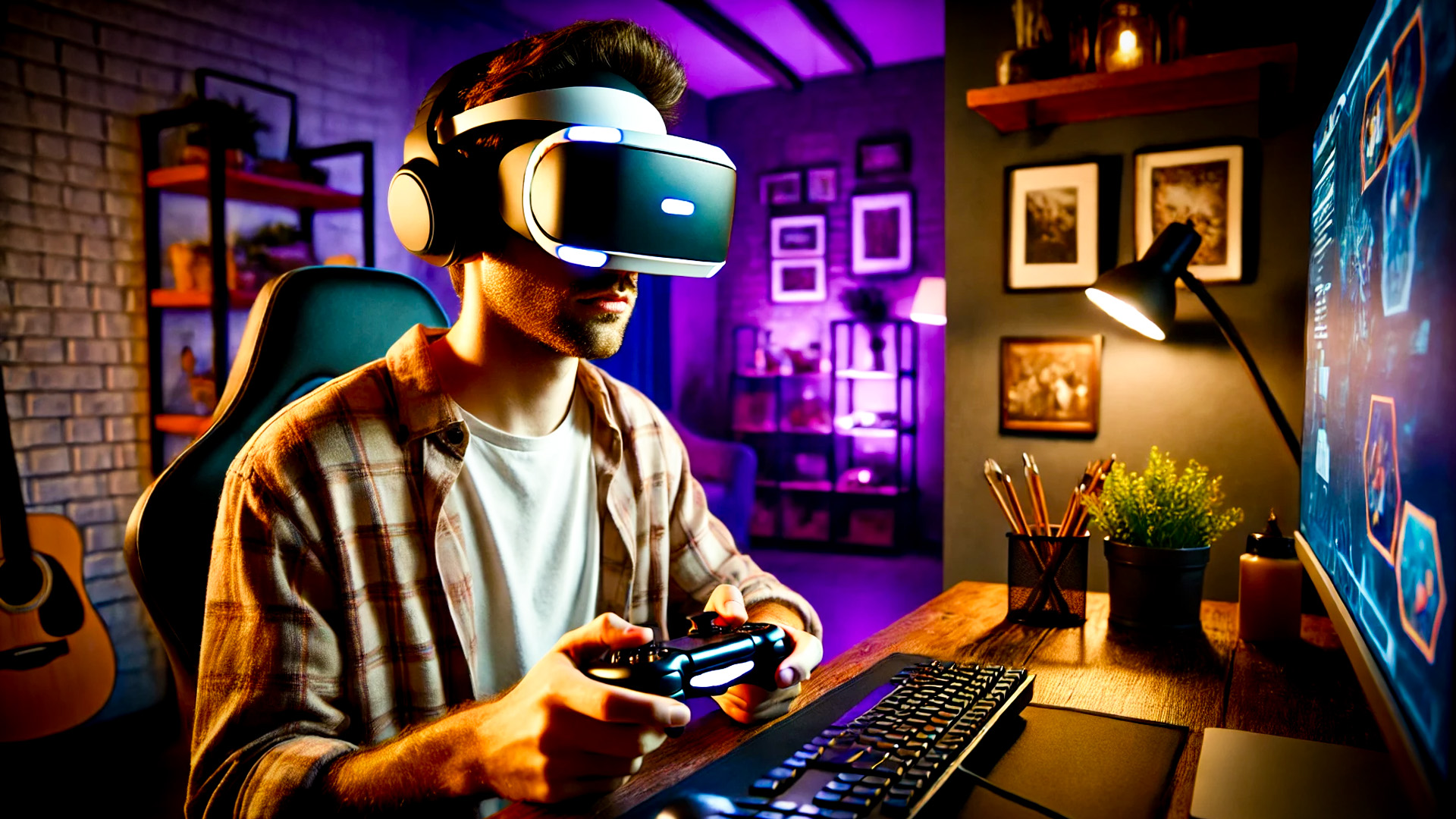
Have you ever wondered how you can travel to Jurassic World from the comfort of your living room? Or are you planning to actively enjoy the upcoming World Cup while in your backyard? Virtual Reality has transformed how users interact with technology. It fully immerses users in three-dimensional environments, replacing their physical surroundings with a digital and interactive world experienced through a headset.
VR is used by entertainment businesses to offer experiences that cannot be achieved in traditional venues. Fans can now attend live music events, like Travis Scott’s Astronomical concert, from anywhere in the world, and enjoy front-row or on-stage experiences using VR. However, it was not always like this.
From Sensorama to Spatial Computing
The idea behind virtual reality began way back in 1962 with Morton Heilig’s Sensorama. This was a mechanical arcade-style booth that used 3D visuals, stereo sound, vibrations, and even atmospheric scents.
In 1968, the Sword of Damocles by Ivan Sutherland took things a step further, with the first true head-mounted display. However, it was so heavy that they had to suspend it from the ceiling.
Now, hardware like wireless diffractive waveguides and MicroLED displays have solved the clunky factor, meaning headsets can be created under a comfortable weight threshold. What was previously an experimental technology eventually has matured into a commercially viable product.
The industry’s hardware sector continues to dominate revenue, having more than half the share. This is influenced by customers’ migration from experimental cardboard viewers to high-fidelity, standalone spatial computers.
The Right Infrastructure
More recently, 5G standalone networks are using network slicing to reserve a dedicated high-speed lane specifically for VR data. This ensures it is not slowed down by other web traffic. Historically, the internet was built for downlink (data moving from a network to a personal device). However, there is a shift to supporting uplink-heavy traffic that is extremely helpful for VR, as it requires constant uploading of sensor and spatial data from the headset to the cloud to keep the 3D environment synced.
The use of metro-edge data centers, rather than central servers has also helped the VR experience. Instead of data traveling to a central server thousands of miles away, it goes to a metro-edge data center in a local city. This reduces the physical distance data travels, cutting the roundtrip time significantly.
Defining the New Digital Experience with VR
What users really want from VR is presence more than immersion. While immersion has objective technical qualities, presence provides a subjective feeling of being ‘there’. Presence has three pillars:
- Spatial presence: the perceptual illusion that digital objects and environments physically exist in the user’s immediate 3D surroundings.
- Self-presence: the user’s perception of ‘embodiment’ in the virtual world.
- Social presence: the psychological sense of being with another intelligent entity.
The use of spatial, audio and haptic feedback helps to create the plausibility illusion (a sense of ‘realness’), making the experience indistinguishable from reality.
This technology has been used across the entertainment industry, with AmazeVR and Wave now hosting VR-first concerts, such as Megan Thee Stallion’s Enter Thee Hottieverse.
Meanwhile, live casino gaming has also been influenced by VR technology. Vegas Infinite and Evolution Gaming’s dedicated VR tables now power game shows for renowned operators. In these games, you do not just click a button when sitting at a live craps table: you can physically reach out to toss the dice. If you play live casino at Casino Days or other sites, you will notice that even non-VR games use elements like interactive chats with the dealer to create a similar feeling of ‘presence’.
When it comes to sports entertainment, F1 drivers also use high-end VR simulators for track acclimation. For instance, the Red Bull team uses VR to simulate specific tire-degradation physics and lighting conditions. This is common for races with a unique transition from sunset to night like the Abu Dhabi GP. Furthermore, Xtadium and Immersiv.io now offer courtside VR experiences for NBA matches.
2026 Performance and the Probable Future
VR reached a global market value of approximately $87 billion in 2026, with over 171 million users worldwide. It is no longer an experiment but a mature industry that is constantly growing. Generative AI, a catalyst to the entire experience, is now creating dynamic and personalized environments on the fly. AI-driven non-player characters use large language models to remember past interactions and adapt their behavior to the user’s mood.
Entertainment hubs, specifically gaming, remains the largest single user case. However, there is a shift in revenue mix as expert applications in healthcare, retail and remote collaboration are growing at a faster rate to prove VR’s utility in professional settings. The industry is aiming to achieve spatial ubiquity by 2030. If they do, we’ll be able to access digital information any time, anywhere, all thanks to VR technology.