

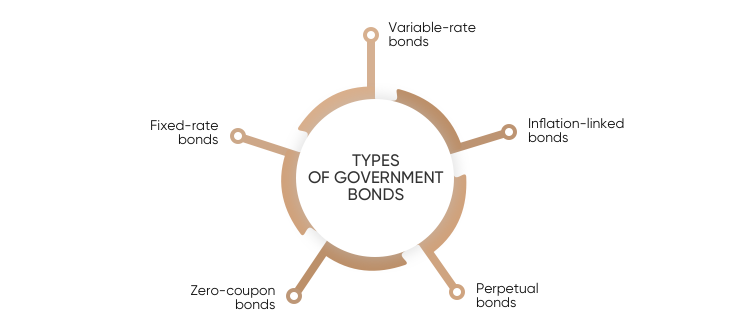
A government bond is essentially a loan you give to the government in exchange for regular interest payments. Governments use these bonds to fund various projects and infrastructure. For investors, government bonds are a way to earn a fixed return over time. In the U.S., these are often referred to as Treasuries. While no investment is entirely risk-free, government bonds from stable economies are considered relatively low-risk.
How Do Government Bonds Work?
When you purchase a government bond, you’re lending the government money for a set period. In return, the government agrees to pay you interest, known as the coupon, at regular intervals. These bonds are classified as fixed-income assets due to the steady interest payments.
Upon the bond’s maturity date, you receive your initial investment back, known as the principal. Bonds come with varying maturity dates, ranging from less than a year to several decades.
Key Bond Terms
- Maturity: The time until the bond expires and makes its final payment.
- Principal: The amount the bond pays at maturity, excluding interest.
- Bond Price: Initially equal to the face value, but can fluctuate in the secondary market.
- Coupon Dates: The scheduled dates for interest payments.
- Coupon Rate: The annual interest payment expressed as a percentage of the principal.
Types of Bonds
Governments and companies can issue bonds, but government bonds are generally seen as higher quality due to the government’s ability to raise taxes to cover debt payments.
U.S. Treasuries
These are considered extremely safe investments. Interest earned is subject to federal tax but usually exempt from state tax. U.S. Treasuries are very liquid, making them easy to buy and sell.
- Treasury Bills (T-Bills): Mature in 1 year or less, sold at a discount, and don’t pay periodic interest.
- Treasury Notes (T-Notes): Mature between 2 and 10 years.
- Treasury Bonds (T-Bonds): Mature in more than 10 years, commonly 30 years.
- Treasury Inflation-Protected Securities (TIPS): Returns adjust with inflation.
- STRIPS: Separate Trading of Registered Interest and Principal of Securities, traded separately from the bond’s face value.
- Floating Rate Notes: Have interest rates that adjust with the market.
Government Agency Bonds
Issued by U.S. government agencies, these bonds are often high-quality and very liquid but can be affected by changes in interest rates. Some are fully backed by the government, making them nearly as safe as Treasuries.
Municipal Bonds
Issued by states and local governments, these bonds are generally safe and often come with tax benefits. Interest is typically exempt from federal income tax and, in some cases, state tax. However, there’s still a risk of default.
Corporate Bonds
These bonds are issued by companies and come with varying levels of risk. Interest from these bonds is subject to both federal and state taxes. They generally offer higher yields than government bonds due to the higher risk involved. High-yield bonds, or junk bonds, fall into this category.
The Bottom Line
Federal government bonds are some of the safest investments, offering what is known as the risk-free rate of return. They include short-term T-Bills, medium-term T-Notes, and long-term T-Bonds. While they offer lower yields due to their lower risk, they remain a reliable investment. State and local governments also issue municipal bonds, which may provide tax benefits.
