

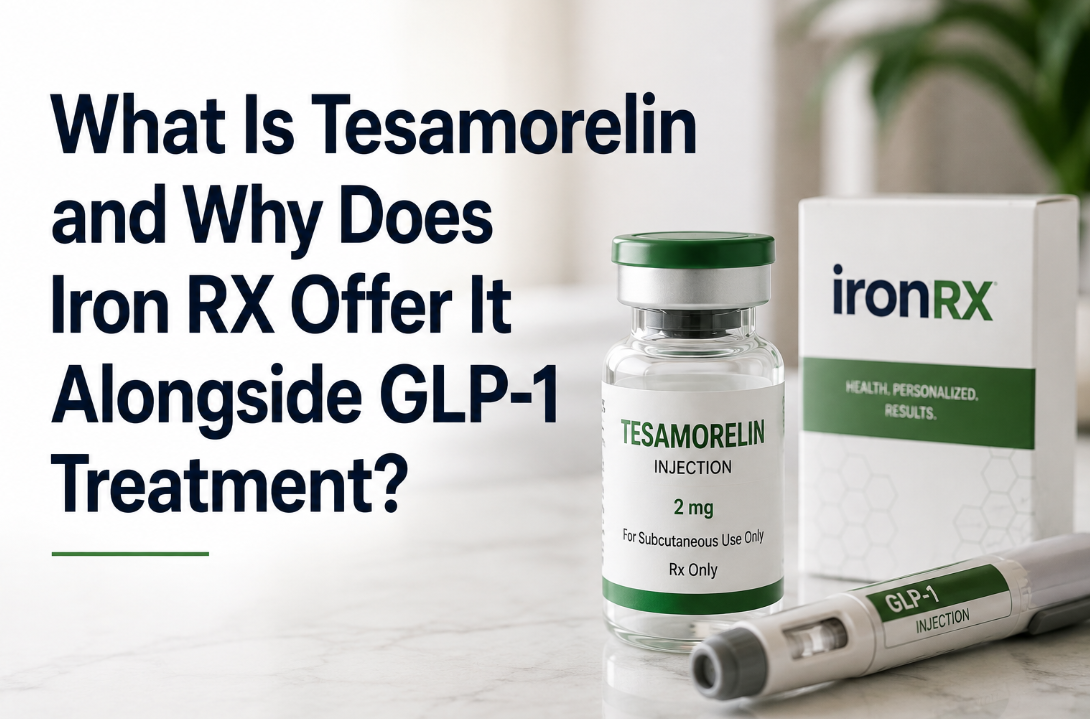
Tesamorelin is a growth-hormone-releasing peptide most recognized for its FDA-approved use in reducing excess abdominal fat associated with lipodystrophy, and it has since drawn interest more broadly in body-composition and wellness programs beyond its original approved use.
How Tesamorelin Works
Unlike GLP-1 medications, which act on appetite and digestion, Tesamorelin works by stimulating the body’s own production of growth hormone. That mechanism is why it’s discussed in a different context than typical weight-loss drugs — it’s less about suppressing hunger and more about influencing how the body manages fat and lean tissue over time.
Iron RX offers Tesamorelin as part of a broader treatment lineup that sits alongside its GLP-1 weight-loss programs, giving patients a peptide-based option that works through a different mechanism than appetite-regulating GLP-1 drugs.
GLP-1 and Tesamorelin: Different Tools for Different Goals
Where GLP-1 medications primarily reduce appetite and slow gastric emptying, Tesamorelin works on the growth-hormone axis, which is why it’s often discussed in the context of body composition rather than pure weight loss. The two approaches address different goals, and some patients may end up asking a provider about one, the other, or both depending on their history and what they’re trying to achieve.
This is also why a platform offering more than a single medication category can be useful — it allows a provider to have a broader conversation about goals rather than fitting every patient into one treatment path.
What the Research Says So Far
Tesamorelin’s FDA approval is specifically for reducing visceral adipose tissue in HIV-associated lipodystrophy, and that’s the indication with the most robust clinical trial data behind it. Interest in broader body-composition and anti-aging applications has grown alongside general enthusiasm for peptide therapies, but it’s worth being clear-eyed about the difference between an approved indication with trial data and an off-label use supported by smaller studies or clinical experience.
That distinction doesn’t mean off-label use is inappropriate — providers prescribe off-label for good clinical reasons across many areas of medicine — but it does mean patients should ask specifically what evidence supports the use case being discussed for their situation, rather than assuming a peptide’s popularity is the same thing as a well-established treatment protocol.
Who Should Talk to a Provider About It
As with any peptide or hormone-adjacent therapy, candidacy depends on a full medical history review. Growth-hormone-related therapies carry their own set of contraindications and monitoring needs, separate from those associated with GLP-1 drugs, which is why self-directed use outside a licensed medical relationship isn’t advisable.
Iron RX’s telehealth intake process is designed to route these conversations to a licensed provider before any prescription is written, rather than treating peptide therapy as a one-size-fits-all product.
Anyone researching Tesamorelin should treat it the way they would any prescription therapy: read the clinical literature, ask a provider about contraindications and monitoring, and avoid sourcing it outside a licensed medical relationship. Peptides bought without a prescription or clinical oversight carry real safety risks that a proper evaluation is designed to catch.
Frequently Asked Questions
Is Tesamorelin the same as HGH?
No. Tesamorelin stimulates the body’s own growth hormone release rather than introducing synthetic growth hormone directly, which is a meaningfully different mechanism with a different regulatory and safety profile.
Can Tesamorelin be combined with GLP-1 therapy?
This is a question for a licensed provider to evaluate case by case, since combining therapies depends on individual health history and treatment goals rather than a one-size-fits-all answer.
What monitoring does Tesamorelin typically require?
Programs generally include periodic follow-up visits to assess response and watch for side effects, similar in structure to the follow-up cadence used for GLP-1 therapy.
How long before Tesamorelin shows noticeable effects?
Timelines vary by individual, but growth-hormone-related therapies generally require a sustained course of treatment before changes become noticeable, which is why realistic timeframe expectations are worth discussing with a provider upfront.
The Bottom Line
Tesamorelin isn’t a replacement for GLP-1 therapy — it’s a different tool aimed at a different mechanism, and the right fit depends on individual goals and history. Iron RX offering it alongside its GLP-1 programs gives patients a broader set of options to discuss with a provider, but as with any peptide therapy, the value comes from a proper clinical evaluation, not from the medication category alone.
