

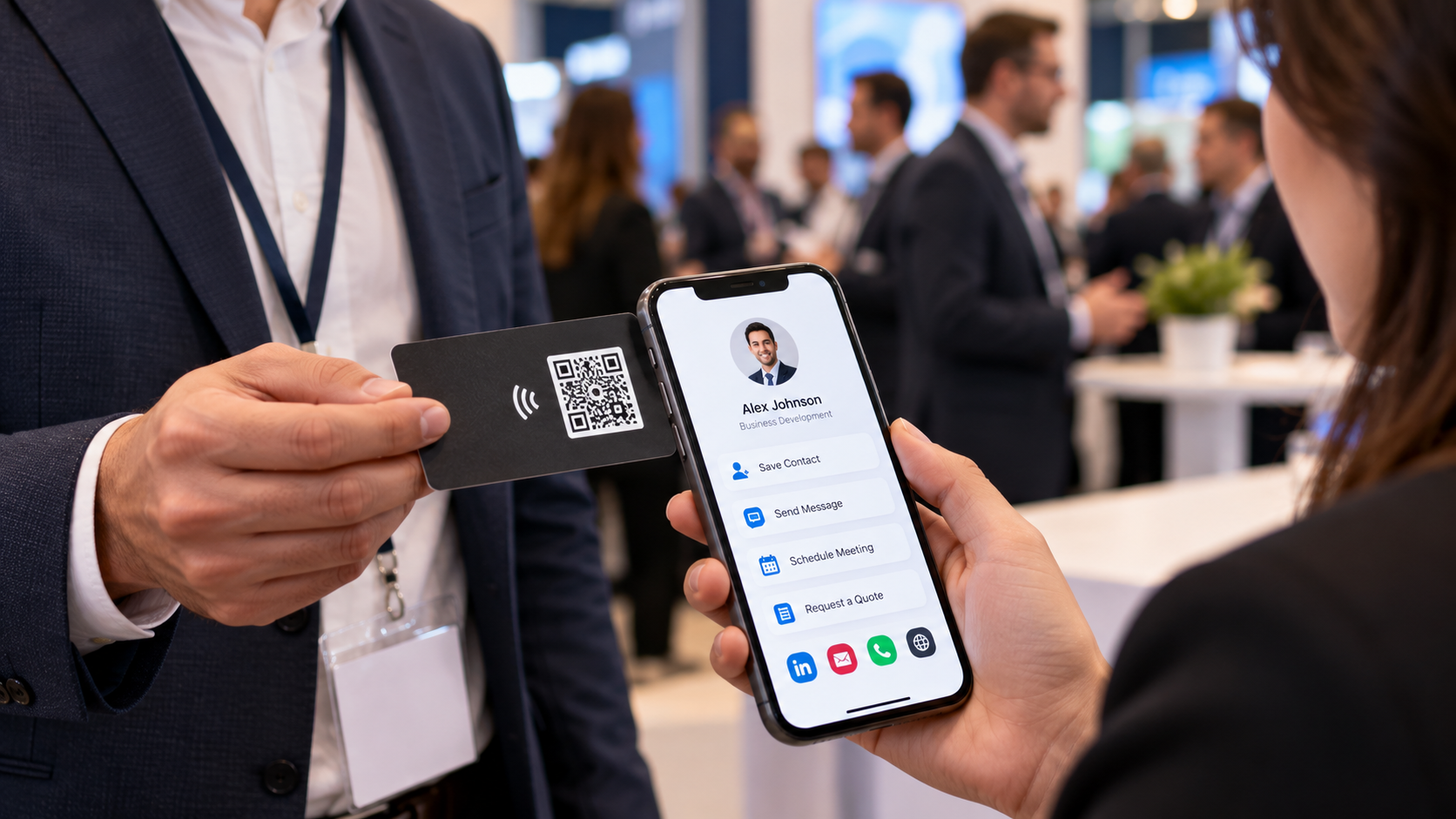
Tap a card. Scan a code. Contact saved. In the world of digital business cards, that sequence is treated as the finish line. It isn’t. It’s the starting line, and almost everything interesting in professional networking happens after it.
Consider what a conventional business card actually answers: who is this person? Useful, but thin. A more capable networking platform could help answer far better questions: What happened after we connected? Have I followed up? Is this contact commercially relevant? What action should happen next? Which contacts need attention, and which networking activity is actually producing engagement?
This is the shift now underway in business networking technology — from the exchange to the relationship.
The evidence for poor follow-up is longstanding. A Harvard Business Review study of online sales leads found that nearly a quarter of companies never responded to a web-generated lead at all, and that firms responding within an hour were roughly seven times more likely to qualify the prospect than those that waited. The data is from 2011 and concerns web leads rather than networking contacts, but the underlying behaviour it describes — attention captured, then squandered through slow or absent follow-up — will be familiar to anyone who has returned from a conference with a pocket full of cards and done nothing with them.
Networking has the same failure mode, minus the measurement. Nobody tracks how many exchanged contacts turn into conversations, because until recently there was no software in the loop to track it with.

That is changing as artificial intelligence moves into sales and relationship workflows. Industry analysis of AI in sales processes suggests around three-quarters of companies now use AI in some form to improve selling, with adopters reporting substantially higher lead generation and conversion. Sellers using generative AI tools report meaningful time savings on lead research and higher response rates, with lead scoring and personalised outreach among the most common applications.
The direction of travel is clear: the same intelligence being applied to pipelines and CRMs is coming for the top of the funnel — the moment of first contact. NFC and QR codes handle the exchange; digital profiles provide the presence; CRM-style tooling supplies the memory; analytics closes the feedback loop; and AI increasingly handles the prioritisation — which contacts matter, what to do next, and when.
The sector is already moving this way. Blinq’s US$25 million Series A in 2025, with HubSpot Ventures participating, signals where investor attention sits: at the intersection of networking and the CRM ecosystem. Mobilo has been building AI-assisted follow-ups and lead scoring into its team-focused offering. Even design platforms are circling the space, with wallet integrations and AI-assisted card creation appearing in mainstream tools.
Among the smaller companies working this thesis is Let’s Connect Card, founded in Wolverhampton in 2024 by Arun Babu Veeranki, the company’s Founder and CEO. Veeranki comes from a digital-growth background — more than a decade in SEO and organic growth, including leading search at a UK e-commerce retailer — and his premise is representative of the broader shift: a tap or scan opens an interactive digital profile in the browser with no app required, and the platform around it adds lead capture, enquiry forms, appointment booking, quote requests, multi-profile support and engagement analytics — the unglamorous infrastructure of follow-up. According to the company, it now serves 400+ paid customers with 700+ units supplied.
The company’s AI-assisted business card scanner illustrates the pragmatic end of the trend: rather than asking the world to abandon paper cards overnight, digitise the cards people still hand you and bring those contacts into the same workflow. It is a small feature, but it points at the right problem — the gap between the physical ritual of networking and the digital system where relationships actually live.
Veeranki’s framing of the opportunity reflects a wider industry intuition: that networking technology spent its first decade answering “who is this person?” and will spend its next answering “what should happen next?”
Step back, and the convergence is hard to miss. NFC and QR made the exchange contactless. Digital profiles made presence portable. CRM integration gave networking a memory. Analytics made it measurable. AI is beginning to make it intelligent — sorting the signal from the noise in the growing pile of people every professional meets.
None of this removes the human part of networking. Trust is still built face to face, and no software schedules a genuine relationship. But the administrative half of networking — capturing, remembering, following up, prioritising — is increasingly software’s job. The companies that understand the first tap is the beginning of the process, not the end of it, are building for where the market is going.
The business card spent a century as a static object. Its future is as the front door to an ongoing digital relationship — and the interesting competition is no longer over the door, but over everything on the other side of it.
