

Flight delays and cancellations are common, but the process of claiming compensation still feels surprisingly old-fashioned. Passengers often need to understand legal rules, check route eligibility, collect documents, contact airlines, wait for responses and sometimes challenge generic refusals. For most travellers, that is not a convenient process. It is paperwork disguised as customer service.
This is where legal tech is becoming more interesting. Instead of treating passenger rights as a purely legal problem, new digital tools are approaching them as a product experience. ClaimWinger is one of the young, agile legal tech companies working in this space. Its focus is simple: help passengers check whether they may have a valid flight compensation claim and guide them through the first steps with less friction.
From Legal Complexity to a Usable Interface
Flight compensation rules under EU261 and UK261 can be valuable for passengers, but they are not always easy to understand. Eligibility may depend on the route, operating carrier, length of delay, reason for the disruption and applicable jurisdiction. A passenger flying from Warsaw to London may face a different practical assessment than someone flying from New York to Warsaw, even if the airline brand is the same.
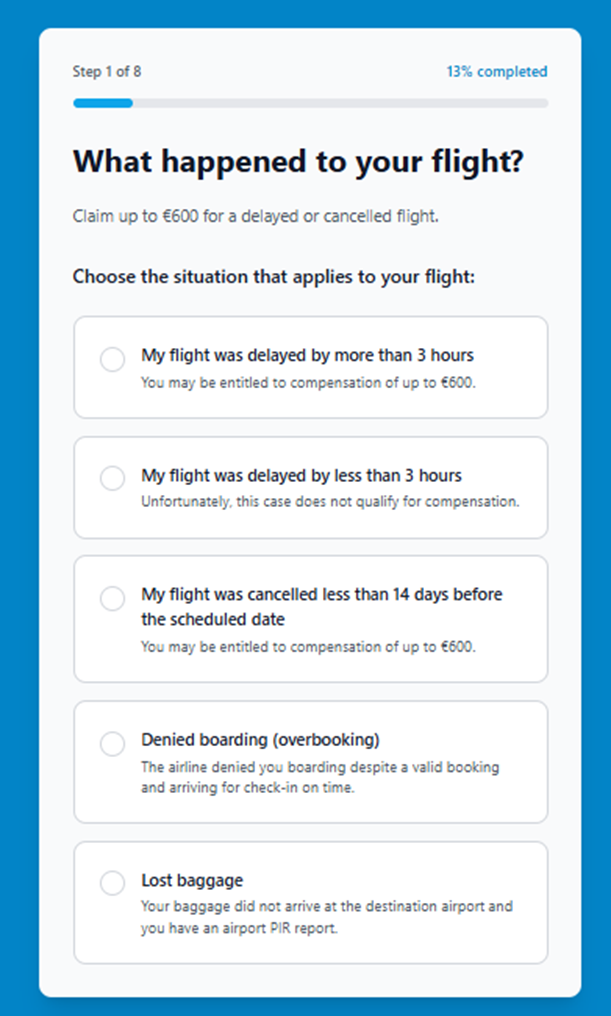
ClaimWinger’s value proposition is not just that it explains the rules. The more interesting technology angle is that it turns those rules into a structured digital workflow. Instead of asking users to read legal guidance from start to finish, the platform collects the key details step by step: departure airport, arrival airport, airline, disruption type, delay length and supporting documents.
That kind of guided intake matters. In legal tech, the first user experience is often the difference between action and abandonment. If the process feels too technical, most consumers simply give up. ClaimWinger reduces that barrier by making the first assessment feel closer to using a travel app than submitting a formal legal complaint.
The Calculator as the Front Door
A practical starting point is the flight compensation calculator. The tool lets users enter route details and disruption information to estimate the possible compensation band. For passengers, this provides a quick sense of whether a case may be worth pursuing before they spend time gathering documents or writing to an airline.
From a technology perspective, the calculator is useful because it converts a legal framework into a decision-support interface. It does not replace legal review, and it should not be treated as a final decision. But it helps users move from uncertainty to an initial, structured assessment. That is exactly where many consumer legal tech products create value: not by replacing professionals entirely, but by organizing messy information into a cleaner path.
Mobile-First Flight Claims
ClaimWinger also reflects a broader shift toward mobile-first legal services. Its mobile app is available on Google Play, which is important because flight disruption is often a mobile moment. A passenger may be standing in an airport, checking messages from the airline, searching for alternative transport or trying to understand whether a delay qualifies for compensation.
In that context, a desktop-only process feels outdated. A mobile app allows users to begin the claim check when the disruption is still fresh. They can enter flight details, review the basic eligibility path and keep the case information in one place. This is not only a convenience feature; it is part of a larger product trend. Legal services are becoming more immediate, more guided and more integrated into everyday digital behaviour.
Why Poland Routes Are a Strong Use Case
ClaimWinger is particularly interesting for passengers travelling to, from or through Poland. Poland is a major route market for UK-based families, business travellers, tourists and long-haul passengers using Warsaw as a hub. At the same time, disruption claims involving Polish routes can raise practical questions about EU261, UK261, the operating carrier and local limitation periods.
For that reason, ClaimWinger has created a dedicated guide to Polish airlines delay compensation for UK and US passengers. This is a useful content angle because it connects legal automation with a real travel pattern. Rather than presenting passenger rights in abstract terms, the guide focuses on routes and scenarios that international passengers actually recognize: LOT Polish Airlines, Wizz Air, Ryanair, UK-Poland flights and long-haul connections involving Warsaw.
This localized approach is important. Many legal tech tools fail when they remain too generic. ClaimWinger’s advantage is that it can combine digital intake with route-specific explanation. That makes the product more relevant for people who are not legal experts but need a fast answer to a practical question: “Can I claim for this specific flight?”
A Young Legal Tech Player With a Clear Niche
ClaimWinger does not need to look like a traditional law firm to be useful. In fact, its appeal comes from being leaner and more product-oriented. The company is positioned around a focused problem: delayed, cancelled or overbooked flights. That narrow scope allows it to build a clearer workflow, simpler messaging and a more understandable user journey.
For a young legal tech company, this focus is a strength. Broad “solve every legal problem” platforms often struggle with complexity. A specialized tool can move faster, test user flows more efficiently and refine the claim journey around repeated patterns. Flight compensation is a good category for this because many cases follow a structured data model: route, airline, disruption, timing, documents and airline response.
What Tech Readers Should Watch
ClaimWinger is worth watching not only as a passenger rights service, but as an example of how consumer legal processes are being redesigned. The underlying opportunity is not just legal knowledge. It is workflow automation, better user interfaces, structured data collection and mobile access.
The best legal tech products do not simply digitize paperwork. They change how users experience a process. In ClaimWinger’s case, the traditional route might involve reading regulations, contacting an airline manually and waiting without knowing whether the claim is even strong. The digital route starts with a guided check, a calculator, an app-based experience and a clearer next step.
For passengers, that means less confusion. For the legal tech market, it shows how specialized tools can make regulated consumer rights easier to use. ClaimWinger is still a young player, but it sits at an interesting intersection of travel, automation, legal services and mobile product design.
As travel volumes continue to grow and passengers become more comfortable using apps for complex tasks, tools like ClaimWinger may become part of the standard post-flight toolkit. Not every delayed flight will qualify for compensation, and no calculator can guarantee a payout. But a fast, structured way to check eligibility is already a major improvement over guessing, waiting or abandoning a valid claim entirely.
