

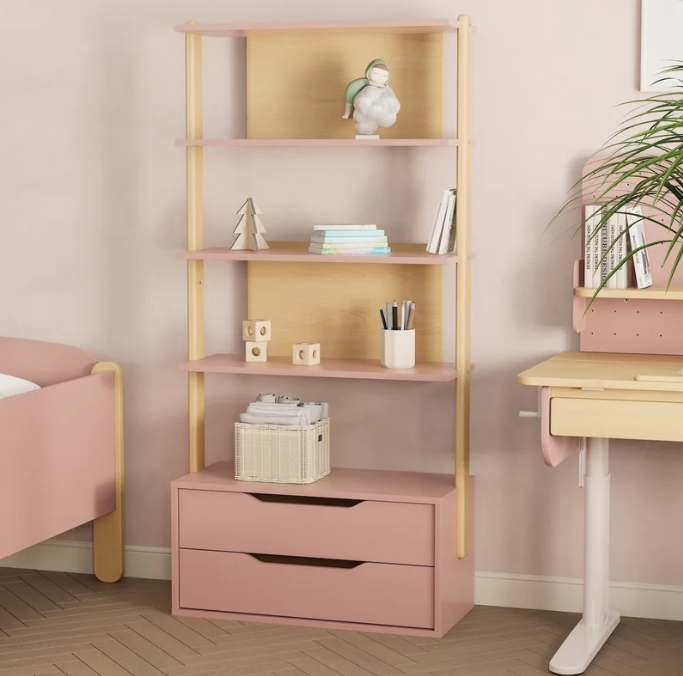
Children’s bookshelf storage refers to furniture that combines a dedicated book display with integrated compartments for toys, craft supplies, and everyday items, creating a single organised unit that children can navigate and tidy independently. For parents managing a child’s bedroom where books, toys, and assorted materials compete for limited space, a combined unit is one of the most practical solutions available. It reduces the number of separate furniture pieces in the room, simplifies the organisation system for the child, and keeps the space functional across multiple years of childhood.
Key Takeaways
- Children’s bookshelf storage works best when books and other items are clearly separated within the unit so children can find and return things without confusion.
- Open bins and baskets on lower sections are more effective for young children than drawers or lidded containers, because the contents are visible at a glance.
- Build quality is more important on a combined unit than a simple shelf, because it carries more weight and handles far more daily use.
- A well-set-up storage bookshelf can replace a toy box, a set of baskets, and a separate bookshelf in a single footprint.
- Consistent category assignments and regular rotation of displayed books are the two habits that keep the system working long term.
Why Combined Bookshelf Storage Makes Sense for Children’s Rooms
The default approach to furnishing a child’s bedroom tends to be additive. A bookshelf appears first, then a toy box, then a set of baskets for overflow, then a small chest for art supplies. Each piece was purchased to solve a specific problem, but the accumulated result is a room where nothing has a clear home and tidying requires adult direction every time.
Children’s bookshelf storage approaches the room differently. Books and everyday items exist in the same space and are used by the same child, so organising them together in one coherent unit makes more sense than separating them into pieces of furniture that compete for floor space and complicate the tidying logic. When everything has an obvious designated place within one unit, children can maintain the organisation themselves rather than relying on adults to direct where things go.
Types of Children’s Bookshelf Storage
| Type | Best For | Age Range | Key Advantage |
| Bookshelf with open cubby bins | Toys and loose items | 1 to 6 years | Contents visible, easy to self-sort |
| Bookshelf with drawers | Craft supplies and smaller items | 4 years and up | Keeps smaller items fully contained |
| Bookshelf with baskets | Mixed everyday storage | 2 years and up | Flexible and easy to reconfigure |
| Bookshelf with bench seat | Reading nooks, small rooms | 3 years and up | Adds seating without extra furniture |
| Tall bookcase with lower storage | Larger collections plus toys | 5 years and up | High capacity across both functions |
What to Look for in Children’s Bookshelf Storage
Structural Strength
A bookshelf that carries both books and a rotating selection of toys and supplies handles significantly more weight than a simple shelf. Thick panels, solid timber or quality MDF construction, reinforced joins at stress points, and a solid back panel are all structural requirements rather than optional quality markers. Check the weight rating per shelf before purchasing, particularly if you plan to store heavier hardcover books or activity materials.
Layout and Accessibility
The layout needs to work for the child using it on an ordinary day. Ask these questions before committing to a unit:
- Are the book display sections front-facing or spine-out? For children under five, front-facing is significantly more effective at encouraging independent book selection.
- Are the storage compartments at a height the child can reach without climbing? Bins above shoulder height will not be used for tidying.
- Are the storage compartments large enough for the items that actually need to go in them? Measure the most-used toys before buying a unit with fixed cubby dimensions.
- Is there clear visual separation between the book section and the storage section?
Safety
Combined storage units are typically larger and heavier than a simple bookshelf, making safety considerations more important. Check for anti-tip wall anchoring brackets, rounded edges on all panels and corners, non-toxic finishes certified to Australian standards, drawer pull-stop mechanisms so drawers cannot be pulled fully out by young children, and no exposed hardware on surfaces children regularly touch.
Adaptability
A quality piece of children’s bookshelf storage should handle the transition from toddler books and wooden blocks to chapter books and art supplies without needing replacement. Adjustable shelf heights, removable compartment dividers, and storage bins that can be swapped independently extend the useful life of the unit well beyond the initial purchase stage.
How to Set Up Children’s Bookshelf Storage
- Assign one bin or compartment to one category of item and keep that assignment fixed. Blocks always in the same bin, craft supplies always in the same drawer. Consistent categories are ones children can maintain independently.
- Put the most-used items at the most accessible level. Whatever the child reaches for daily should sit at or below eye level without any searching.
- Label every storage section. For pre-readers, a photo label on each bin is more effective than a word label. A photograph of the blocks on the block bin removes all ambiguity.
- Fill each compartment to about two-thirds capacity. A bin packed to the top is harder to sort through and harder to tidy. Room to see what is inside is what makes independent tidying realistic.
- Rotate toys out of the storage section every couple of months. Swapping half the toys into out-of-sight storage and back again periodically keeps the system manageable and makes returning toys feel new again.
Frequently Asked Questions
Can children’s bookshelf storage replace a toy box?
In most cases yes. Open cubby bins and baskets built into a bookshelf unit can store a comparable volume of toys to a standard toy box while keeping individual items visible rather than buried. The key advantage over a toy box is that children can see what they have at a glance and retrieve specific items without emptying the entire container.
What height works best for children’s bookshelf storage?
For children under five, a maximum overall height of around 90cm with all storage compartments at or below shoulder height. For older children, units up to 120cm are appropriate. The guiding principle is that the child should reach both books and storage independently without stretching or climbing.
How do I maintain the organisation long term?
Consistency matters more than any specific system. Once categories are assigned, keep them fixed week to week and month to month. Children respond to predictable systems, and a storage arrangement that never changes is one they are far more likely to maintain themselves. Avoid reorganising the unit completely, as this resets the child’s understanding of where things belong and triggers a period of disorder while the new system is learned.
How much storage is enough?
Three to four open compartments for a toddler’s room and five to six for a school-age child with more varied materials is a practical starting point. The goal is not to store everything the child owns in one unit but to store the items accessed daily in a visible and logical way.
Final Thoughts
Children’s bookshelf storage earns its place in a child’s bedroom by solving more than one problem at once. It keeps books visible and accessible, organises daily-use items in a system the child can maintain independently, and reduces the overall furniture footprint of the room. For Australian families investing in children’s furniture that works across multiple years of childhood, a purpose-built children’s bookshelf storage unit from a specialist children’s furniture brand will consistently outperform a collection of separate pieces assembled one at a time.
