

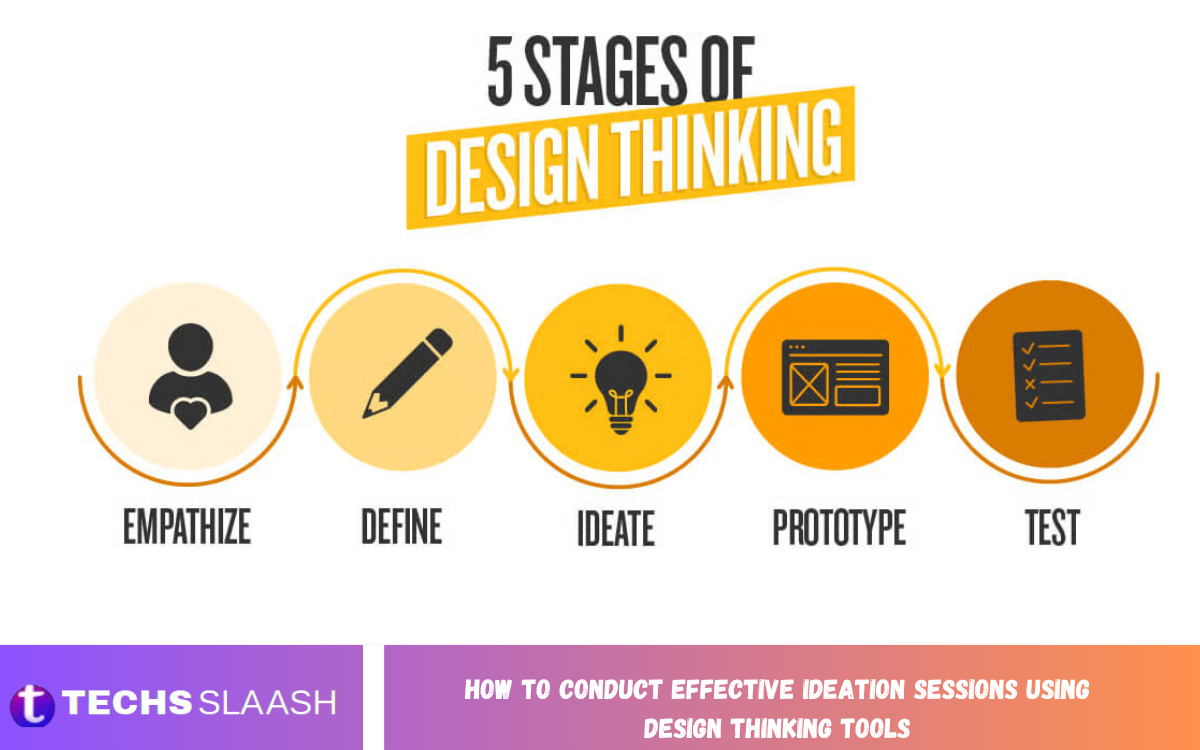
Effective ideation sessions help teams transform user needs, challenges, and observations into practical and innovative solutions. How to Conduct Effective Ideation Sessions Using Design Thinking Tools begins with creating the right environment, understanding the problem clearly, and encouraging participants to explore many possibilities before judging individual ideas.
Design thinking tools make ideation more organized, collaborative, and user-focused. Techniques such as brainstorming, mind mapping, SCAMPER, “How Might We” questions, sketching, storyboarding, and rapid prototyping allow teams to move beyond obvious answers and discover solutions that can create meaningful value for users and organizations.
Prepare the Right Ideation Environment
A successful session requires an environment where participants feel comfortable sharing unusual or incomplete ideas. Choose a space that supports movement, visual thinking, and collaboration. Whiteboards, sticky notes, markers, sketches, and digital collaboration tools can make ideas easier to capture and organize.
Psychological safety is equally important. Participants should understand that criticism is postponed during the initial idea-generation stage. When people know that every contribution will be heard respectfully, they are more likely to suggest creative possibilities instead of limiting themselves to safe and familiar solutions.
Start With User-Centered Insights
Design thinking places users at the center of the problem-solving process, so ideation should begin with meaningful user insights. Review research findings, interviews, observations, feedback, journey maps, or customer pain points before asking the team to generate solutions.
This preparation helps participants understand the real problem rather than relying on assumptions. A useful approach is to summarize the most important user frustrations, motivations, and needs and then turn them into clear opportunity areas. Strong insights provide a foundation for more relevant and practical ideas.
Use How Might We Questions
“How Might We” questions are one of the most useful design thinking tools for opening an ideation session. They turn problems into opportunities without immediately suggesting a specific solution. For example, “How might we make online checkout easier for first-time customers?” creates space for many different possibilities.
The wording of the question matters because overly broad questions can become confusing, while overly narrow questions can restrict creativity. A good question focuses on a genuine user need and leaves enough room for participants to explore products, services, processes, communication methods, and experiences.
Apply Brainstorming Effectively
Traditional brainstorming becomes more productive when it follows clear rules. Encourage participants to focus on quantity first, build on other people’s ideas, avoid judgment during idea generation, and express thoughts quickly. A short time limit can create energy and prevent overthinking.
Silent brainstorming can also improve participation. Some people naturally speak more than others, while quieter participants may have valuable ideas that remain unheard. Giving everyone time to write ideas independently before sharing them can create a more balanced session and increase the diversity of concepts.
Explore Mind Mapping
Mind mapping helps teams expand an idea by connecting related thoughts, problems, opportunities, and possibilities. Start with the central challenge in the middle of a board and create branches for different themes. Each branch can then develop into additional concepts or potential solutions.
This technique is particularly useful when a problem has multiple dimensions. Participants can visually identify relationships that may not be obvious during ordinary discussion. Mind maps also make it easier to combine ideas from different areas and discover new directions for further exploration.
Use SCAMPER for Fresh Ideas
SCAMPER provides a structured way to challenge existing products, services, and processes. The method encourages participants to Substitute, Combine, Adapt, Modify, Put to another use, Eliminate, and Reverse different elements of an existing solution.
Using SCAMPER prevents teams from becoming dependent on completely new concepts. Instead, participants can examine what already exists and ask how it could be changed or improved. Small modifications can sometimes produce highly valuable solutions, especially when the original experience already meets many user expectations.
Encourage Sketching and Visual Thinking
Not every idea needs to be explained through long conversations. Sketching allows participants to communicate concepts quickly, even when the idea is still incomplete. Simple drawings can show a product layout, customer journey, service interaction, application screen, or physical experience.
Visual thinking also encourages participants to improve ideas collaboratively. One person can sketch an initial concept while another adds an element, changes the process, or proposes a different interaction. The result can become more useful than an idea developed by one person working alone.
Introduce Rapid Ideation Exercises
Rapid ideation exercises encourage teams to produce ideas within a limited period. Setting a timer for five or ten minutes can reduce hesitation and help participants focus on generating possibilities rather than trying to perfect their first thought.
Exercises can include rapid sketching, brainwriting, forced connections, worst-possible-idea activities, or idea remixing. The purpose is to create momentum and challenge habitual thinking. After the exercise, the team can review the results and identify concepts that deserve deeper investigation.
Build on Ideas Instead of Judging Them
One of the most important principles of effective ideation is learning to build on ideas. A participant may present a basic concept that another person can improve, combine with another suggestion, or adapt for a different user group. This creates collective creativity.
Immediate criticism can stop this process. During the generation stage, the team should capture ideas without deciding whether they are good or bad. Evaluation should happen later, when participants have enough options to compare. Separating creation from judgment allows creativity to develop more freely.
Prioritize the Most Valuable Concepts
Generating many ideas is useful, but teams eventually need to identify which concepts deserve attention. Establish evaluation criteria before selecting ideas. Common factors include user value, business value, technical feasibility, cost, time, scalability, and alignment with strategic objectives.
Dot voting, impact-effort matrices, and weighted scoring can make prioritization more transparent. Teams should avoid selecting ideas simply because they are popular. A concept that receives fewer votes may have significant potential when evaluated against user needs and long-term opportunities.
Read Also: How to Save Big with Wholesale Corrugated Boxes
Create Rapid Prototypes
Once promising concepts have been selected, convert them into simple prototypes. A prototype does not need to be polished or expensive. It can be a paper sketch, clickable screen, role-play, storyboard, physical model, or basic service simulation.
The purpose of prototyping is to learn quickly. Instead of debating whether an idea will work, teams can place it in front of users and observe their reactions. Feedback from early testing can reveal weaknesses, unexpected opportunities, and improvements before significant resources are invested.
Facilitate the Session Professionally
A skilled facilitator keeps the session focused while allowing participants enough freedom to explore. The facilitator should explain the objective, introduce each exercise, manage time, encourage balanced participation, and record important ideas. They should also recognize when the group needs a change of activity.
The facilitator should remain neutral when evaluating ideas. Their role is not to promote personal preferences but to help the team follow the design thinking process. Clear instructions, visible time limits, organized documentation, and respectful communication can significantly improve the quality of the session.
Avoid Common Ideation Mistakes
One common mistake is starting with solutions before understanding the problem. Another is allowing senior participants to dominate the discussion. Teams can also lose valuable ideas when they spend too much time criticizing concepts before generating enough alternatives.
Poor preparation can create similar problems. If participants do not understand the user, challenge, objective, or expected outcome, the session may become a collection of unrelated suggestions. Strong facilitation and a well-defined challenge help prevent these issues and keep the conversation productive.
Measure the Success of an Ideation Session
A successful ideation session should produce more than a large number of ideas. Teams should consider whether the ideas address genuine user needs, whether participants contributed meaningfully, and whether promising concepts can move into testing or development.
Reviewing the session afterward can also improve future workshops. Ask what activities produced the strongest ideas, where participants became confused, and which evaluation methods worked best. Continuous improvement helps organizations develop an increasingly effective approach to collaborative problem-solving.
Turn Ideas Into Action
Ideation has little value if promising concepts remain on sticky notes or in digital documents. At the end of the session, assign clear next steps for the strongest ideas. These steps may include additional research, prototype development, user testing, technical assessment, or business analysis.
Each selected concept should have an owner and an expected timeline. A simple action plan creates accountability and keeps momentum after the workshop. The transition from ideas to experiments is where design thinking becomes a practical approach to innovation rather than simply a creative exercise.
Frequently Asked Questions
What is an ideation session?
An ideation session is a structured activity where individuals or teams generate multiple possible solutions to a defined problem. It encourages creative thinking before ideas are evaluated, helping participants explore different perspectives and opportunities.
Why are design thinking tools useful for ideation?
Design thinking tools provide structure while keeping the process focused on people and their needs. They help teams understand problems, generate diverse concepts, organize ideas, and select solutions that can be tested and improved.
What is the best tool for an ideation session?
There is no single best tool for every situation. Brainstorming, “How Might We” questions, mind mapping, SCAMPER, sketching, and rapid prototyping can all be effective depending on the problem, participants, and desired outcome.
How long should an ideation session last?
An ideation session can last anywhere from thirty minutes to several hours. The ideal duration depends on the complexity of the challenge and the number of participants. Short, focused activities often produce better results than unnecessarily long discussions.
How many people should participate in an ideation session?
A small group of around five to ten participants is often manageable and productive. Larger groups can provide greater diversity but may require stronger facilitation, smaller breakout teams, or structured activities to ensure everyone participates.
How do you encourage people to share creative ideas?
Create a judgment-free environment and clearly explain that ideas will not be evaluated during the initial generation stage. Silent brainstorming, anonymous submissions, and rapid exercises can also help participants who are less comfortable speaking in groups.
Should bad ideas be included during ideation?
Yes. Unusual or impractical ideas can sometimes lead to useful concepts when they are modified or combined with other suggestions. Teams should separate idea generation from evaluation so participants have enough freedom to explore possibilities.
How do you prioritize ideas after brainstorming?
Ideas can be prioritized using criteria such as user value, feasibility, cost, impact, time, and strategic relevance. Tools such as dot voting and impact-effort matrices can help teams compare concepts and select the most promising opportunities.
What happens after an ideation session?
After ideation, the strongest concepts should move into research, prototyping, and testing. Teams should document decisions, assign responsibilities, and establish next steps so valuable ideas can progress toward practical solutions.
How can ideation sessions be improved over time?
Teams can improve sessions by reviewing participant feedback, measuring outcomes, and identifying which exercises generated the strongest concepts. Adjusting the agenda, facilitation style, group structure, and evaluation criteria can make future sessions more effective.
Conclusion
Learning How to Conduct Effective Ideation Sessions Using Design Thinking Tools requires a balance between creativity, structure, user understanding, and practical evaluation. The strongest sessions begin with a clearly defined challenge and create an environment where participants can contribute freely without immediate criticism or unnecessary restrictions.
By combining “How Might We” questions, brainstorming, mind mapping, SCAMPER, sketching, rapid ideation, prioritization, and prototyping, teams can turn diverse perspectives into meaningful opportunities.
