

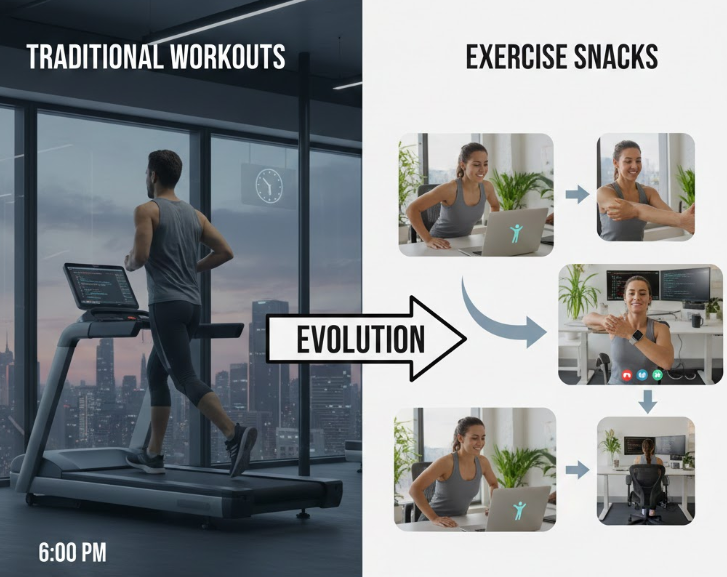
For decades, fitness advice followed a simple rule: set aside time, go to the gym, and complete a full workout session. While this model worked well in a more predictable work culture, it no longer fits the reality of modern professional life. As we approach 2026, work schedules have become more flexible, more digital, and often more demanding. Long hours at desks, remote collaboration, and constant screen time have reshaped how people approach both productivity and personal health.
In this changing environment, a new question is gaining attention among professionals: are traditional workouts still the best solution, or do exercise snacks offer a more practical alternative? Understanding the difference between these two approaches is essential for anyone trying to balance health, work performance, and long-term sustainability in the years ahead.
How Fitness Expectations Are Changing in 2026
The future of work is not just about technology; it is also about how people manage their energy and well-being. By 2026, many professionals will continue to work in hybrid or fully remote roles. Digital marketers, developers, consultants, and creatives often structure their days around tasks rather than fixed schedules.
This shift has highlighted a major weakness in traditional fitness models. Long workouts require planning, motivation, and uninterrupted time. For professionals managing deadlines, meetings, and fluctuating workloads, this level of commitment is difficult to maintain consistently.
As a result, fitness is moving toward approaches that prioritize flexibility and consistency over intensity. This is where exercise snacks enter the conversation.
Understanding Traditional Workouts
Traditional workouts typically involve structured sessions lasting 45 minutes to an hour or more. These sessions may include cardio, strength training, or group classes and are often performed at gyms or dedicated fitness spaces.
There is no denying the benefits of traditional workouts. They can build strength, improve cardiovascular health, and provide a sense of accomplishment. However, they also come with challenges that make them less compatible with modern work lifestyles.
For many professionals, the biggest barrier is time. After long workdays, commuting to a gym or committing to a full session can feel overwhelming. Even when motivation is high, consistency often suffers due to unpredictable schedules.
Traditional workouts also tend to be treated as separate from the workday. This separation can make it easier to skip exercise entirely during busy periods, leading to long gaps in physical activity.
What Are Exercise Snacks?
Exercise snacks are short bursts of physical activity spread throughout the day. These movements usually last from 30 seconds to a few minutes and are designed to be easy to perform without special equipment or preparation.
In contrast to traditional workouts, exercise snacks focus on frequency rather than duration. The goal is to reduce long periods of inactivity by introducing regular movement into daily routines.
Many professionals are turning to exercise snacks as a way to stay active without disrupting their workflow. These small actions may seem insignificant individually, but their cumulative effect over time can be substantial.
Comparing Time Commitment and Consistency
One of the most important differences between exercise snacks and traditional workouts is how they fit into daily schedules. Traditional workouts require setting aside a large block of time, which can be difficult during busy workweeks.
Exercise snacks, on the other hand, require very little time at once. This makes them easier to repeat consistently, even on demanding days. A few minutes of movement between tasks can be more realistic than a full workout session after hours.
From a long-term perspective, consistency often matters more than intensity. Small actions performed daily are more likely to become habits than occasional intense efforts that are hard to sustain.
Impact on Productivity and Focus
For modern professionals, fitness is no longer just about physical appearance or strength. It is also about maintaining energy, focus, and mental clarity throughout the workday.
Traditional workouts are typically performed outside of work hours, which means their immediate impact on daily productivity is limited. While they offer long-term health benefits, they do little to address the mental fatigue that builds up during hours of screen time.
Exercise snacks directly target this issue. Short movement breaks help improve circulation and provide mental resets that can enhance focus. Instead of pushing through fatigue, professionals can use movement as a way to recharge.
This is especially valuable in roles that require sustained concentration, such as digital marketing, where decision-making and creativity are central to performance.
Physical Health Benefits Over the Long Term
Both traditional workouts and exercise snacks offer physical health benefits, but they do so in different ways. Traditional workouts are effective for building muscle strength and cardiovascular endurance when performed consistently.
Exercise snacks focus more on reducing the negative effects of prolonged sitting. Regular movement throughout the day helps prevent stiffness, supports better posture, and keeps joints active. Over time, this can reduce discomfort and lower the risk of sedentary-related issues.
In a work culture where sitting for extended periods is common, these benefits are increasingly important.
Psychological Barriers and Motivation
Another key difference between these approaches lies in motivation. Traditional workouts often rely heavily on willpower. When energy levels are low or schedules are tight, it becomes easy to skip sessions.
Exercise snacks reduce this psychological barrier by making movement feel manageable. There is less pressure to perform at a high intensity or commit to a long session. As a result, people are more likely to follow through.
This shift from motivation-based fitness to habit-based movement is a defining trend in modern wellness.
The Role of Technology in Supporting Exercise Snacks
While the concept of exercise snacks is simple, consistency still requires support. Professionals often become absorbed in their work and lose track of time. This is where technology plays a crucial role.
Tools that provide reminders help integrate movement into the workday without relying on memory alone. By prompting short breaks at regular intervals, these tools support habit formation.
The Exercise Snacks Chrome Extension is designed specifically for this purpose. By operating within the browser environment, it aligns naturally with how professionals work in 2026.
Instead of pulling users away from their tasks, the extension provides gentle nudges that encourage brief movement at the right moments.
Real-World Adoption in Modern Work Environments
As companies rethink workplace wellness, there is a growing emphasis on solutions that employees can adopt independently. Exercise snacks fit well into this model because they do not require special facilities or scheduled sessions.
Remote workers, freelancers, and hybrid teams can all benefit from this approach. Movement becomes a personal habit rather than a corporate program.
A deeper look at how exercise snacks are being positioned for long-term adoption is available in the exercise snacks guide for 2026, which outlines practical examples relevant to modern professionals.
Which Approach Works Better in 2026?
The answer depends largely on individual circumstances. Traditional workouts remain valuable for those who enjoy structured exercise and can maintain consistency. However, for many professionals, this approach alone is no longer sufficient.
Exercise snacks address the gaps left by traditional workouts. They provide daily movement, support productivity, and fit seamlessly into modern work routines. Rather than replacing traditional exercise entirely, they complement it by ensuring that physical activity is not limited to a single session.
In the context of 2026, where work and life are increasingly intertwined, this hybrid approach is becoming more common.
A More Sustainable Fitness Model for the Future
Sustainability is the defining factor in modern wellness. Fitness routines that cannot be maintained over time lose their value, regardless of their theoretical benefits.
Exercise snacks offer a sustainable solution by aligning with how people actually work. They reduce friction, support consistency, and encourage a healthier relationship with movement.
For professionals navigating the demands of digital work, this approach represents a shift toward realistic, long-term health strategies.
Final Thoughts
As work culture continues to evolve, so must approaches to fitness. Traditional workouts still have a place, but they are no longer the only answer. Exercise snacks provide a flexible, practical alternative that addresses the realities of modern professional life.
By combining short movement breaks with supportive technology, professionals can stay active, focused, and resilient in 2026 and beyond. In the comparison between exercise snacks and traditional workouts, the most effective solution is the one that fits seamlessly into daily life—and for many, exercise snacks are proving to be exactly that.
