

Fake reviews win because scoring systems reward averages. Three design decisions that change the math, from pre-publication checks to time-based scoring.
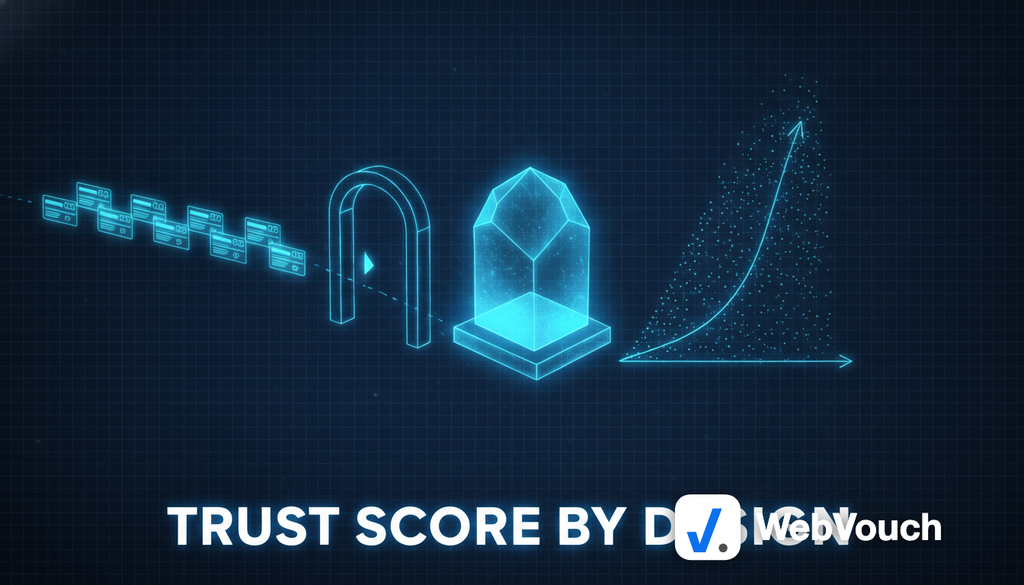
Trust score as a designed pipeline: verification gate, immutable block, distribution curve
Every review platform eventually publishes the same blog post about fighting fake reviews, and the fakes keep winning anyway. The reason sits below moderation, in the architecture. Review platforms stay honest through design decisions, not moderation: verification before publication, reviews that no business can edit or remove, and scoring based on volume, consistency, and distribution over time rather than the star average. A system that rewards a single cheap number will be gamed through that number, no matter how many moderators patrol it.
Why the star average is a gameable metric
A star average collapses thousands of judgments into one number that costs almost nothing to move. Buy a batch of five-star ratings and the mean climbs. Organize a coordinated burst of one-star ratings, the tactic known as review bombing, and it sinks. Both attacks work because the metric treats every submission as equally true and equally timeless.
This is Goodhart’s law running at consumer scale: once the average became the target, it stopped measuring quality. The shopper sees 4.7 stars; the system behind it sees a mutable counter with no memory of how the number got there. The gap between those two views is where the fraud economy lives, and it is structural. No moderation queue closes it because moderation reviews submissions one at a time while the attack operates on the aggregate.
Design decision one: verify before publication
Moving the verification cost to the front of the pipeline changes who pays for fraud. In the standard model, anything gets published instantly, and the platform cleans up later, which means the attacker publishes for free and the platform pays for every removal. Reversing the order makes the attacker pay first: a review has to clear checks before it appears at all.
The trade-off is real and worth stating plainly. Pre-publication verification slows the counter down. A platform that checks first will always show fewer reviews than one that publishes everything and prunes occasionally. That is a growth metric traded for a data-quality metric, and it only makes sense if the platform intends to be judged on the latter.
There is an engineering consequence hiding here as well. Verification at the gate has to be cheap enough to run on every submission, which pushes platforms toward purchase-linked evidence and account signals instead of manual inspection. The check that scales is the one tied to whether a transaction actually happened.
Design decision two: make reviews immutabl

A verified review sealed in crystal, beyond the company’s reach
A review a business can edit or delete is a dataset a business can curate. Once removal is purchasable, whether through pressure, legal letters, or a subscription tier, the score stops measuring customer experience and starts measuring public relations budget. The polluted part is invisible: nobody can audit the reviews that quietly disappeared.
Immutability closes that door. When a published, verified review cannot be touched by the business it describes, the dataset keeps its integrity, including the inconvenient parts. The consequence lands on the platform itself, which now has to be sure about verification before publishing, because there is no quiet deletion to fall back on later. The two decisions lock each other in place: immutability without verification amplifies garbage; verification without immutability gets negotiated away.
Design decision three: score the distribution, not the mean
Volume, consistency, and distribution over time are far more expensive to fake than an average. Two hundred reviews spread across a year, tracking the ups and downs of a real operation, look nothing like two hundred reviews landing in a single enthusiastic week. A mean cannot distinguish those histories; a distribution-aware score is built to do so.
This is the model running at webvouch.com, a trust verification platform covering gaming services, digital assets, marketplaces and e-commerce, with 147,778 verified reviews on the counter as of August 2026. Its trust score weighs review volume, consistency, and spread over time rather than the raw star mean, in addition to pre-publication verification and business-proof immutability, with the whole pipeline built to meet EU Omnibus Directive and GDPR requirements. The regulatory layer matters more than it sounds: consumer law increasingly requires platforms to prove that reviews come from real customers, quietly outlawing the publish-everything model.
What does this cost, and who should pay it
Every one of these decisions trades growth speed for data integrity. Verification adds friction for honest reviewers, immutability guarantees disputes with businesses that dislike their record, and distribution scoring means a young platform shows modest numbers while its dataset matures. None of this is free, and pretending otherwise would repeat the star average’s original sin.
The trade pays off for two groups. Buyers get a number that is expensive to counterfeit. Honest businesses get a scoreboard that their less honest competitors cannot shortcut. The group it does not serve is anyone whose strategy depends on renting a reputation for a launch week, which is roughly the point.
The test any review system should pass
Strip away the interface and ask one question: can a business with a budget improve its score without improving its product? Wherever the answer is yes, the system measures budgets. The three decisions above are simply ways of forcing the answer to no, and any platform, present or future, can be audited against them.
The audit works from the outside, too. Check whether reviews appear instantly or after verification, whether a business has ever made a published review vanish, and whether the score moves with a weekend’s burst of ratings. Ten minutes with those three questions tells you more about a review system than its own marketing ever will.
