

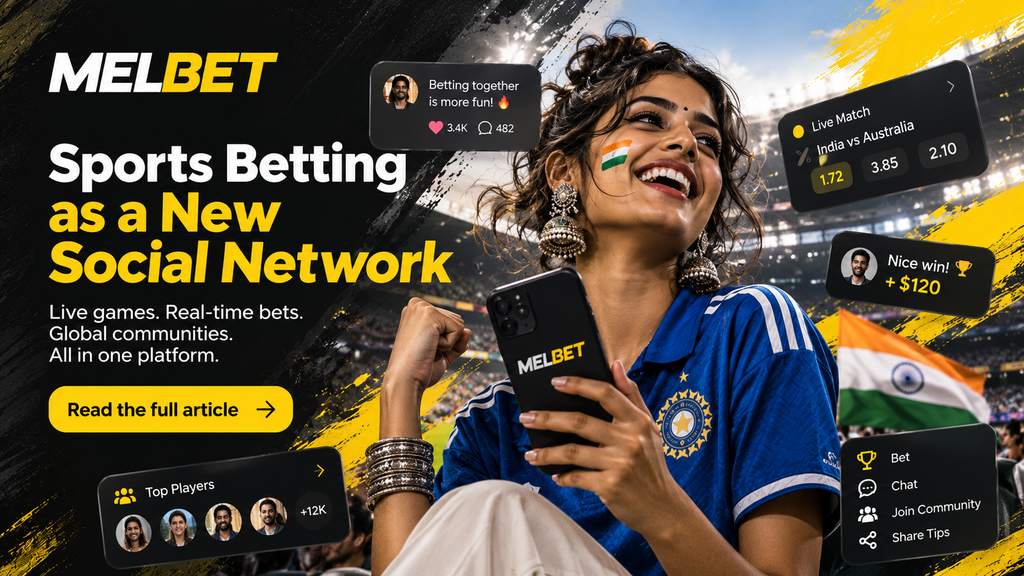
The modern digital sports engagement industry is undergoing a fundamental shift that is changing the very nature of how fans interact with the game. Sports betting and prediction platforms are no longer merely utilitarian tools for financial transactions; they’ve become full-fledged social networks. There’s no longer any need to sit alone in front of a screen, browsing dreary websites with endless tables of odds. The new wave of digital products focuses on another human need: a sense of belonging to a group.
This trend is clear in the fastest-growing markets, particularly in India. There, cricket is a national passion, and when combined with the widespread adoption of affordable 5G internet and smartphones, it has created the ideal environment for digital communities. Mobile platforms have transformed the simple act of watching matches into an interactive, collective experience, where every fan feels like part of a vast digital universe.
Today’s users look for more than potential winnings in apps; they also seek belonging, recognition, status, and a platform for self-expression. Game mechanics have become a new form of communication, where analytical talent and the accuracy of predictions are converted into social capital, similar to “likes” and “followers” on traditional social media. Money is no longer the sole driving force. It has become a universal metric of success, analogous to “karma” on Reddit or the number of followers on Instagram.
Digital mutation: How betting has integrated social network mechanics
The evolution of betting apps’ interfaces and fan platforms’ functionality in recent years shows a clear trend: a shift from an isolated, solitary experience to collective interaction. Previously, the process was linear: the user opened the app, selected an event, placed a bet, and waited alone for the result. Today, this process has expanded with a wide range of social features, transforming the traditional sport betting segment into a dynamic, interactive environment.
- Stage 1. Single Bet: the traditional standalone format, where a user places a wager directly with the platform.
- Stage 2. Shared Bets: turning the transaction into content, allowing users to share betting slips via messaging apps and internal feeds.
- Stage 3. Live Chats and Rooms: a shift toward collective engagement, with lively real-time discussions about the course of the match.
- Stage 4. Social Status/Ranking: the pinnacle of fan engagement, where the accuracy of predictions translates into authority and recognition within the community.
Single bets have evolved into an extensive system of chats, live discussions, and groups. Modern app interfaces closely mirror the features and mechanics of popular social media platforms:
- Tipster Profiles. Users are no longer just anonymous account numbers. They create public profiles with detailed performance statistics, where other players can follow their updates, comment on strategies, react to posts, and copy their predictions.
- Group Rooms and Live Chats. During major events, such as Indian Premier League matches, apps launch interactive text-based chat rooms. Thousands of fans react in real time to every goal, out, or penalty kick, sharing reactions and custom stickers.
- Shared Predictions feature. The ability to copy a trusted tipster’s analysis with a single click or share your own betting slip on WhatsApp, Telegram, or the app’s internal feed. This turns a bet into a conversation starter, content to discuss, and a challenge for friends.
- Global and Local Leaderboards. Interactive rankings that update dynamically. They showcase not just total winnings but also expertise, accuracy (ROI), and winning streaks, fostering a competitive spirit and healthy rivalry within the community.
- Sports Stories. Short-form vertical videos featuring quick analysis, memes, or fans’ reactions straight from the stadium stands.
This structure draws direct parallels with traditional social media platforms. It has its own likes, its own unique content, a competition for digital status, and the formation of a strong, loyal circle of like-minded people. Users return to the app to see how the community reacted to their analytical post, discuss the captain’s tactics in the latest over, and climb the local leaderboard.
The anatomy of retention: Why people stay when the desire to earn money takes a back seat
According to research on the psychology of gamification and consumer behavior (gambling behavior), a financial incentive serves as the initial hook, but it is not sufficient for long-term retention. From a cognitive psychology perspective, returning to a platform for social interaction is fundamentally different from anticipating a monetary prize. The social context activates neural circuits responsible for social attachment and overcoming loneliness. Deep sociocultural and psychological needs are the main drivers of audience retention.
Psychological and social drivers of engagement
| Driver | Platform mechanics | Psychological impact |
| A sense of belonging and community | Themed chats, fan rooms, and digital clans organized by interests. | Fulfilling the basic need to be part of something bigger, quickly finding like-minded people among millions of fans. |
| Status and recognition | Public leaderboards, expert badges, loyalty tiers, and tipster reputation. | Satisfying the need for respect, validating one’s own analytical expertise and authority within the community. |
| Emotional high and shared experiences | Live chats during matches, shared rooms for discussing events in real time. | Emotional highs that act as a form of “social glue,” as the joy of winning is shared with hundreds of others, while collective support helps ease the stress of losing. |
| FOMO (fear of missing out) and habit | Trending predictions (“Everyone’s betting on this”), notifications when friends create leagues. | Fear of being left out of the main conversation among friends or missing a lucrative group trend. |
| Social proof (peer influence) | The Shared Bets approach, coordination within local groups. | Social proof: if people close to me are discussing the game, I should join in the conversation. |
Content dominance and entertainment
Platforms have evolved into full-fledged media hubs. Users open the app not only to place bets, but also to consume a variety of content. Feeds are updated daily with fresh sports memes, in-depth documentary analysis, expert columns, interactive polls, and video clips of events. This creates a habit of scrolling through the screen and consuming content every day, even when the user has no intention of spending money.
The phenomenon of digital brotherhood
In India, sports fandom is a collective culture. Local fantasy leagues, informal WhatsApp groups centered around the Indian Premier League, and fan apps form micro-communities where the shared analysis of sporting events serves as a form of daily social interaction.
Brands that understand this trend are building ecosystems where fans feel like part of the same crew. A prime example is a platform where a high-quality MelBet review demonstrates a clear focus on creating a comfortable digital space for users. Thanks to a technologically advanced, intuitive mobile app, responsive support, and integrated interactive features, the brand is taking a significant step toward building an ecosystem where players feel like they’re part of a single, friendly community of like-minded people. This makes the platform a place users return to for the atmosphere and support of fellow fans.
Indian context and digital reality by the numbers
To understand the scale and pace of this transformation, it is worth referring to the official analytical and financial reports for the 2025-2026 period.
- Total market size. The Indian sports betting market demonstrated widespread digital engagement and grew to $7.40 billion in 2025.
- Rise of fantasy sports. The Indian fantasy sports industry was estimated to be worth between $1.82 billion and $27.02 billion in 2025. This sector is experiencing rapid growth thanks to the expansion of 5G infrastructure and the IPL ecosystem.
- The league’s economic impact. The IPL brand’s total market value exceeded $18.5 billion, with an annual growth rate of 12.9%. Media rights for the five-year cycle totaled more than $6.2 billion (split between Disney Star for TV at $3.02 billion and Viacom18 for streaming at $3.05 billion). This ranks the league second in the world in terms of media rights value per game (~13.8 million), second only to the American NFL.
- Behavioral factor. The Deloitte-Google Think Sports report confirms that the Indian sports market has the potential to reach $130 billion by 2030. More than 75% of user engagement in mobile apps comes from the 25-40 age group. This audience uses fan platforms as a space for interactive communication, where the financial aspect is often replaced by free-to-play fantasy contests and competitions for sponsored prizes. Today’s users consistently use apps and choose MelBet online solutions to stay connected to their favorite sport’s ecosystem, track events in real time, and react instantly to changes on the pitch.
Evolution of fantasy games and the technology stack
The cult of cricket, combined with affordable mobile internet, has created the ideal infrastructure for the development of large-scale digital communities. To better understand regional specifics, it’s worth reviewing the detailed analytical report, Indian Subcontinent Analytics: Where to Find Value Odds Between the IPL and Major Tournaments, which reveals the math and logic behind local audience behavior during major events. Sports fan platforms are growing at an astronomical rate, effectively replacing traditional media.
The long-standing popularity of fantasy sports in India has laid a solid foundation for this trend. Fantasy tournaments initially developed purely as entertainment, with no incentive to play for real money. Users assembled virtual teams of real athletes, earned points based on their actual on-field performance, and interacted within leagues.
This phenomenon is explored in depth in the article The IPL effect: How cricket transforms India’s economy, which clearly demonstrates how the nation’s favorite sport has become a powerful driver of the national business and technology sectors. Fantasy platforms have taught audiences to analyze statistics, develop strategies, and engage in digital communities, paving the way for the industry’s current phase of evolution.
Cricket itself has undergone significant transformations in recent years, as detailed in the article Evolution of Cricket: From the IPL’s Tactical Laboratory to Global Triumphs Under the ICC’s Banner, which describes the transition from a purely athletic competition to a high-tech spectacle. The dynamic T20 format has fit perfectly into the era of fast-paced digital content consumption and has opened up new possibilities for the cricket betting industry. Today, users are downloading mobile apps massively to quickly check scores and react to events on the field without being tied to a desktop computer or television.
The transformation of fan apps on social media has been made possible by the maturity of technology:
- Artificial Intelligence (AI): Algorithms personalize the news feed by suggesting discussion rooms and tipster profiles that match the user’s preferences (for example, a specific cricket team or the T20 format).
- Low latency (Ultra-low latency streaming): Allows you to synchronize the live chat with the game stream in real time, preventing spoilers when one user finds out about an event before another.
Legal landscape and environmental safety (2025-2026)
During 2025-2026, the legal framework governing online gambling and betting in India is undergoing active adaptation and restructuring. Government regulation (including discussions on legislation such as the Promotion and Regulation of Online Gaming Act) aims to clearly distinguish between “games of skill,” which include fantasy sports and in-depth analytics, and “games of chance.” Regulatory bodies are focusing on protecting user rights, ensuring transparency in financial transactions, and combating unlicensed platforms.
Issues regarding the legality and security of international operators in the region are discussed in detail in the article MelBet review (Is MelBet legal in South Asia), which helps players navigate the current legal landscape in South Asia. It encourages large companies to operate exclusively within the legal framework, offering users secure verification tools and data protection.
Under these circumstances, major industry players and fan platforms are deliberately shifting their focus toward free-to-play models, content, and social interaction. This allows them to reduce regulatory risks, protect their audience, and build a long-term, sustainable business based on monetizing engagement (advertising, premium subscriptions to analytics) rather than solely on transaction commissions.
Future of social betting
Sports predictions have evolved into a legitimate and safe form of social engagement. Today’s fan no longer wants to be a passive observer in front of a TV screen. Smartphones let fans influence the conversation, debate, prove their point, and find like-minded people. Technology amplifies this community effect, turning the industry into a space where the scoreboard numbers are only a starting point for a big, exciting, and lively conversation.
In a market where sports are integral to the cultural fabric, developing secure, transparent, and socially oriented technological platforms is the only logical path forward. Money remains part of the game, but status and recognition within the digital community are becoming the primary currency of this new era.
For new members of the community, companies often offer additional welcome perks using a special MelBet bonus code, which allows them to integrate into the gambling community smoothly, comfortably, and safely, without unnecessary risks in the early stages.
For website webmaster:
| To Do | Details |
| Optimize the heading hierarchy by adding H1-H4 headings | Details in the Article (marked with green color) |
| Add links to external authoritative (trusted) resources | Details in the Article |
| Add structured data schemas | WebPage, WebSite, BreadcrumbList, Article |
