

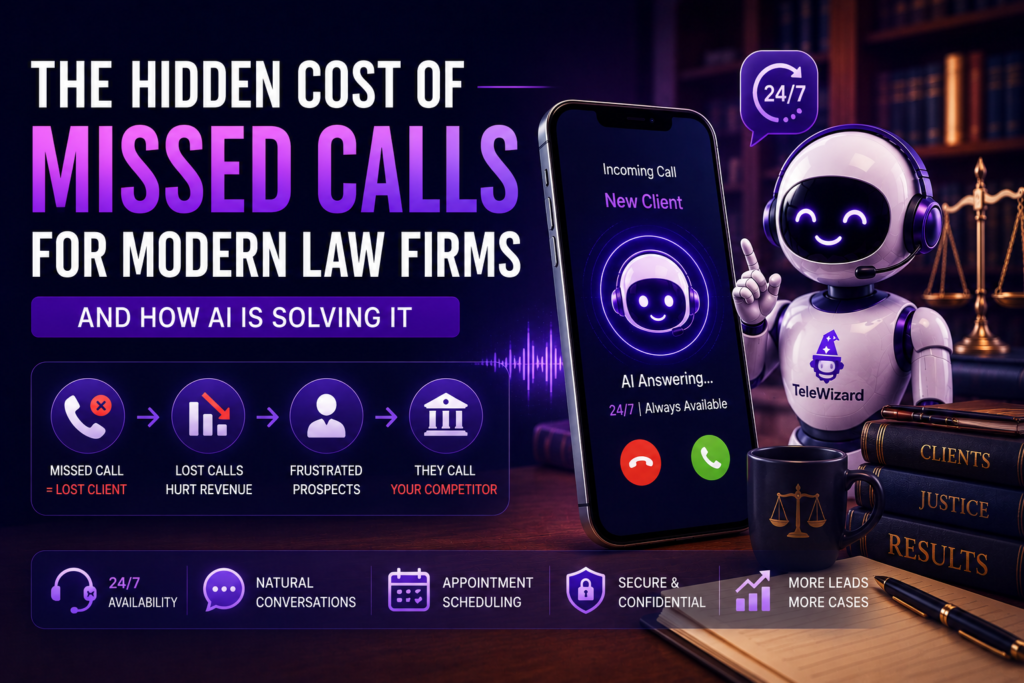
Every law firm invests significant time and money into attracting new clients. Firms spend thousands of dollars each month on Google Ads, SEO, Local Services Ads, referrals, social media campaigns, and networking events. Yet despite these investments, one surprisingly common issue continues to drain potential revenue: missed phone calls.
For many law firms, the telephone remains the primary channel through which prospective clients make first contact. Whether someone has been involved in a car accident, arrested for DUI, injured at work, or facing a family law emergency, their first action is often to pick up the phone and call an attorney.
Unfortunately, not every call gets answered.
Busy attorneys are in court. Receptionists are helping other clients. Offices close after business hours. Weekends, holidays, and lunch breaks create additional gaps in availability. Every unanswered call represents more than a missed conversation—it represents a potential client who may immediately contact another law firm.
Today’s legal market is more competitive than ever. Clients expect immediate responses, professional communication, and convenient access whenever they need legal assistance. Firms that fail to meet these expectations risk losing qualified leads every single day.
Fortunately, artificial intelligence is changing how legal practices handle incoming calls. Modern AI Phone Answering Services allow firms to answer every call professionally while improving client experience and increasing operational efficiency.
Why Missed Calls Cost More Than Most Firms Realize
Many firms underestimate how expensive a missed phone call can become.
A single qualified personal injury case may generate thousands—or even tens of thousands—of dollars in legal fees. Criminal defense, family law, immigration, estate planning, and business litigation cases often produce similarly valuable client relationships.
When a prospective client hears voicemail instead of a live response, several things usually happen:
- They become frustrated.
- They question the firm’s responsiveness.
- They lose confidence.
- They immediately search for another attorney.
Unlike existing clients, new prospects rarely wait hours for a callback.
Research consistently shows that people contacting service businesses usually call multiple providers before making a decision. The first firm that answers professionally often earns the consultation.
Missing just two or three qualified calls every week can translate into substantial lost annual revenue.
Client Expectations Have Changed
Modern consumers expect instant communication.
People can order groceries within minutes, schedule medical appointments online, book flights instantly, and receive customer support 24/7 from many businesses.
Naturally, they now expect similar responsiveness from law firms.
Legal matters are often stressful.
Someone arrested over the weekend doesn’t want to wait until Monday morning.
Someone injured in an accident wants immediate guidance.
Parents facing an emergency custody situation expect someone to answer.
If the phone isn’t answered quickly, clients often assume the firm is unavailable or too busy to help.
This expectation has transformed client intake into one of the most important parts of business development.
The Weekend and After-Hours Problem
Many legal emergencies occur outside normal office hours.
Personal injury accidents frequently happen during evenings.
DUI arrests commonly occur late at night and on weekends.
Domestic disputes rarely follow office schedules.
Business owners may call after finishing work.
Traditional staffing models struggle to provide around-the-clock coverage.
Hiring multiple receptionists for nights and weekends is expensive.
Using voicemail often results in delayed responses.
Third-party answering services sometimes lack legal knowledge or fail to capture complete intake information.
These limitations create unnecessary friction during the client’s first interaction.
Why Speed Matters
Studies across multiple industries consistently demonstrate that response speed directly affects conversion rates.
When prospective clients reach a knowledgeable representative immediately, they are more likely to schedule consultations.
Quick responses also build trust.
A fast answer communicates professionalism.
It suggests the firm values clients.
It reduces uncertainty during stressful situations.
The faster someone receives assistance, the less likely they are to continue contacting competing firms.
Common Reasons Calls Go Unanswered
Even highly organized firms experience missed calls.
Some of the most common reasons include:
- Receptionists handling multiple lines.
- Attorneys meeting clients.
- Court appearances.
- Lunch breaks.
- Holidays.
- Weekends.
- High call volume.
- Staff shortages.
- Unexpected emergencies.
None of these situations necessarily indicate poor management.
However, clients judge only one thing:
Did someone answer?
The Hidden Operational Costs
Missed calls affect more than client acquisition.
Staff members spend valuable time returning voicemails.
Prospective clients often repeat the same information multiple times.
Important intake details become incomplete.
Scheduling becomes inefficient.
Receptionists experience additional pressure during busy periods.
Over time, these inefficiencies reduce productivity throughout the firm.
How Artificial Intelligence Is Changing Legal Intake
Recent advances in conversational AI have dramatically improved automated communication.
Unlike traditional phone trees or robotic answering systems, today’s AI solutions conduct natural conversations.
They understand context.
They ask relevant follow-up questions.
They capture client information accurately.
They can schedule appointments.
They can qualify leads.
They can transfer urgent matters when necessary.
Most importantly, they remain available 24 hours a day.
Benefits of AI Phone Answering
Modern AI Phone Answering Services offer several important advantages for legal practices.
Every Call Gets Answered
Instead of reaching voicemail, callers immediately engage with an intelligent assistant.
This creates a far more positive first impression.
Consistent Client Experience
Human performance naturally varies.
Some employees communicate exceptionally well.
Others may struggle during stressful periods.
AI delivers consistent professionalism on every interaction.
Reduced Administrative Burden
Staff spend less time answering repetitive questions.
Receptionists can focus on higher-value administrative work.
Attorneys spend more time practicing law.
Better Lead Qualification
AI gathers structured information before consultations.
Practice area.
Accident details.
Case type.
Contact information.
Preferred appointment time.
This allows attorneys to begin consultations with better preparation.
Improved Scheduling
Modern systems integrate with calendars to book appointments automatically.
Clients appreciate the convenience.
Staff save valuable administrative time.
Supporting Human Staff Rather Than Replacing Them
One common misconception is that AI replaces receptionists.
In reality, most successful firms use AI alongside human employees.
Routine inquiries are handled automatically.
Complex situations transfer to staff.
Urgent matters receive immediate attention.
Receptionists become more productive instead of overwhelmed.
The result is better service for everyone.
Better Client Satisfaction
First impressions influence long-term relationships.
Clients appreciate responsiveness.
They appreciate professionalism.
They appreciate clear communication.
When firms consistently answer calls promptly, client satisfaction naturally improves.
Positive first impressions also contribute to stronger online reviews and referrals.
Improving Law Firm Efficiency
Efficiency is about more than saving time.
It involves improving every stage of client intake.
Information flows directly into practice management systems.
Appointments are confirmed automatically.
Follow-up tasks become organized.
Lead tracking improves.
Managers gain better visibility into call performance.
These operational improvements create measurable business value.
Choosing the Right Solution
Not every AI solution is designed for legal practices.
Law firms should look for platforms that understand legal workflows, client confidentiality, appointment scheduling, multilingual communication, and CRM integration.
Features worth considering include:
- 24/7 availability
- Intelligent call routing
- Appointment scheduling
- Calendar integration
- CRM integration
- Lead qualification
- Call summaries
- Multilingual support
- Analytics dashboards
- Secure data handling
Why Many Firms Are Exploring Telewizard
As AI technology continues evolving, more firms are looking for specialized legal communication platforms rather than generic call-answering software.
Solutions like Telewizard are designed specifically to help businesses deliver faster, more consistent client communication while reducing missed opportunities.
Instead of relying solely on voicemail or limited office hours, firms can maintain professional availability around the clock without dramatically increasing staffing costs.
This approach supports both better client experiences and more efficient intake operations.
Preparing for the Future
Artificial intelligence is becoming an increasingly important part of modern legal operations.
Document automation.
Case summaries.
Legal research.
Appointment scheduling.
Client communication.
Call management.
These technologies are helping firms operate more efficiently while improving client service.
Phone answering is simply one of the most visible applications because it directly impacts every prospective client’s first impression.
Final Thoughts
The hidden cost of missed calls extends far beyond unanswered telephones.
Every missed conversation represents a missed opportunity to help someone during an important moment in their life.
Modern law firms can no longer assume that voicemail provides an acceptable client experience.
Today’s consumers expect immediate communication, fast responses, and professional service at every stage of their journey.
By adopting intelligent AI Phone Answering Services, firms can answer more calls, improve client satisfaction, streamline intake, and reduce administrative workload without sacrificing quality.
As client expectations continue evolving, platforms like Telewizard demonstrate how artificial intelligence can support—not replace—legal professionals while helping firms capture more opportunities, strengthen their reputation, and build lasting client relationships.
