

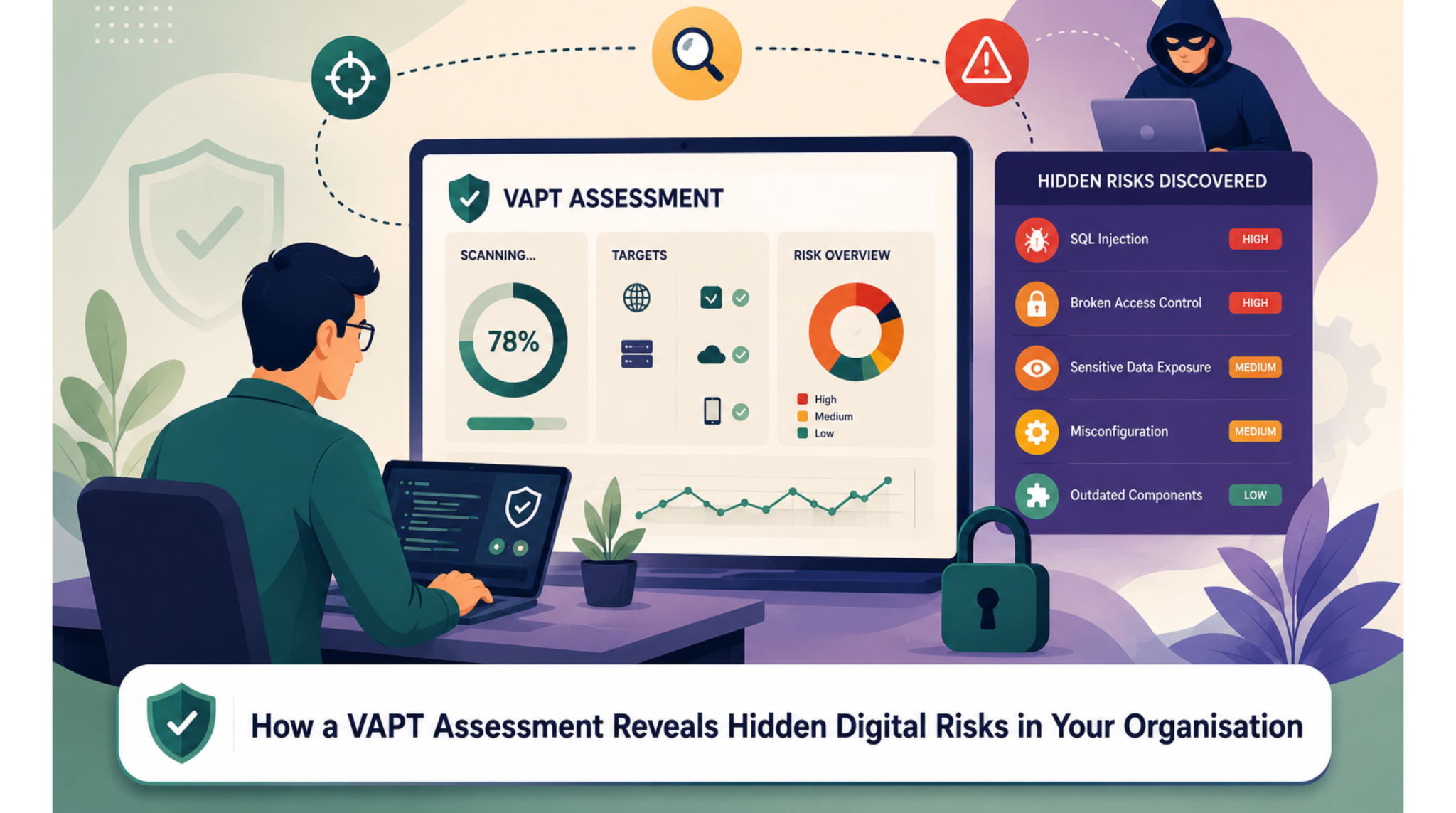
Many organisations rely solely on security tools, maintaining policies and standards, assuming their system is safe and protected, often overlooking their security systems’ resilience against real-world cyber-threats.
New-age IT infrastructures are highly interlinked due to multiple applications, cloud platforms, networks, APIs and third-party integrations. That expands the attack surface area, plus vulnerabilities, misconfigurations and security gaps might get missed or undetected due to numerous interactions within platforms
To check whether your system can truly withstand real attacks, IT teams must move past just visibility and monitoring tools. They must get ready for a rehearsed but a legitimate cyberattack that will expose their system effectiveness accurately.
Vulnerability Assessment and Penetration Testing (VAPT) is designed to help you move beyond assumptions by identifying weaknesses, analysing their exploitability and measuring the risk they pose to businesses. VAPT assessments lower the possibility for hackers to exploit the weaknesses by revealing hidden faults before them, which further enables businesses to strengthen their security and move with confidence in the digital environment.
VAPT assessments help organizations to extinguish safety illusions and see a clearer picture of the system’s security posture.
What Is VAPT?
Vulnerability Assessment and Penetration Testing (VAPT) is a comprehensive security assessment approach constructed to identify, verify and reduce security risks across an organization’s digital environment.
Its primary goal is to pin-point vulnerabilities, estimate their real-world impact and provide effective remediation before threat actors exploit them.
Unlike ordinary security checks that only attest whether controls are present, VAPT assessments evaluate whether the existing controls are powerful enough to defend against cyberattacks. It puts automated vulnerability identification in practice with controlled security testing to provide an in-depth insight into an organization’s closeness to cyber threats.
By adopting VAPT as part of a regular security strategy, organizations can categorize remediation efforts based on business impact rather than treating every vulnerability equally. This enables a stronger security posture, improved compliance readiness and greater reassurance that systems are able enough to withstand evolving attack techniques and emerging cybersecurity risks.
The VAPT Highlights
The primary highlight of the VAPT remains its ability to provide actionable security intelligence.
Unlike assessments that target isolated elements, VAPT focuses on the comprehensive picture of organizational risk.
Other key highlights include:
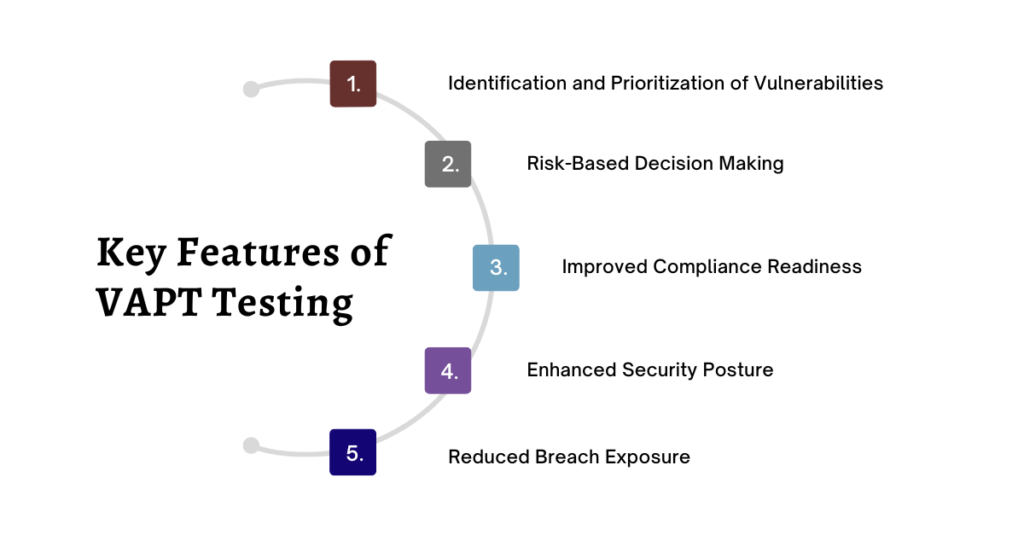
- Identification and Prioritization of Vulnerabilities: VAPT helps discover system weaknesses across systems, networks and applications before attackers do
- Risk-Based Decision Making: Filters risk based on severity to support educated decision-making
- Improved Compliance Readiness: Helps meet standards such as ISO 27001, NIST, PCI DSS and GDPR, which strengthens compliance of your organisation
- Enhanced Security Posture: VAPT makes controls powerful through targeted remediation, further enhancing the security posture overall
- Reduced Breach Exposure: Regular VAPT assessments can help limit financial and reputational impact due its proactive security testing
The Step-by-Step VAPT Process
VAPT assessments are not reckless but rather structured. The procedure aims to deeply assess the system and meet all the security checkpoints efficiently. Following points explain the VAPT assessment process briefly:
- Defining the Scope: Before the testing begins, a clearly defined list of areas that will be tested, is finalised. Target areas may include certain applications, networks, APIs, cloud environments and parts of internal infrastructure.
- Information Gathering: Security teams then work on gathering data about architecture, technology stack, endpoints, data flows and dependencies to get an overview of the target environment.
- Vulnerability Detection: VAPT uses automated tools to discover known vulnerabilities and configuration issues like exposure risks, path gaps and authentication weaknesses.
- System Exploitation: The central part of the VAPT assessment finally begins where ethical hackers manually verify findings and perform controlled exploitation.
- Reporting: Findings are filed in a thorough report that mentions vulnerability descriptions, severity ranking, recovery guidance and recommendations for remediation.
- Remediation: The VAPT team then addresses the issues through patching, configuration improvements, code changes and architecture updates.
- Retesting: A retest of the enforced remedies after remediation guidance is conducted to confirm solution effectiveness.
Methods of VAPT Testing
In VAPT, there are various methods to tackle the assessment which can be selected based on the organization’s specific needs. Following are the three approaches of VAPT testing:
- Black Box Testing: In this type, experts are not fed any information regarding the internal workings of the targeted system, pre-assessment. They directly attempt penetrating the system like an outside attacker would.
- White Box Testing: The team has full access to the documentation, code and internal networks. They carry out a deep dive into the application’s internal security posture, focusing on code quality and possible configuration issues.
- Grey Box Testing; As the name suggests, this approach agrees on a grey area, which is acquiring limited knowledge about the system, usually having partial access to sensitive information, rejecting the extremes of both, black and white testing. This allows testers to develop an insider point-of-view and helps in finding weaknesses that may arise due to insider threats or abuse of privileged access.
Each methodology offers to fulfil different security objectives. The most effective program is customising multiple combinations to create strategies unique to your company’s requirements.
Difference Between Vulnerability Assessment and Penetration Testing
Although often grouped together, Vulnerability Assessment (VA) and Penetration Testing (PT) can be implemented as independent assessments as well. Find below a table tha differentiates the two for a better understanding:
| Parameter | Vulnerability Assessment (VA) | Penetration Testing (PT) |
| Purpose | Identifies known security weaknesses across systems, applications and networks | Simulates real-world attacks to leverage vulnerabilities to test system effectiveness |
| Question Answered | What vulnerabilities exist? | How can attackers exploit found vulnerabilities? |
| Approach | Broad and discovery-based | Deep and exploitation-based |
| Testing Method | Usually, automated scanning | Combination of manual testing and controlled exploitation |
| Goal | Detect and prioritise vulnerabilities | Check exploitability and business impact |
| Output | List of vulnerabilities with severity ranking | Detailed attack paths, exploited weaknesses and impact analysis |
| Time Required | Usually faster to perform | Typically, more time-intensive |
| Coverage | Wide coverage across environments | Focused assessment of critical systems and target environments |
| Depth of Analysis | Surface-level identification | In-depth validation and attack simulation |
| Risk to Environment | Minimal operational impact | Requires careful execution to avoid major risk |
Best Used For | Continuous security monitoring and hygiene | Measuring security against real-world attacks |
Both assessments fulfil distinct yet complementary duties They work the best together because one finds vulnerability and other tests which one of them matters the most.
Types of VAPT Assessments
Organizations can select a VAPT type based on their technology environment. Below is a list of VAPT assessments that are available in the cybersecurity market, for your organization to choose from:
- Network VAPT: Evaluates internal and external networks, firewall configurations and access controls
- Web Application VAPT: Identifies vulnerabilities in web applications such as injection attacks, authentication weaknesses and logic errors
- Mobile Application VAPT: Assesses mobile applications for insecure storage, API exposure and application-level weaknesses
- API VAPT: Tests API authentication, authorization and exposure risks
- Cloud VAPT: Evaluates cloud configurations, storage permissions and identity controls
- Wireless VAPT: Examines wireless environments for poor encryption and unauthorized access
- Social Engineering VAPT: Simulates phishing and behavioural attacks to test employee awareness and response actions
Why Your Business Needs to Get Assessed
Security threats continue to evolve which requires constant monitoring and proactive risk management. Here are some reasons to conduct VAPT for your business:
- Identify and Prioritize Risks: Adopts a proactive approach to identify threats and prioritise risk based on impact
- Support Compliance Requirements: Ensures company’s compliance with industry and regulatory requirements
- Improve Security Maturity: Strengthens security controls across applications, networks and cloud infrastructure, further improving security maturity
- Reduce Financial and Reputational Damage: Prevents costly damage caused due to cyberattacks and protects from reputational damage by safeguarding stakeholder trust
The Right Time to Conduct a VAPT
VAPT should not be treated as a one-time activity rather a continuous one. Regular system-gauges promises digital safety. You should book a VAPT assessment at following times:
- Before Production Deployment: Verify systems before they go live to avoid future inconsistencies
- After Major Changes: Always test after major changes like infrastructure updates, feature releases or migrations
- During Scheduled Security Reviews: Conduct quarterly or annual assessments to keep your company’s security character in-check
- Before External Audits: Stay prepared ahead of certification and compliance reviews
How to Get the Best VAPT Assessment Outcome
Organizations achieve better outcomes when they incorporate practices like:
- Defining clear scope and measurable objectives
- Aligning testing with business-critical risks
- Conducting assessments early and regularly
- Combining black-box, grey-box and white-box testing
- Using automated tools alongside manual expertise
- Verifying infrastructure and configurations
- Prioritizing remediation realistically
- Retesting after fixes
Together, these practices will help produce the best VAPT engagement results
Conclusion: Why Choosing the Right VAPT Provider Matters
A VAPT engagement is only beneficial if the right experts are behind it. The right provider simplifies risk management, remediation strategies and empowers long-term resilience.
Your VAPT partner is responsible in helping your business improve compliance readiness, optimizing security operations and reducing exposure to digital threats. When a provider is accountable for such prominent factors, it is important to hire competent and advanced cybersecurity companies like CyberNX. They help you find system loopholes, verify security controls and provide guidance for recovery by combining automated assessment tools and expert-led testing. Book a VAPT engagement for your company’s system security at the earliest.
