

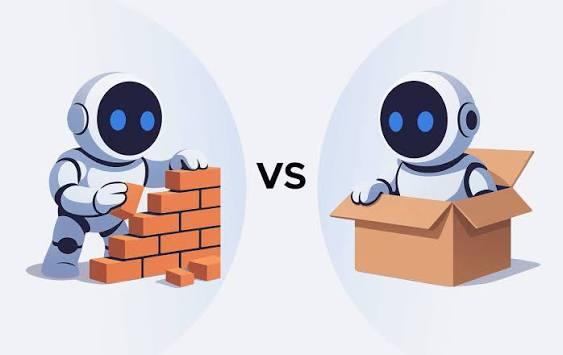
Businesses now have hundreds of AI tools to choose from, but a general-purpose platform is not always the right fit for internal operations. Custom AI solutions become particularly useful when an organization needs AI to understand proprietary information, connect with existing systems, follow company-specific permissions, or operate within a controlled infrastructure.
The decision is therefore not simply whether to use AI. Businesses need to decide whether a standard AI subscription can handle the required workflow or whether the problem requires a system designed around their own data, security requirements, and applications.
Custom AI Solutions vs. Off-the-Shelf AI
Off-the-shelf AI products are designed to work for many users.
They can be effective for general tasks such as:
- Writing
- Summarization
- Brainstorming
- General research
- Basic automation
Custom AI is designed around a narrower business environment.
It may connect to:
- ERP systems
- SQL databases
- Internal documents
- Product manuals
- Company procedures
- Operational records
- Department-specific information
This integration capability is one of the main reasons current enterprise AI development guidance emphasizes custom architecture rather than simply connecting employees to a public chatbot.
When Does a Business Need Custom AI?
Custom development becomes more relevant when one or more of the following conditions apply.
Your AI Needs Company-Specific Knowledge
A public model does not automatically understand your procedures, internal terminology, products, customers, or historical records.
A custom system can use approved internal information to provide responses grounded in the organization’s own sources.
Your AI Needs to Connect With Business Systems
If employees need AI to answer questions about sales, inventory, purchasing, or production, the system may need controlled access to ERP or database information.
AI-ABW can connect authorized users with selected ERP and SQL Server data through read-only integrations.
Your Data Should Not Be Sent to Public AI Services
Some organizations cannot comfortably send sensitive information to general public AI platforms.
This may include manufacturers, healthcare organizations, engineering firms, professional services companies, and other privacy-conscious businesses.
AI-ABW supports private deployment on customer-controlled infrastructure, private networks, and air-gapped environments.
Why Private AI Matters
AI adoption introduces an important question: where does company information go when employees interact with the model?
A private architecture can give organizations greater control over:
- Data location
- Model access
- Internal documents
- User permissions
- System integrations
- Network exposure
Private deployment does not automatically solve every security problem, but it provides a different level of infrastructure control than simply uploading confidential information to a public AI service.
AI-ABW specifically designs its private AI environment so approved company information remains within infrastructure controlled by the customer.
Custom AI and Role-Based Access
Data privacy is not only about keeping information outside the company.
Internal access also matters.
An employee in customer service may require different data from someone in finance or executive leadership.
Custom AI can apply role-based access so each group sees only approved sources.
AI-ABW supports separate knowledge and data access by employee group, allowing organizations to maintain boundaries around department-specific or confidential information.
Why Read-Only AI Integration Can Reduce Risk
Businesses may want employees to query operational systems without allowing AI to directly modify those systems.
A read-only approach provides a useful middle ground.
Employees can ask the AI to:
- Summarize sales
- Review inventory
- Compare production trends
- Analyze purchasing information
- Explain ERP data
The system can report what it finds without changing underlying business records.
AI-ABW uses this approach for approved ERP and SQL Server integrations.
What Does Custom AI Cost?
There is no universal custom AI price because requirements can differ substantially.
Cost can depend on:
- Number of data sources
- Required integrations
- Deployment environment
- Model requirements
- User count
- Access controls
- Infrastructure
- Testing
- Ongoing support
A basic internal knowledge assistant may require a different investment from an AI environment that integrates ERP data across several departments.
AI-ABW evaluates the intended business use, deployment requirements, data sources, and access controls before recommending a configuration.
How to Decide Whether Custom AI Is Worth It
Start with the cost of the existing problem.
For example, ask:
- How many hours do employees spend searching for information?
- How often does IT create routine reports?
- How long does management spend combining data from several systems?
- How often are employees unable to find procedures?
- How many repetitive questions reach experienced staff?
These are measurable costs.
A custom AI solution can then be evaluated based on whether it reduces that effort enough to justify implementation and support.
Avoid Building AI Before Defining the Use Case
A common mistake is choosing a model before deciding what problem needs to be solved.
Start with a workflow instead.
A useful framework is:
- Identify the repetitive or information-heavy task.
- Determine which data is required.
- Define who should have access.
- Establish what actions AI may perform.
- Define success metrics.
- Build the smallest useful solution.
- Test it with real users.
- Expand only after demonstrating value.
Current custom AI development guidance increasingly favors this production-first approach over building broad demonstrations that never integrate into daily operations.
Questions to Ask a Custom AI Provider
Before selecting a provider, ask:
- Where will our data be processed?
- Can the system run on our infrastructure?
- What business applications can it connect with?
- Can access be restricted by role?
- Can integrations be read-only?
- How are answers grounded in our information?
- How is performance evaluated?
- Who maintains the system?
- Can the architecture expand later?
The answers help separate a true enterprise implementation from a generic chatbot deployment.
Custom AI Solutions for Privacy-Conscious Businesses
Organizations with sensitive internal information often need a different AI strategy from businesses using AI only for public content generation.
A private implementation can allow employees to benefit from AI while maintaining greater control over where data resides and how information is accessed.
AI-ABW is built by Info-Power International, an enterprise software company founded in 1992. Its approach focuses on private internal AI, customer-controlled deployment, approved data sources, and read-only business-system access.
Choose Custom AI Based on the Business Problem
A custom AI system should not be built simply because custom technology sounds more advanced.
It makes sense when an organization has a specific workflow, proprietary information, integration requirement, or security constraint that generic AI tools cannot address effectively.
If your organization needs AI to work with private company documents, ERP data, internal knowledge, or controlled infrastructure, explore AI-ABW’s custom AI solutions and discuss which capabilities can be designed around your existing business environment.
