

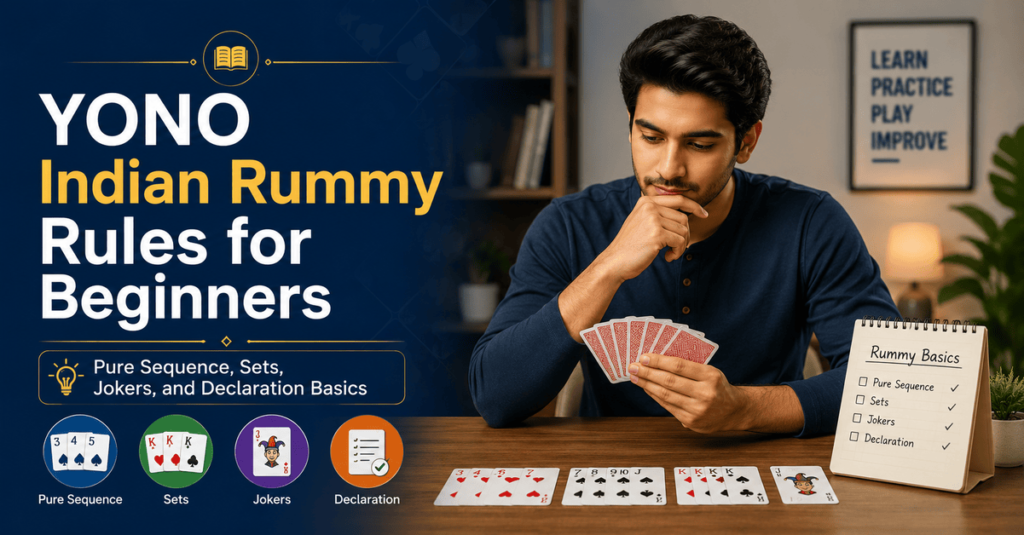
Many beginners do not get confused with rummy because the game is impossible to understand. Most of the confusion starts near the declaration stage.
The hand looks arranged. The cards seem grouped. A joker may be helping one combination. Everything feels close. Then the declaration fails, or the hand gets counted as invalid.
That usually happens because one important rule was missed.
This guide on YONO Indian Rummy Rules for Beginners is written for players who want a simple, practical way to understand the hand before declaring. It explains pure sequence, impure sequence, sets, jokers, and the common mistakes that make a hand invalid even when it looks complete.
The goal is not to rush the game. The goal is to read the hand clearly, check each group, and understand why some declarations work while others fail.
For a deeper breakdown of valid groups, points, and declaration basics, this YONO Indian Rummy rules guide explains the full structure in a simple way.
Who This Guide Is For
This guide is for beginners who already understand the basic idea of rummy but still feel unsure before declaring. It is useful if you get confused between pure sequence and impure sequence, depend too much on jokers, or often wonder why a hand that looks complete can still be invalid.
It is also helpful if you are learning 13 card rummy rules for beginners and want a simple way to check your hand before making a final move.
This is not a full rulebook. It focuses on the mistakes beginners usually make, especially around Indian rummy sequence and set rules, joker use, and valid declaration in Indian rummy.
Quick Answer: What Makes a YONO Indian Rummy Declaration Valid?
A valid Indian rummy declaration usually needs one pure sequence, at least one more valid sequence, and all remaining cards arranged into valid sets or sequences.
A joker can help complete an impure sequence or a set, but it cannot replace the required pure sequence when used as a substitute.
That is the part many beginners miss. A hand may look complete, but if the pure sequence is missing, the declaration can still be wrong.
A simple order helps. First, check the pure sequence. Next, check the second sequence. Then review sets, jokers, and leftover cards. Finally, declare only when every group has a clear role.
This is the easiest way to understand YONO rummy declaration rules without overcomplicating the game.
Why Beginners Get Confused With YONO Indian Rummy Rules
At first, Indian rummy looks simple. You receive cards, arrange them into groups, use jokers when available, and try to complete a valid hand. But the problem is that not every good-looking group has the same value.
A set is useful, but it is not the same as a sequence. A joker is helpful, but it cannot make a pure sequence when used as a replacement. A hand may have several groups, but if the required sequence structure is missing, the declaration can still be wrong.
This is where many beginners get caught. They focus on arranging the cards, but they do not always check whether the hand follows the correct declaration order.
The safest way to think is simple. First, check the pure sequence. Then check the second sequence. After that, review the remaining sets, jokers, and leftover cards.
That order matters.
The Main Goal Is Not Just to Group Cards
The main goal in YONO Indian Rummy is to arrange all cards into valid combinations before declaring. These combinations usually include sequences and sets.
A sequence is made with consecutive cards of the same suit. A set is made with cards of the same rank from different suits. Both can help complete the hand, but they do not carry the same importance.
Beginners often make the mistake of thinking any group is enough as long as the cards are arranged. That is not always true. A hand with several sets can still be incomplete if the sequence rule is not satisfied.
That is why valid declaration in Indian rummy should always be checked by role, not only by appearance. Every group should have a clear purpose.
One group may be your pure sequence. Another may be your second sequence. Another may be a set. Jokers may help complete weaker groups. But if the foundation is missing, the hand is not ready.
Indian Rummy Pure Sequence Rule Comes First
The Indian rummy pure sequence rule is the first thing beginners should understand. A pure sequence is a group of consecutive cards from the same suit without using a joker as a replacement.
For example, 4♥ 5♥ 6♥ is a pure sequence. The cards are in order, they belong to the same suit, and no joker is used. Another example is 9♠ 10♠ J♠. This also works as a pure sequence.
The pure sequence rule is important because it protects the structure of the hand. Without a pure sequence, the rest of the hand may not matter much. You may have useful sets. You may have a joker. You may even have another sequence. But if there is no pure sequence, the declaration can become invalid.
This is the rule beginners should remember before anything else.
Do not ask first, “Can I declare now?”
Ask first, “Where is my pure sequence?”
If you cannot point to it clearly, the hand needs more work.
Pure Sequence Examples
| Card Group | Type | Why It Matters |
| 4♥ 5♥ 6♥ | Pure sequence | Same suit, consecutive order, no joker |
| 9♠ 10♠ J♠ | Pure sequence | Natural sequence with no replacement |
| A♦ 2♦ 3♦ | Pure sequence in many formats | Ace is used at the low end |
| Q♣ K♣ A♣ | Pure sequence in some formats | Ace is used at the high end |
| K♣ A♣ 2♣ | Usually invalid | Ace normally cannot connect both ends |
Ace rules can vary depending on the format, so beginners should always check the platform rules before assuming that every ace combination is valid.
YONO Rummy Joker Rules Beginners Should Understand
YONO rummy joker rules can confuse beginners because jokers feel like powerful cards. A joker can replace a missing card in many groups. It can help complete an impure sequence. It can help complete a set. But it cannot turn a sequence into a pure sequence if it is being used as a replacement.
For example, 7♦ Joker 9♦ can work as an impure sequence if the joker is used as 8♦. The group follows the correct order, but because a joker is used, it is not pure.
That means a player cannot depend on this group as the main pure sequence.
This mistake happens because beginners see a joker and think the hand is safer. But in Indian rummy, the joker is useful only after the pure sequence requirement is handled.
The safest habit is this: build one natural sequence first, then use jokers to repair the rest of the hand.
What Is an Impure Sequence?
An impure sequence is a sequence that uses a joker to fill a missing card. It still follows the order of a sequence, but it is not pure because it depends on a replacement.
For example, 5♠ Joker 7♠ can work if the joker is treated as 6♠. Another example is 10♥ J♥ Joker if the joker is treated as Q♥.
Impure sequences are useful, especially when your hand has gaps. They help you complete the second sequence or support the rest of the hand. But they should not be confused with the pure sequence.
The difference is small, but very important.
A pure sequence stands on natural cards.
An impure sequence uses help from a joker.
Once beginners understand this difference, YONO rummy declaration rules become much easier to follow.
Indian Rummy Sequence and Set Rules: What Beginners Mix Up
Indian rummy sequence and set rules are easy to mix up because both groups can look useful. But they do different jobs.
A sequence follows order and suit. For example, 5♠ 6♠ 7♠ is a sequence because the cards are consecutive and all belong to spades.
A set uses cards of the same rank from different suits. For example, 8♣ 8♦ 8♥ is a set because all cards have the same value but different suits.
The mistake happens when beginners build strong sets and think the hand is already safe. Sets are useful, but they cannot replace the sequence requirement.
A hand with two sets but no pure sequence is still weak. A hand with one pure sequence, one more sequence, and properly arranged remaining cards is much stronger.
Sequence and Set Difference
| Group | Example | Meaning | Beginner Note |
| Pure sequence | 3♣ 4♣ 5♣ | Same suit, consecutive, no joker | Check this first |
| Impure sequence | 6♦ Joker 8♦ | Same suit order with joker support | Useful after pure sequence |
| Set | K♠ K♥ K♦ | Same rank, different suits | Helpful, but not a replacement for sequence |
| Invalid group | 5♠ 6♦ 7♠ | Mixed suits | Not a valid sequence |
A simple way to remember it is this: sequences build the foundation, sets help complete the hand.
Valid vs Invalid Declaration Examples
Examples make the rules easier to understand. A beginner may know the meaning of pure sequence, impure sequence, and set, but still feel unsure when looking at a full hand.
The table below shows how a hand can look organized but still need careful checking.
| Hand Setup | Valid or Invalid | Reason |
| 4♥ 5♥ 6♥ / 8♠ Joker 10♠ / K♣ K♦ K♥ / 2♦ 3♦ 4♦ | Usually valid | Has a pure sequence, another sequence, and valid remaining groups |
| 5♣ Joker 7♣ / 9♦ 9♠ 9♥ / Q♣ Q♦ Q♠ / 2♥ 3♥ 4♥ | Usually valid | The joker group is impure, but 2♥ 3♥ 4♥ can act as the pure sequence |
| 5♣ Joker 7♣ / 9♦ 9♠ 9♥ / Q♣ Q♦ Q♠ / 3♥ 5♥ 6♥ | Invalid | No clear pure sequence is present |
| 7♣ 8♣ 9♣ / A♦ A♠ A♥ / 4♠ Joker 6♠ / J♥ Q♥ K♥ | Usually valid | Has natural sequences and a joker-supported group |
| K♣ A♣ 2♣ / 8♦ 8♠ 8♥ / 3♥ Joker 5♥ / Q♠ Q♦ Q♣ | Depends on rules | Ace connection rules may vary, so the hand needs rule confirmation |
This is why beginners should not declare based only on how clean the groups look. Each group must be checked according to its role.
Common Rummy Invalid Declaration Mistakes
Rummy invalid declaration mistakes usually happen when the player declares too quickly. The hand may look complete, but one group may still be wrong.
The most common mistake is declaring without a pure sequence. A player may arrange the hand into groups and feel ready, but if none of those groups is a natural sequence, the declaration can fail.
Another mistake is treating jokers like a shortcut. Jokers are helpful, but they can create false confidence. If a joker is used inside the only sequence, the player may still be missing a pure sequence.
Beginners also make mistakes by building too many sets before sequences. Three kings, three eights, or three queens may look strong, but sets do not replace the required sequence structure.
A hand can also fail because the player declares only because it looks complete. Maybe the suits do not match in a sequence. Maybe a set has repeated suits. Maybe one card is sitting in a group where it does not truly belong.
Before declaring, do not only look at whether the cards are separated into groups. Check each group one by one.
Is this a pure sequence?
Is this an impure sequence?
Is this a set?
Is this group actually valid?
Is there any ungrouped or wrongly grouped card?
This slow check can prevent many beginner mistakes.
High-Value Cards Need Attention
High-value cards can help create strong groups, but they can also increase risk if they remain ungrouped.
Cards like A, K, Q, and J may carry higher points in many rummy formats. If they are not part of a valid group, they can become a problem.
That does not mean every high card should be thrown away immediately. A group like J♠ Q♠ K♠ can be useful. A set like Q♣ Q♦ Q♥ can also help. But if high cards are sitting alone without a clear path, beginners should be careful.
A simple question helps:
Can this card become part of a valid group soon?
If the answer is no, it may be better to reduce the risk instead of holding it too long.
Why Watching Discarded Cards Helps
Beginners often focus only on their own cards. That is natural, but it limits decision-making.
Discarded cards give clues. They show which cards may no longer be easy to get. They also show what other players may not need.
For example, if you are waiting for 8♥ to complete 6♥ 7♥ 9♥, but 8♥ has already been discarded, your plan may be weak. Waiting too long for one exact card can slow your hand.
In that situation, it may be better to change the plan instead of forcing one combination.
Watching discarded cards does not mean guessing everything perfectly. It simply helps you avoid waiting for cards that may no longer be available.
What to Check Before You Pick or Discard a Card
A good declaration starts before the final move. Every card you pick or discard can change the direction of your hand.
Before picking a card, ask if it helps your pure sequence, second sequence, or remaining group. If it does not help any clear group, it may only add confusion.
Before discarding a card, check whether it breaks a possible sequence or gives away something useful. For example, if you discard 8♠ while another player may be building around 6♠ 7♠ or 9♠ 10♠, that card may help them.
You do not need to guess every opponent’s plan. But you should avoid discarding cards carelessly, especially when those cards can complete common sequences.
A simple habit helps: every picked card should have a purpose, and every discarded card should be checked before it leaves your hand.
Simple Declaration Checklist for Beginners
Before declaring, use this checklist. It is simple, but it can save you from common mistakes.
| Check | Question to Ask |
| Pure sequence | Do I have one natural sequence without a joker? |
| Second sequence | Do I have another valid sequence? |
| Joker use | Did I use jokers only where they are allowed? |
| Sets | Are my sets made with the same rank and different suits? |
| Leftover cards | Are all cards inside valid groups? |
| High cards | Am I holding risky high-value cards without a purpose? |
| Final review | Am I declaring because the hand is valid, not just because it looks arranged? |
This checklist is especially helpful for beginners because it turns the rules into a practical habit.
Beginner Example: A Safer Hand Arrangement
Here is a simple example of a hand that is easier to understand:
4♥ 5♥ 6♥
8♠ Joker 10♠
K♣ K♦ K♥
2♦ 3♦ 4♦
The first group, 4♥ 5♥ 6♥, is a pure sequence. It is natural, same suit, and has no joker.
The second group, 8♠ Joker 10♠, can work as an impure sequence if the joker is used as 9♠.
The third group, K♣ K♦ K♥, is a set.
The fourth group, 2♦ 3♦ 4♦, is another pure sequence.
This hand is easier to check because the pure sequence is clear. The joker is not being used as the foundation of the hand. It is only helping another group.
That is the kind of structure beginners should learn to notice.
Beginner Example: A Hand That Looks Complete but Has a Problem
Now look at this example:
5♣ Joker 7♣
9♦ 9♠ 9♥
Q♣ Q♦ Q♠
3♥ 5♥ 6♥
At first, the hand may look organized. There are groups. There is a joker. There are sets.
But the first group, 5♣ Joker 7♣, is not a pure sequence because the joker is used. The sets are useful, but they do not replace the required pure sequence. The last group, 3♥ 5♥ 6♥, is not a clean sequence because 4♥ is missing.
This hand has a problem because there is no clear pure sequence.
This shows why checking the full hand matters. One group alone does not tell the whole story.
A Simple Way to Arrange Your Hand
Beginners can make the game easier by arranging cards in a fixed order.
Start by separating possible pure sequences. Look for cards from the same suit that are already close together, such as 4♠ 5♠ or 9♥ 10♥. These are useful because they may become natural sequences.
Next, separate possible impure sequences. These are groups where a joker can fill the gap.
After that, check possible sets. Sets are helpful, but they should not come before the sequence structure.
Finally, place loose cards at the side. These are cards that do not yet belong anywhere. Watch these carefully because they can increase risk if they stay ungrouped.
This simple arrangement helps you see the hand clearly instead of moving cards randomly.
Common Myths Beginners Should Not Follow
Some beginner mistakes come from simple misunderstandings. These myths can make a hand look safer than it really is.
| Myth | Reality |
| A joker can fix any hand | Joker helps, but it cannot replace the pure sequence rule |
| Sets are enough if all cards are grouped | Sets cannot replace required sequences |
| A neat hand is always valid | Every group must follow the rule structure |
| High cards should always be kept | High cards are useful only when they support a valid group |
| Declare fast when the hand looks close | Check every group before declaring |
| One good group means the hand is ready | The full hand must be valid, not only one group |
The more clearly you understand these myths, the easier it becomes to avoid wrong declarations.
Beginner Glossary
Here are simple meanings of common terms beginners may see while learning YONO Indian Rummy Rules for Beginners.
| Term | Simple Meaning |
| Pure Sequence | Consecutive cards of the same suit without joker replacement |
| Impure Sequence | Consecutive cards of the same suit with joker support |
| Set | Same-rank cards from different suits |
| Joker | A card used to complete certain groups |
| Declaration | Final action after arranging a valid hand |
| Invalid Declaration | A declaration that fails because the hand structure is wrong |
| High-Value Cards | Cards like A, K, Q, and J that may carry higher points |
| Grouping | Arranging cards into sequences or sets |
This glossary is useful because many beginners know the cards but not the terms. Once the terms are clear, the rules become easier to follow.
Small Note on Rule Differences
Indian rummy rules can vary slightly depending on the platform, table format, or house rules. Some formats may treat ace combinations differently. Scoring, joker use, and declaration checks may also have small differences.
Because of that, beginners should always check the rules shown inside the platform before declaring. This is especially important when playing a format for the first time.
The safest approach is to learn the basic structure, then confirm the exact table rules before making decisions.
What Beginners Should Remember About YONO Rummy Declaration Rules
YONO rummy declaration rules become easier when you follow the same order every time.
First, find one pure sequence.
Second, make sure there is another valid sequence.
Third, use jokers carefully.
Fourth, complete the rest with sets or sequences.
Fifth, check every card before declaring.
The rules are not difficult when they are read in the right order. The confusion usually comes from treating every group as equal.
A pure sequence is not equal to a set.
A joker sequence is not equal to a pure sequence.
A neat-looking hand is not always a valid hand.
Once you understand these differences, the game becomes much easier to follow.
Quick Beginner Summary
YONO Indian Rummy Rules for Beginners are easier to understand when you focus on declaration structure. The pure sequence should come first because it is the foundation of the hand. Jokers are useful, but they cannot create a pure sequence when used as a replacement. Sets can help complete the hand, but they cannot replace the sequence requirement.
Beginners should avoid declaring too early, depending too much on jokers, ignoring high-value cards, and forgetting to recheck the hand after rearranging.
The safest habit is simple. Before declaring, check the pure sequence, second sequence, joker use, sets, and leftover cards. If every group has a clear role, the hand becomes easier to trust.
FAQs About YONO Indian Rummy Rules for Beginners
What is the most important rule in YONO Indian Rummy?
The most important rule is to form at least one pure sequence before declaring. Without a pure sequence, the hand can become invalid even if other groups look complete.
Can a joker be used in a pure sequence?
A joker should not be used as a replacement in a pure sequence. A pure sequence should be made with natural consecutive cards from the same suit.
Can sets replace sequences in Indian rummy?
No. Sets can help complete the hand, but they do not replace the required sequence structure. Beginners should focus on sequences first, then arrange sets after that.
Why does a declaration fail even when all cards are grouped?
A declaration can fail if the groups do not follow the correct structure. Common reasons include missing a pure sequence, using a joker in the only sequence, or forming an invalid group.
Should beginners focus on sets or sequences first?
Beginners should focus on sequences first, especially the pure sequence. Sets are useful, but they should come after the required sequence structure is clear.
Are YONO rummy joker rules the same in every format?
YONO rummy joker rules are usually similar, but small differences may exist depending on the platform or table format. It is always better to check the specific rules before playing.
What is the easiest way to check a hand before declaring?
Start with the pure sequence. Then check the second sequence. After that, review jokers, sets, and leftover cards. If every group has a clear role, the hand is easier to trust.
Why should beginners watch discarded cards?
Discarded cards help you understand which cards may no longer be easy to get. If the card you need has already been discarded, it may be better to adjust your plan instead of waiting too long.
Final Thoughts
Learning YONO Indian Rummy Rules for Beginners is not only about knowing card terms. It is about understanding why a declaration becomes valid or invalid.
A beginner does not need to rush. It is better to slow down, check the hand, and understand the role of each group. Pure sequence first. Second sequence next. Jokers and sets after that.
Once this order becomes familiar, the hand becomes easier to read. The game feels less confusing because you know exactly what to check before declaring.
