

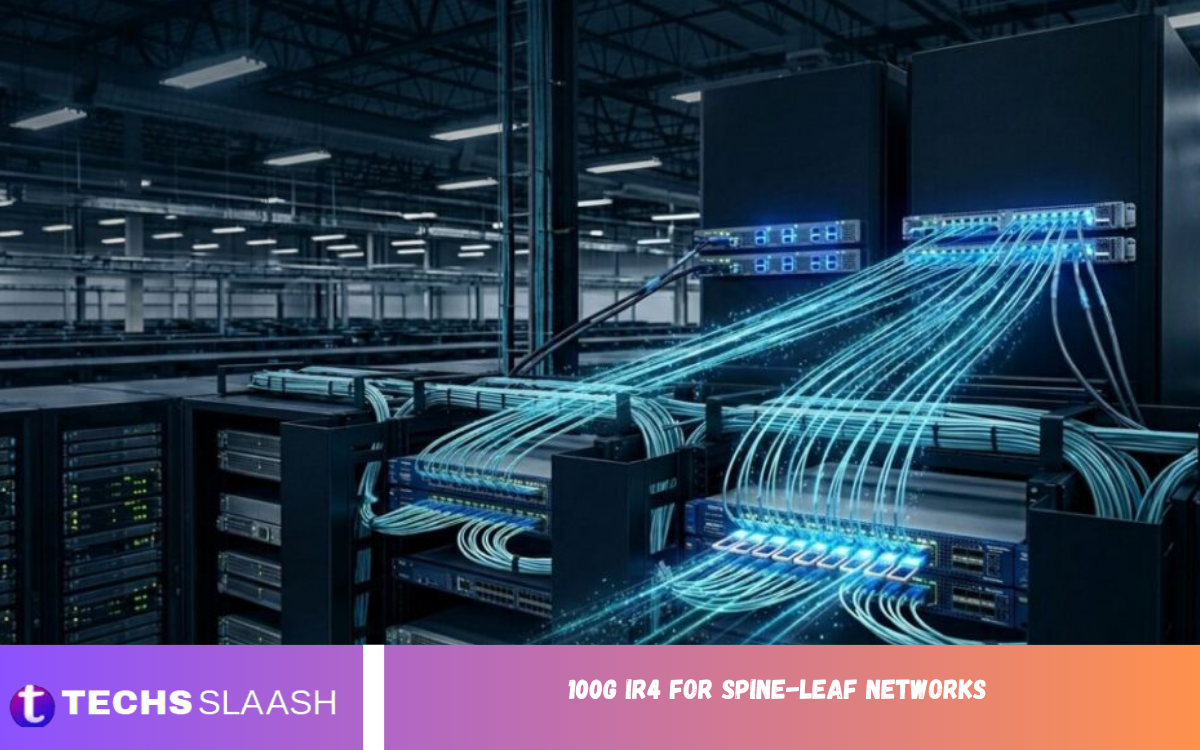
Modern data centers demand faster communication, lower latency, and scalable infrastructure to support cloud computing, virtualization, artificial intelligence, and enterprise applications. As network traffic continues to grow, organizations require reliable optical connectivity that delivers consistent performance while maintaining cost efficiency.
The spine-leaf architecture has become the preferred design for modern data centers because it provides predictable performance and simplified scalability. Combining this architecture with 100G IR4 optical technology allows businesses to build efficient, high-capacity networks that support demanding workloads.
Understanding Spine-Leaf Network Architecture
Spine-leaf architecture is a two-layer network design where every leaf switch connects directly to every spine switch. This structure minimizes bottlenecks while providing equal latency between connected devices across the entire network.
Unlike traditional three-tier networks, spine-leaf topology eliminates unnecessary network hops and improves traffic flow. The architecture allows organizations to expand network capacity simply by adding more spine or leaf switches without redesigning the infrastructure.
What is 100G IR4 Technology?
100G IR4 is an optical transceiver standard designed for 100 Gigabit Ethernet communication over single-mode fiber. It transmits four optical wavelengths, each carrying 25 Gbps, to achieve an overall bandwidth of 100 Gbps.
The technology supports medium-distance data center interconnections while maintaining stable performance and efficient power consumption. Its compact design and compatibility with standard networking equipment make it suitable for modern enterprise deployments.
Why 100G IR4 for Spine-Leaf Networks is Important?
Data centers generate enormous east-west traffic as servers continuously exchange information. 100G IR4 for Spine-Leaf Networks ensures sufficient bandwidth to handle this communication without introducing congestion.
Organizations deploying virtualization, cloud platforms, AI clusters, and storage networks benefit from faster connections that improve application responsiveness. The result is better user experience, higher productivity, and greater infrastructure efficiency.
Key Features of 100G IR4 for Spine-Leaf Networks
One major advantage is its support for high-speed transmission using single-mode fiber. This enables reliable communication across larger data center environments while maintaining consistent signal quality.
Another important feature is interoperability with many networking vendors. Businesses can integrate compatible transceivers into existing infrastructure without requiring major hardware replacements or costly redesigns.
Benefits of Using 100G IR4 in Modern Data Centers
High bandwidth allows applications to transfer massive datasets with minimal delay. Whether handling cloud workloads or distributed databases, organizations gain faster communication between servers and storage systems.
The technology also improves scalability. As business demands increase, additional spine and leaf switches can be deployed without affecting existing network performance, making expansion simple and efficient.
Reduced Latency and Faster Performance
Low latency is essential for applications such as financial trading, AI processing, virtualization, and high-performance computing. Spine-leaf architecture already reduces transmission delays, while 100G IR4 further enhances communication speed.
Faster packet delivery enables servers to exchange information almost instantly. This improves workload distribution, database synchronization, and application responsiveness throughout the data center.
Improved Scalability for Growing Businesses
Businesses often experience unpredictable growth in users, applications, and workloads. A scalable networking solution allows expansion without major disruptions or infrastructure redesign.
100G IR4 for Spine-Leaf Networks supports gradual scaling by providing high-capacity links between switches. Organizations can increase server density while maintaining reliable network performance.
Enhanced Reliability and Network Stability
Reliable connectivity is essential for mission-critical applications. Optical transmission using single-mode fiber provides stable communication with minimal interference compared to copper-based networking.
Network redundancy in spine-leaf architecture ensures traffic reroutes automatically if one connection fails. This improves overall availability and reduces downtime for business operations.
Cost Efficiency of 100G IR4 Deployment
Although high-speed networking requires an initial investment, long-term operational savings often outweigh deployment costs. Efficient optical technology reduces maintenance requirements and lowers energy consumption.
Organizations also save money by avoiding frequent infrastructure upgrades. High-capacity 100G links provide sufficient bandwidth for future expansion, extending network lifespan.
Installation and Deployment Best Practices
Successful deployment begins with proper planning, including bandwidth analysis, switch compatibility verification, and fiber infrastructure assessment. Careful preparation minimizes installation issues.
Cable management, transceiver validation, and network testing should follow industry standards. Thorough verification ensures stable operation before production workloads begin using the new infrastructure.
Compatibility with Existing Infrastructure
Many enterprise switches support 100G IR4 optical modules through standardized interfaces. This compatibility simplifies migration from older networking technologies while protecting previous investments.
Network administrators should always confirm firmware versions, supported transceiver specifications, and vendor recommendations before deployment to ensure optimal interoperability.
Security Advantages in Data Center Networks
Fast networking alone is insufficient without strong security measures. Modern spine-leaf networks integrate firewalls, segmentation, encryption, and access control to protect sensitive business data.
Reliable optical communication also reduces physical interference risks, making unauthorized signal interception significantly more difficult than traditional networking methods.
Read Also: Surface Treatments for Zinc & Aluminum Castings
Supporting Cloud Computing and Virtualization
Cloud environments require constant communication between compute, storage, and networking resources. 100G IR4 for Spine-Leaf Networks provides sufficient bandwidth to support dynamic virtual machine migration and distributed workloads.
Virtualized environments benefit from reduced congestion, enabling applications to scale efficiently while maintaining consistent response times during peak utilization periods.
AI, Machine Learning, and High-Performance Computing
AI and machine learning workloads process massive datasets that require rapid communication between GPU clusters and storage systems. High-bandwidth networking significantly reduces training and processing delays.
Machine learning environments also benefit from lower latency, enabling faster synchronization across distributed computing nodes and improving overall computational efficiency.
Future of 100G IR4 for Spine-Leaf Networks
As enterprise applications continue demanding greater bandwidth, optical networking technologies will remain essential. Many organizations currently adopting 100G infrastructure are preparing smooth migration paths toward even faster Ethernet standards.
Despite future advancements, 100G IR4 for Spine-Leaf Networks will continue serving as a dependable solution for medium-sized and large-scale data centers requiring high performance, scalability, and reliability.
Common Deployment Challenges
One challenge involves ensuring compatibility between switches and optical modules. Careful verification during procurement prevents interoperability issues that may delay deployment.
Another challenge is proper fiber installation and testing. Following professional installation standards minimizes signal loss and ensures maximum network performance throughout the infrastructure.
Best Practices for Network Optimization
Regular monitoring helps identify bandwidth utilization, latency trends, and potential bottlenecks before they affect production services. Network analytics support proactive maintenance and capacity planning.
Firmware updates, optical cleaning procedures, and periodic hardware inspections maintain optimal performance while extending the lifespan of networking equipment.
Frequently Asked Questions (FAQs)
What is 100G IR4 for Spine-Leaf Networks?
It is a 100 Gigabit optical networking solution designed for high-speed communication between spine and leaf switches using single-mode fiber.
Why is spine-leaf architecture popular?
It provides predictable latency, improved scalability, simplified expansion, and better east-west traffic performance.
What fiber type does 100G IR4 use?
It primarily uses single-mode fiber for reliable medium-distance optical transmission.
Is 100G IR4 suitable for enterprise data centers?
Yes. It is widely used in enterprise, cloud, and hyperscale data centers requiring reliable high-speed connectivity.
Does 100G IR4 reduce latency?
Yes. Combined with spine-leaf architecture, it significantly improves communication speed and reduces transmission delays.
Can existing switches support 100G IR4?
Many modern enterprise switches support compatible 100G IR4 transceivers, depending on hardware and firmware compatibility.
Is 100G IR4 energy efficient?
Yes. Optical transceivers are designed for efficient power consumption while delivering high bandwidth.
What applications benefit most?
Cloud computing, virtualization, AI, machine learning, storage networks, and high-performance computing benefit greatly.
How does 100G IR4 improve scalability?
It enables organizations to add switches and servers without redesigning the network architecture.
Is 100G IR4 future-ready?
Yes. It provides a strong foundation for modern data centers while supporting future network growth and higher-capacity infrastructure.
Conclusion
100G IR4 for Spine-Leaf Networks has become a vital technology for modern enterprise data centers seeking higher bandwidth, lower latency, improved scalability, and dependable performance. Its ability to deliver reliable 100 Gigabit connectivity over single-mode fiber makes it an ideal solution for cloud computing, virtualization, AI, storage networking, and business-critical applications.
By combining efficient optical communication with the simplicity of spine-leaf architecture, organizations gain a future-ready infrastructure capable of meeting growing digital demands.
