

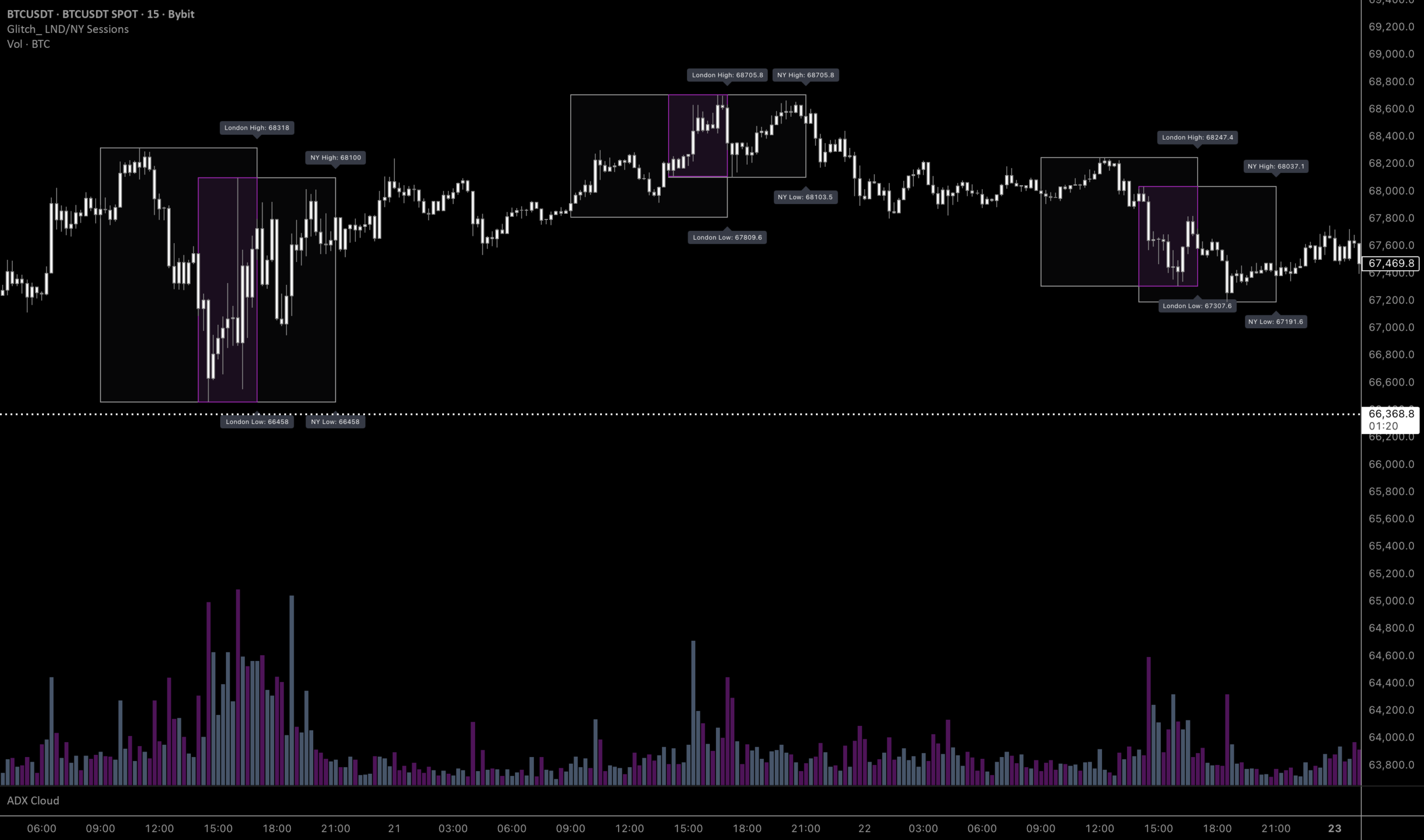
A retail forex trader who reviews their performance only in aggregate is missing one of the most informative breakdowns available in the entire asset class: performance by trading session.
Forex is technically a 24-hour market, but it does not behave like one. It behaves like a series of overlapping sessions — Sydney, Tokyo, London, New York — each with distinct liquidity profiles, distinct volatility characteristics, and distinct participant mixes. A trade taken at 3 AM London time and a trade taken at 9 AM London time are not facing the same market, even if the price chart looks similar. A trade taken during the London-New York overlap is operating in entirely different conditions than a trade taken during the Asian session.
For most retail forex traders, performance varies significantly by session — often by a wider margin than they realize. Some traders are systematically profitable during the London open and unprofitable during the New York afternoon. Others have the opposite pattern. Most have meaningful variation that they have never measured, because their journal aggregates everything into a single weekly P&L number that hides the session-level differences entirely.
This article walks through what session analysis actually reveals, why the differences exist, and how to set up a journal that produces this breakdown without manual work.
Disclaimer: This article is for educational and informational purposes only. It is not investment advice or a recommendation to trade. Forex trading carries substantial risk of loss, including risks specific to leveraged trading, currency volatility, and counterparty exposure to brokers. Always do your own research and consult a licensed professional before making financial decisions.
What the major sessions actually are
Before talking about analysis, the structure of the forex market matters, because the sessions are defined by where the trading desks are awake — not by any official market schedule.
The Sydney session runs roughly from late Sunday evening UTC through the early hours of the Asian trading day. It is the thinnest major session, with relatively low liquidity in most pairs and limited participation from large institutional desks. Volatility tends to be moderate, but spreads can widen meaningfully on smaller pairs, and prices can move on relatively small order flow.
The Tokyo session overlaps with Sydney for several hours and then continues into the morning of the Asian day. Liquidity is higher than Sydney, especially for JPY pairs. Asian sovereign and corporate flows are more active. The session is often described as range-bound, but this is a generalization — there are plenty of Tokyo sessions where significant moves originate, particularly around economic data from Japan, China, or Australia.
The London session opens during the late morning of the Asian day and represents a major step up in liquidity, especially for EUR, GBP, and CHF pairs. London is historically the largest forex trading center by volume, and many of the day’s largest moves originate during this session. The first one to two hours of London — what traders call the London open — is typically the highest-volatility window of the entire 24-hour cycle.
The New York session opens roughly five hours after London and overlaps with London for several hours. The London-New York overlap, typically running from around 12:00 to 16:00 UTC, is generally the deepest liquidity window in forex. This is when most major economic releases from the U.S. occur, when U.S. institutional desks are active, and when the largest cross-border flows happen.
The afternoon and evening windows. After London closes, New York continues into its afternoon, typically with declining volume. By the time New York closes, Sydney is opening, and the cycle repeats. The post-London-close window in New York is often the slowest period of the trading day, with thin order books and price action that can be erratic on relatively small flow.
These descriptions are generalizations. The specific behavior of any session on any given day depends on the calendar, the news flow, and the prevailing market regime. The point is that the sessions have different structural characters — and a strategy that works in one may not work in another.
Why session matters for retail performance
The reason session analysis is so useful is that retail traders’ results are typically not uniformly distributed across sessions, even when their strategy theoretically should be. Several patterns recur in the data.
Win rate often varies by session. A strategy with a 55% overall win rate may have a 65% win rate during one session and a 45% win rate during another. The trader sees the average and concludes the strategy is roughly working; the session breakdown shows that one session is carrying the entire result while the other is bleeding it. Trading less in the bad session — or stopping entirely during it — would produce better total performance than the trader is currently achieving.
Average winner-to-loser ratios shift. A strategy may produce roughly equal-sized winners and losers during one session and significantly asymmetric outcomes during another. This is often a function of liquidity: in deeper markets, stops are respected more cleanly and targets are hit more reliably; in thinner markets, slippage on stops and partial fills on targets distort the realized risk-reward ratio in subtle ways.
The same setup behaves differently. A breakout strategy may have very different reliability during the London open (where directional moves are common) versus during the New York afternoon (where breakouts more often fail and reverse). Traders who don’t break their results down by session may be running a single strategy across multiple market characters and treating the average as if it were representative.
Volatility-based risk varies. A 1% position sizing rule produces different actual risk depending on the volatility of the session. The same position size that’s appropriate for a quiet Tokyo session can be excessive during the London open, where typical price ranges are several times larger. Traders who use static position sizing across all sessions are effectively taking different amounts of risk depending on when they trade, often without realizing it.
The trader’s own state varies by session. A trader operating from one location experiences each session in a different physiological state. Trading the London open from New York means being awake at 3 AM. Trading the New York close from London means being at the screen until midnight. The trader’s decision-making is not constant across these states, and performance reflects it. This is one of the most underappreciated reasons that session breakdowns matter.
What a useful session breakdown actually shows
A session-level analysis is most useful when it goes beyond simple “P&L by session” and includes the metrics covered in earlier articles in this series, computed for each session separately.
The minimum useful breakdown:
Net P&L per session, including costs. Not just gross outcome — the breakdown has to include all spreads, commissions, swaps, and slippage, attributed to the session in which the trade occurred. A session that looks profitable on a gross basis may be unprofitable after costs, particularly during low-liquidity windows where spreads are wider.
Number of trades per session. Many traders take more trades during the sessions where they are statistically worse, simply because those sessions tend to be the ones they’re awake for or the ones where they have nothing else to do. Trade frequency by session is one of the more revealing metrics — and the gap between “where I trade most” and “where I trade best” is often material.
Win rate per session. Same calculation as overall win rate, computed separately for each session. The variance across sessions is often larger than traders expect.
Average winner and loser size per session. The risk-reward shape of the strategy can vary significantly by session. Knowing the per-session average winner and loser is essential for understanding which sessions are actually producing the strategy’s edge.
Profit factor per session. A clean summary metric per session. Combined with trade count, this tells the trader where the meaningful edge exists and where the activity is essentially noise.
Drawdown contribution by session. Which session contributed most to the trader’s deepest drawdowns? In many traders’ data, a single session is responsible for a disproportionate share of total drawdown — often the session the trader is most fatigued during, or the one where they take the most reactive trades.
When these metrics are computed separately for Sydney, Tokyo, London, the London-NY overlap, the NY afternoon, and the post-NY-close window, the picture that emerges is rarely uniform. Most traders have one or two sessions that are clearly carrying their results and one or two that are clearly hurting them. Until the breakdown exists, this pattern is invisible.
The London open and the New York close: two specific case studies
Two session windows are worth specific discussion because they appear so frequently in retail forex performance data.
The London open
The first one to two hours of the London session — typically running from around 7:00 to 9:00 UTC, depending on the time of year — is the highest-volatility window in many traders’ data and one of the most studied periods in the entire forex day.
Common characteristics:
- Large, fast directional moves at the start of the session, often establishing the day’s range within the first hour.
- High liquidity in EUR pairs, particularly EUR/USD, GBP/USD, and EUR/GBP.
- Strong response to overnight news that accumulated during the Asian session.
- Frequent reversals after initial moves, as institutional flow plays out across the morning.
Many retail breakout strategies were originally designed around or are most effective during the London open, because the session reliably produces directional moves and the deep liquidity means stops and targets are respected cleanly.
The reason the London open shows up in journal analysis: it’s a session where edge tends to be cleaner and easier to see. Traders who have a working strategy often find that their London open performance is meaningfully better than their performance in other sessions. Traders who don’t have a working strategy often discover, painfully, that the rest of the day’s results are not just slightly worse — they are negative enough to erase whatever the London open contributed.
The New York close
The post-New York-close window — typically running from around 21:00 UTC through the start of Sydney several hours later — is structurally one of the harder windows for retail traders.
Common characteristics:
- Sharp drop in liquidity as U.S. and European desks close.
- Wider spreads, especially on minor pairs.
- Erratic price action driven by relatively small order flow.
- Increased frequency of false breakouts and rapid reversals.
- Higher slippage on stops and partial fills on limit orders.
Many retail traders are still at the screen during this window, particularly those trading from Asia or those who have been at the screen since the European morning. Decision-making during this window is often degraded by fatigue, and the market’s structural characteristics — thin liquidity, erratic action — punish degraded decision-making more harshly than they would in deeper sessions.
In aggregated retail forex data, the post-NY-close window is one of the most consistently underperforming sessions. Traders whose journals show this pattern usually find that simply not trading during this window is one of the highest-leverage adjustments they can make — without changing strategy, without learning new analysis, simply by recognizing that their data shows a session in which they don’t have an edge.
What session analysis reveals about strategy fit
Beyond the trader-specific findings, session analysis often reveals something about the strategy itself: which sessions it was actually built for, even if the trader didn’t know it at the time.
A trend-following strategy with strict pre-defined breakout rules will typically perform best in sessions with reliable directional moves — London open, certain windows during the London-NY overlap, sometimes the start of New York after key economic releases. The same strategy applied to range-bound sessions like Tokyo or post-NY-close will often produce false signals at high frequency, eroding any edge the strategy has during its native sessions.
A mean-reversion strategy is the opposite: it tends to work in range-bound conditions and fail during strongly directional sessions. A trader running mean-reversion through the London open is fighting the session’s structural character, and the data will usually show it.
A news-event strategy works only in specific time windows around scheduled releases, regardless of session. Outside those windows, the strategy doesn’t have a hypothesis — and the data shows trades taken outside the window typically produce negative expectancy.
Once these alignments become visible in the journal, the implication is straightforward: the trader has a choice between trading the strategy only during the sessions where it actually works, or attempting to develop an additional strategy for the sessions where the current one doesn’t. Both are reasonable. Trading the same strategy through every session, on the assumption that “the market is the market,” is the option that the data tends to argue against.
The infrastructure problem for session analysis
Session analysis sounds simple — break down P&L by time of day, look for patterns. In practice, it’s harder than it sounds for several reasons that most retail journals don’t handle well.
Time zone handling. Sessions are defined by UTC, but most brokers report trade times in their own server time, which may be GMT, EST, or some custom offset. A “9 AM trade” reported by a broker may have actually occurred at a different UTC time than the trader assumes. Without explicit time zone normalization, session breakdowns can be off by several hours, which materially distorts the analysis.
Daylight saving time shifts. The London-New York overlap shifts by an hour twice a year, when one region changes DST and the other has not yet (or has already). Session boundaries that are static in clock time will misclassify trades during these transition periods. Session boundaries defined relative to UTC handle this correctly; session boundaries defined relative to local time do not.
Pair-specific liquidity. “London session” means something different for EUR/USD than for AUD/JPY. The general session windows are useful starting points, but pair-specific liquidity profiles can vary, and traders who run analysis purely by clock time may miss patterns that show up only when pair-specific structure is considered.
Multi-broker data. Forex traders often run accounts at multiple brokers — perhaps one for major pairs and another for exotic pairs, or different brokers for different account sizes. Each broker’s export uses different time stamping conventions. Manually reconciling these into a unified time-zone-normalized dataset is the kind of work that gets skipped in practice.
Correct session attribution for held positions. A trade entered during the London open and exited during the New York session — does it belong to London or New York for analysis purposes? Different journals make different choices, and the choice affects the breakdown. The analysis is most useful when each session is credited or debited based on the price action that happened during it, not just based on entry or exit timing.
These are not impossible problems, but solving them manually for hundreds of trades is the kind of operational friction that causes session analysis to be abandoned. A journal designed to handle them automatically — multi-broker imports, UTC-normalized time stamping, configurable session boundaries, DST-aware breakdowns — removes the friction and makes session analysis a default view rather than a custom report.
Modern tools like Tradebb support this kind of session-aware analysis natively, alongside multi-broker imports for forex (MT4, MT5, cTrader, and proprietary platforms) and consolidated reporting across forex, stocks, crypto, options, futures, and prop firm accounts. The infrastructure matters because session analysis only produces value if it is being run regularly — and it only gets run regularly if the data layer makes it easy.
For traders setting this up, multi-broker forex journaling and analytics with session-level breakdowns are available at https://www.tradebb.ai/. The specific tool matters less than whether the data layer can handle the time zone, multi-broker, and pair-specific complications correctly. A session breakdown built on flawed timestamping is worse than no session breakdown at all, because it produces confidently wrong conclusions.
A practical exercise
For traders who want to see whether session-level patterns exist in their own data, a single exercise is informative:
Take the past three months of forex trades. Group them into five buckets: Asian session (Sydney + Tokyo), London-only (before NY opens), London-NY overlap, NY-only (after London closes), and post-NY-close. For each bucket, compute net P&L, win rate, and average trade outcome.
If the buckets are roughly similar in performance, the trader’s strategy and execution are reasonably session-agnostic — which is unusual.
More commonly, two patterns emerge:
- One or two sessions clearly carry the results. The remaining sessions are either flat or negative. The implication: trading less during the underperforming sessions, or not at all, would produce better aggregate results.
- Performance is similar across sessions, but trade frequency varies wildly. Most trades happen during sessions that the trader is awake for or the sessions where they have nothing else to do, even though those sessions are not where their edge is concentrated. The implication: the trader is not letting their data shape their schedule.
Either finding is actionable. The exercise takes about an hour if the data is in a usable format and longer if reconciliation work is needed first — which is why having the data layer set up properly matters more than any specific analytical technique.
The honest bottom line
Forex is taught and discussed as a single market, but it is operationally a series of distinct sessions with different characters. Most retail traders’ performance reflects this even when they don’t measure it — some sessions are quietly producing the strategy’s edge, and others are quietly bleeding it.
Session analysis is one of the most informative breakdowns available in forex journaling, and it requires no advanced statistics or machine learning to produce. It requires only that the journal handle time zones correctly, support multi-broker data, and produce per-session metrics as a default view rather than as a custom report.
Traders who run this analysis regularly tend to discover, within a month or two, that their results are concentrated in fewer sessions than they realized. The natural follow-up is to trade more selectively — not by changing strategy, but by aligning the trading schedule to the sessions where the data shows the strategy actually works.
Most retail forex traders have never run this analysis. The ones who do tend to find adjustments worth making.
The market does not care which sessions the trader prefers. The data shows which sessions the trader is actually winning in. The journal is where those two facts get reconciled.
This article is for educational purposes only and does not constitute investment, financial, legal, or tax advice. Forex trading involves substantial risk of loss and is not suitable for every investor. Leveraged trading can result in losses exceeding initial deposits. Past performance does not guarantee future results.
